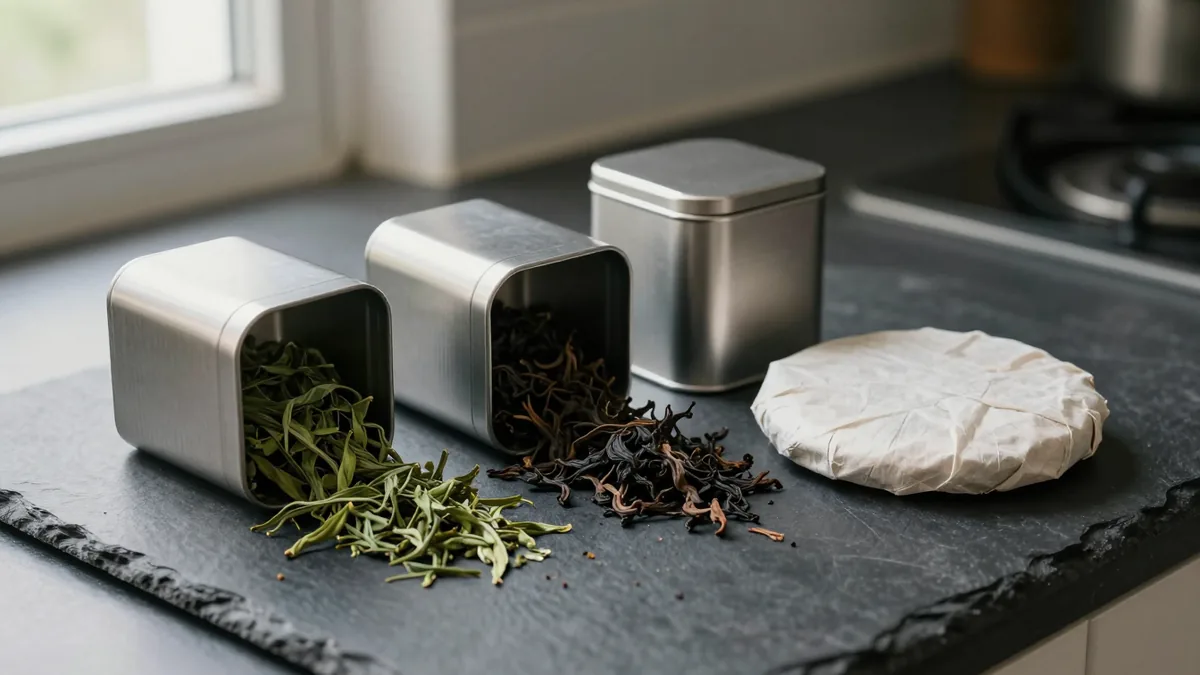
Store tea airtight, dark, dry and away from strong smells, below 25 °C. Heat does the most damage: in one 150-day study, green tea kept at room temperature lost 81% of its vitamin C, while tea kept at −20 °C lost 10%. Drink green and Japanese teas within about 6–12 months (1 month once a Japanese tea bag is opened), black tea within 12–24 months, and keep puer at 60–70% relative humidity if you want it to age.
Tea goes stale from five things: oxygen, light, heat, moisture and odors. The fixes are cheap. The mistakes are mostly about the fridge and about treating every tea the same way.
This guide covers the numbers from storage studies, the vendor rules for Japanese green tea, shelf life by type, and how puer storage differs from everything else.
What Actually Degrades Stored Tea
Each of the five factors attacks a different part of the leaf.
- Oxygen oxidizes catechins and aroma oils. An airtight lid is the main defense.
- Light breaks down pigments and creates off-flavors. Red Blossom Tea recommends "metal or ceramic storage" instead of transparent glass or plastic.
- Heat speeds every chemical reaction. In a Purdue study of green tea powder stored at 43–97% relative humidity and 25–60 °C for up to 16 weeks, temperature was the dominant factor in catechin loss.
- Moisture softens the leaf, speeds reactions and, past a point, feeds mold.
- Odors transfer fast. Red Blossom notes that subtle teas "can be overwhelmed by the aromas of spices, or even the smell of a wooden storage box."
The light effect is easy to measure in brewed tea. In a Virginia Tech study, bottled green tea kept at 4 °C under fluorescent light lost 42.2% of its EGCG in 20 days, against 10.8% for the same tea with full light protection. That was liquid tea, not dry leaf, but the direction is the same: keep tea out of clear containers.
Get the tea newsletter
New tea rooms, brewing notes, and tea worth trying. Free, no spam.
No fixed schedule. Unsubscribe anytime.
Heat Matters Most: The Temperature Data
The clearest numbers come from a 2019 Anhui Agricultural University study that stored Huangshan Maofeng green tea at four temperatures for 150 days. The authors recommended −20 °C or −80 °C for long storage.
Vitamin C is a good freshness marker because it oxidizes quickly. Starting level: 2.32 mg/g.
| Storage temperature | Vitamin C after 150 days (mg/g) | Share retained |
|---|---|---|
| −80 °C | 2.20 | 95% |
| −20 °C (home freezer range) | 2.08 | 90% |
| 4 °C (fridge) | 1.74 | 75% |
| Room temperature | 0.44 | 19% |
Source: Dai et al., J Food Sci Technol 2019, Table 2. Share retained is our calculation from the table values.
Room-temperature tea kept about one-fifth of its starting vitamin C. Freezer tea kept nine-tenths. The sensory panel agreed: tea from −80 °C and −20 °C still tasted fresh, while tea from 4 °C and room temperature showed "an obvious decrease" in freshness.
The fridge result matters. A fridge slowed the loss but did not stop it, and the 4 °C tea's aroma profile had shifted significantly by day 100.
Moisture: The Numbers Behind "Keep It Dry"
Finished tea is dry by design. Kenya's draft black tea standard, DKS 65:2016, sets a maximum moisture content of 7.0% by mass. The international standard ISO 3720 sets no limit; it only says moisture may be measured by the ISO 1573 oven method.
Tea picks up water from the air when it is stored open or in a humid room. In the Anhui study, the room-temperature samples went from 57.21 mg/g of moisture (5.7%) to 82.37 mg/g (8.2%) over 150 days. The 4 °C samples stayed at 5.8%.
That rise from 5.7% to 8.2% is enough to push a tea past the 7.0% ceiling Kenya sets for black tea at sale.
Practical rules:
- Close the bag or tin within seconds of scooping. Every opening lets in fresh humid air.
- Use a dry spoon. Never scoop with damp fingers or a wet scoop.
- Keep tea away from the kettle, stove and dishwasher. Steam and heat are both there.
- Do not store tea above the fridge, where the compressor vents warm air.
Fridge and Freezer Rules for Japanese Green Tea
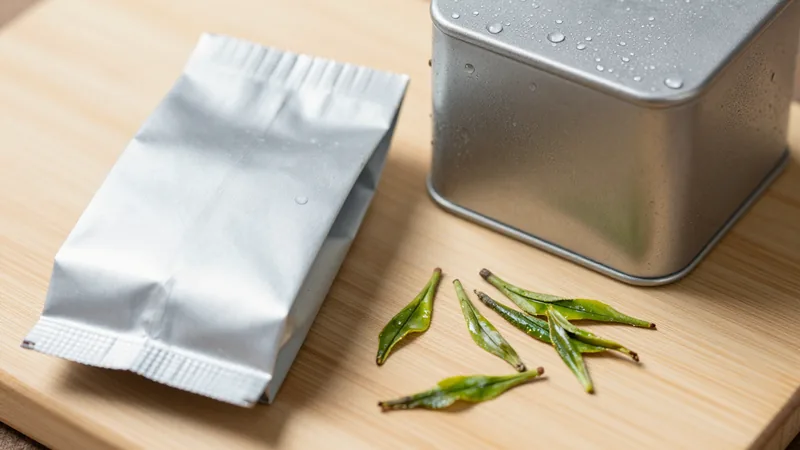
Japanese vendors do use cold storage, but only for sealed packages. The risk is condensation: cold leaves pull water out of warm room air the moment the bag opens.
- Hibiki-an says an unopened package kept in the fridge "will stay fresh for one year," against six months for an unopened package "stored at cool temperature (under 20C, 68F) in a dark place." It recommends "waiting a few hours to a day" before opening a chilled package and does not recommend refrigerating open packages.
- Ippodo gives unopened tea a best-before of around 6 months from packing, asks you to finish an opened bag within about 1 month, and suggests the freezer for tea you want to keep past 6 months, with about 5 hours at room temperature before opening.
- Red Blossom Tea, a San Francisco shop, takes the opposite view and "typically don't recommend" the fridge or freezer at all, because of condensation.
The two positions agree on the mechanism. The safe version of cold storage:
- Freeze only unopened, factory-sealed bags, or bags you have pressed the air out of and resealed.
- Put the bag inside a second airtight container to block fridge odors.
- Take out one bag at a time and let it reach room temperature, 5 hours or more, before opening.
- Once open, keep it in the cupboard and finish it within about a month.
Matcha follows the same rules. For grade differences, see our matcha grades guide.
Shelf Life by Tea Type
These windows are for quality, not safety. Old dry tea is rarely unsafe; it is flat.
| Tea type | Container | Where | Quality window |
|---|---|---|---|
| Japanese green, matcha (sealed) | Original foil bag, inside a tin | Freezer or fridge, sealed | About 6 months at room temp; 1 year in fridge |
| Japanese green, matcha (opened) | Bag rolled shut, inside a tin | Cupboard, not fridge | About 1 month |
| Chinese green | Opaque airtight tin | Cool, dark, below 25 °C | 6–12 months |
| Oolong (green style) | Opaque airtight tin or foil | Cool, dark, below 25 °C | 6–12 months; freshest in 3–6 |
| White | Opaque airtight tin | Cool, dark | 6–12 months fresh; can be aged |
| Black | Opaque airtight tin | Cupboard, 15–25 °C | 12–24 months |
| Puer and dark tea | Paper wrapper, cardboard box or crock | 60–70% RH, about 20–25 °C | Years; changes with age |
Sources: Ippodo, Hibiki-an, Speciality Tea Europe storage guide (green, oolong, white, black and puer windows and humidity range).
Climate shifts these windows. Red Blossom says San Francisco's dry air keeps its green teas fresh "for at least a full year," while humidity in growing regions can make green tea stale "in less than six months."
Puer and Aged Tea: Storage That Changes the Tea
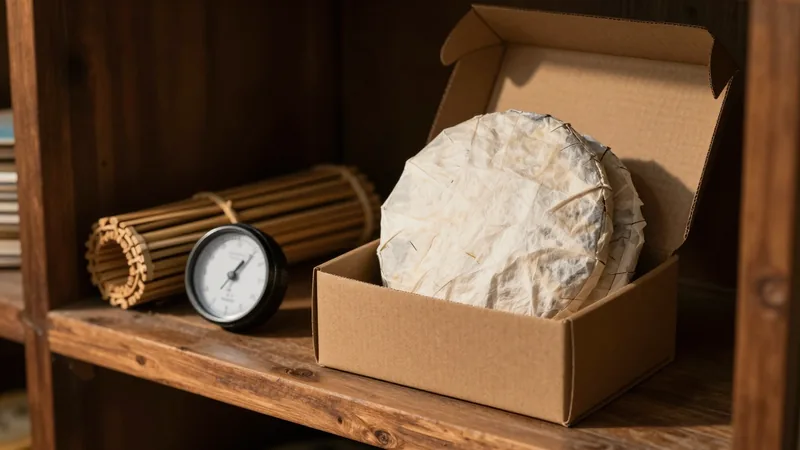
Puer is the exception. For sheng puer, storage is part of production, so you want some air, some humidity and stable warmth. Our sheng vs shou puer guide covers how the two are made.
The humidity ranges sources give are close together:
- Speciality Tea Europe: 60–70% relative humidity is optimal; above 75% "encourages undesirable proliferation of molds"; below 50% causes "excessive drying."
- TeaDB, for home setups: 65–75% humidity at 16–21 °C. Its "70/70" rule says a climate averaging 70 °F and 70% humidity or more will age tea fairly quickly without help.
- A nine-year study of ripe puer stored in Kunming used a dry environment of 15–25 °C and 50–70% RH.
Dry vs wet storage. Wymm Tea defines dry storage as under 80% relative humidity and wet storage as damp, dark rooms above 80%. Wet storage "was popularized by tea merchants in Guangzhou and Hong Kong back in the 1970s," often in basements. It ages tea faster and darker. Kunming storage is drier and slower.
Home rules for puer:
- Keep cakes in their paper wrappers, stacked in a cardboard box or unglazed crock. No plastic bags for tea you want to age.
- Put a cheap digital hygrometer in the box. Aim for 60–70% RH.
- Keep the box away from kitchens, perfume and cleaning products. Puer absorbs smells for years.
- Check every few months. White fuzz or a musty smell means humidity is too high; dry it out and lower the humidity.
White tea can also be aged, but most drinkers buy white tea to drink fresh. See our white tea grades guide.
How Much Tea to Buy at Once
Buying in smaller lots beats any storage trick. The math is simple.
At 3 g of leaf per cup (our working figure for Western-style brewing), 2 cups a day uses 180 g in 30 days. That fits Ippodo's one-month window for an opened bag only if you buy 180 g or less of that tea at a time. A one-cup-a-day drinker should buy 90 g or less.
For teas with a 6–12 month window, one bag is rarely the problem. At 6 g a day, a 100 g bag lasts about 17 days. The problem is a cupboard of open bags: ten 100 g bags at 6 g a day take 167 days to finish, right at the 6-month edge for green tea.
Check the harvest year before you buy. A shelf-life clock is useless if the label does not say when the tea was made. In the Tea Explorer catalog, 7,306 teas from 40 vendors, fetched 2026-10-01, the share of in-stock teas that list a harvest year varies a lot by type:
| Tea type (in stock) | Teas | With harvest year | Share |
|---|---|---|---|
| Sheng puer | 1,535 | 1,474 | 96.0% |
| Shou puer | 663 | 596 | 89.9% |
| White | 322 | 223 | 69.3% |
| Oolong | 544 | 247 | 45.4% |
| Black | 646 | 269 | 41.6% |
| Green | 462 | 140 | 30.3% |
| Matcha | 192 | 4 | 2.1% |
Source: Tea Explorer catalog, 7,306 teas from 40 vendors, fetched 2026-10-01; samplers, gift sets and teaware excluded.
The teas that stale fastest, green tea and matcha, are the ones least likely to carry a harvest year. Puer sellers almost always list one, and 510 of the 1,474 dated sheng puer listings (34.6%) are from 2016 or earlier. Our guide to reading a tea label covers the other dates and codes to look for.
Frequently Asked Questions
Should I keep tea in the fridge?
Only sealed packages, and only for green tea or matcha you will not open for months. A 2019 study found tea at 4 °C kept 75% of its vitamin C after 150 days, against 19% at room temperature and 90% at −20 °C. Let a cold bag sit at room temperature for about 5 hours before opening so condensation does not form on the leaves.
How long does loose leaf tea last?
For best flavor, about 6–12 months for green, oolong and white tea, 12–24 months for black tea, and about 1 month for an opened bag of Japanese green tea. Puer and other dark teas can be kept for years at 60–70% relative humidity. Old tea is usually safe but flat; mold or a musty smell means throw it out.
Are glass jars good for tea storage?
Clear glass lets in light, which degrades tea. In one study, bottled green tea under fluorescent light lost 42.2% of its EGCG in 20 days versus 10.8% when shielded. Use opaque metal or ceramic tins, or keep glass jars in a closed cupboard.
What humidity is best for storing puer?
Most sources put it at 60–70% relative humidity, with mold risk rising above 75%. TeaDB suggests 65–75% at 16–21 °C for home setups. Traditional wet storage in Hong Kong and Guangzhou ran above 80%, which ages tea faster but darker.