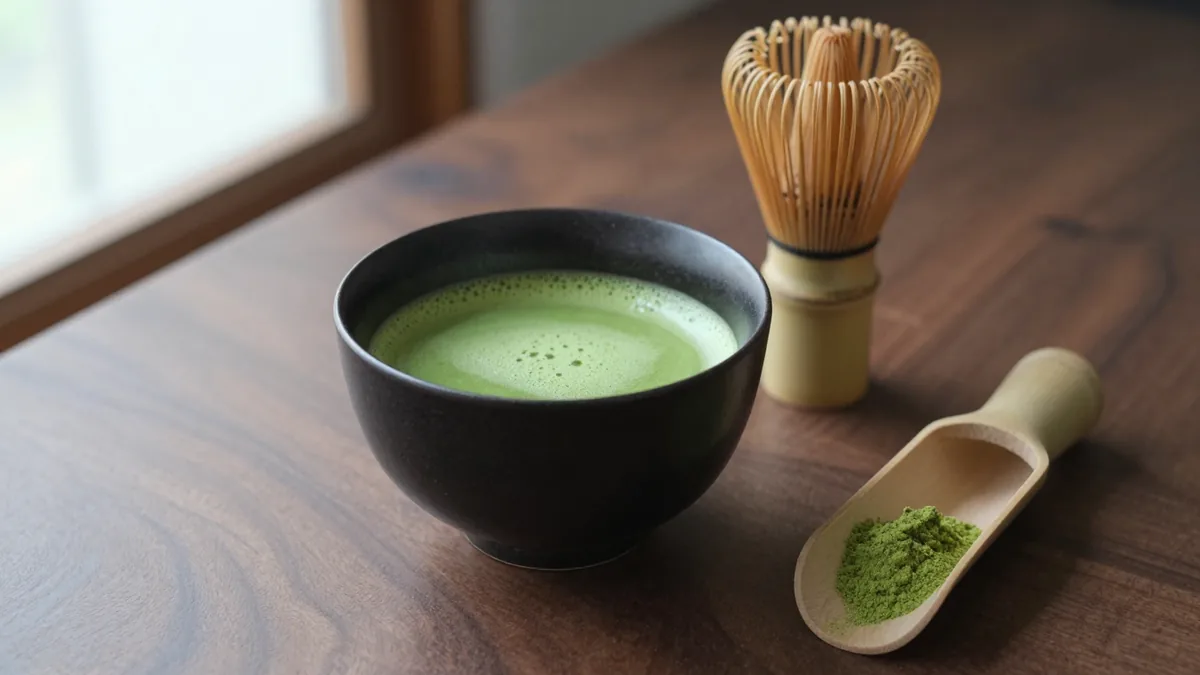
"Ceremonial grade" has no legal or industry definition in Japan. Japan's tea association defines matcha only as shade-grown tencha (2–3 weeks of cover) ground fine in a stone mill or equivalent, and ISO/TR 21380:2022 defines no grades either. What separates a $1 bowl from a $10 bowl is harvest, leaf, milling and origin. Kyoto's first tencha auction averaged 13,972 yen/kg in May 2026, about 2.9 times the 2016 record.
What "Ceremonial Grade" Means (and What It Does Not)
The phrase is a seller's label, not a standard. Japan's tea industry body, the Japan Tea Central Public Interest Incorporated Association, publishes the labeling definitions Japanese packers follow. Its green tea labeling standard defines matcha as tencha "ground into a fine powder with a tea stone mill or similar." It names no grades.
The international reference is ISO/TR 21380:2022. It defines matcha as tea from shaded Camellia sinensis var. sinensis, steamed, dried without rolling, then finely ground. It also lists no ceremonial or culinary tiers.
So any tin can say "ceremonial." The words tell you how the seller wants you to use it, not how it was grown.
The Japanese standard does draw one line that matters. It says autumn tencha and similar unrolled leaf are understood as "food-processing tencha" and go almost entirely to food manufacturing (Japan Tea Central association). That is the closest thing Japan has to an official "culinary" category, and it is about harvest season, not a grade stamp.
Get brewing and teaware notes
Steep times, water temperatures, leaf ratios, and teaware that is worth buying. Free, no spam.
No fixed schedule. Unsubscribe anytime.
What Actually Separates Good Matcha From Cheap Matcha
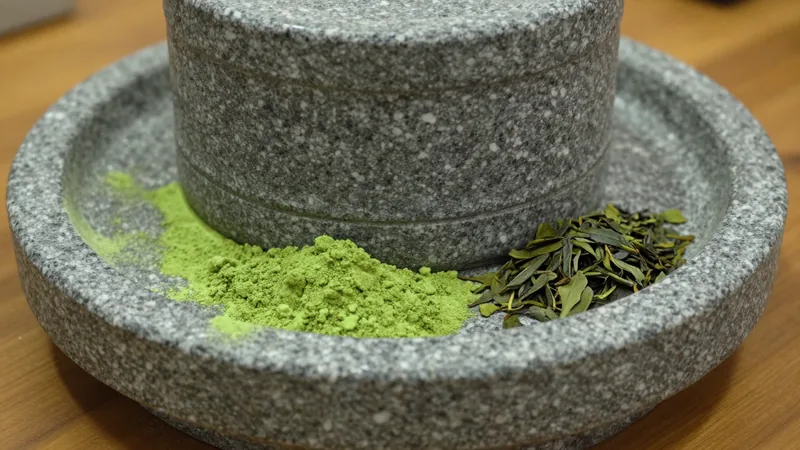
Four production choices decide what is in the tin. Check each one against the label.
- Shading. Tencha fields are covered with reed screens, straw or cloth for about 2–3 weeks before picking. A 2026 Nutrients review reports that shading raises chlorophyll, caffeine and L-theanine and lowers the catechins EC, ECG, EGC and EGCG. That is why shaded leaf tastes sweeter and less astringent.
- Harvest. The same review says the best matcha comes from buds and first leaves picked in spring, and later, larger leaves give the flatter taste sold as culinary grade (Nutrients).
- Milling. A granite mill is slow. Ippodo says one stone mill grinds about 40 g of matcha per hour. The review notes faster methods are used for lower-quality matcha (Nutrients).
- Origin. Kyoto (Uji) supplies about a quarter of Japan's tencha. Kagoshima produced about 2,150 tons in 2024, roughly 40% of the national total. Japan made 5,336 tons of tencha in 2024.
Label Claims Decoded
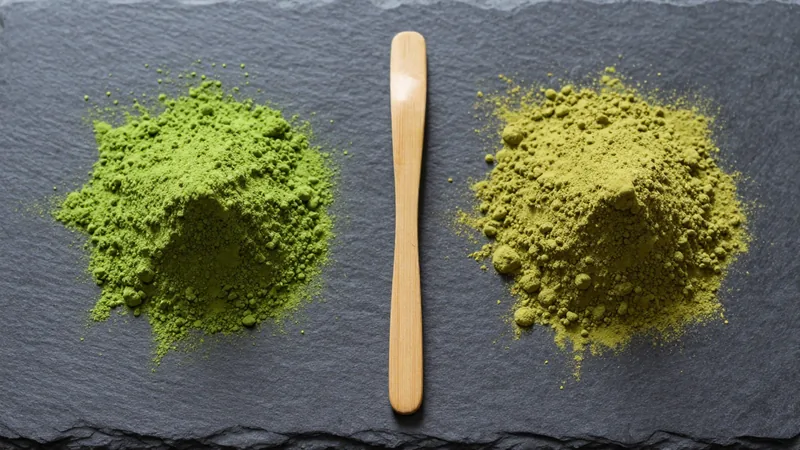
Use this table to read a matcha label. The right column is what you can verify.
| Label claim | Regulated in Japan? | What it usually means | What to look for instead |
|---|---|---|---|
| "Ceremonial grade" | No (JTCA) | Seller's top tier, meant for whisking with water | Harvest (first flush), origin, mill type |
| "Culinary grade" | No | Later-harvest or lower-cost leaf for baking and lattes | Price per gram; color |
| "Matcha" | Labeling definition (JTCA) | Shaded tencha, ground fine | Japan origin on the label |
| "First harvest" / ichibancha | No grade, a harvest fact | Spring buds and first leaves (Nutrients) | Harvest year on the tin |
| "Stone-ground" | No | Granite mill, about 40 g/hour (Ippodo) | Producer named, small tin sizes |
| "Uji" | Origin claim | Kyoto Prefecture tencha | Prefecture and packer named |
Color is the quickest check at home. Shading raises chlorophyll (Nutrients), so well-shaded spring leaf gives a bright jade powder. A dull olive powder is a reason to ask the seller for the harvest season.
Why Matcha Became Scarce in 2024–2026
Demand rose faster than shaded fields could. Kyoto tea house Ippodo wrote in December 2024 that demand had "surged unexpectedly and without precedent" and limited how much matcha a customer could buy at once.
Reuters reported in July 2025 that one buyer's customer demand grew ten-fold in a year, and that a heat-hit Kyoto grower harvested 1.5 tons of tencha instead of his usual 2 tons.
Exports show the scale:
- 2024: green tea exports reached 8,798 tons and 36.4 billion yen, up 24.7% by value. Matcha and other powdered tea were 58% of volume (5,092 tons). The US took 32%.
- January–August 2025: exports hit 38 billion yen, more than all of 2024.
- Fiscal 2025 (April 2025–March 2026): exports reached 13,125 tons, up 42%, and 84.7 billion yen, 2.2 times the prior year, per Finance Ministry customs data. Powdered tea was about 70% of volume.
On August 1, 2025, Ippodo said the matcha it buys had risen to about 2.7 times the prior year's price and announced new pricing from October 1, 2025.
Tencha Auction Prices, 2016–2026
Tencha is the raw leaf for matcha. Its auction price is the cost floor under every tin.
| Auction | Average price (yen/kg) | Change | Source |
|---|---|---|---|
| Kyoto, prior record (2016) | 4,862 | Baseline | GJTA May 2025 |
| Kyoto, first sale 2024 | about 4,840 | Implied from 1.7x ratio | Derived from GJTA |
| Kyoto, first sale May 9, 2025 | 8,235 | 1.7x 2024 | GJTA May 2025 |
| Kyoto, machine-picked, May 13, 2026 | 13,972 | 1.7x 2025 | GJTA May 2026 |
| Kagoshima tencha, May 14, 2026 | about 19,000 | 1.8x 2025 | GJTA May 2026 |
Kyoto's 2026 average is 2.9 times the 2016 record (13,972 ÷ 4,862). Two years of 1.7x increases compound to about 2.9x.
US Tariffs on Matcha, 2025–2026
Tariffs added a second shock, then went away for tea.
- August 7, 2025: the US-Japan agreement set a 15% floor rate on most Japanese goods; products with a lower normal duty were topped up to 15% (Executive Order 14345, Federal Register).
- November 13, 2025: Executive Order 14360 removed certain agricultural products from the reciprocal tariff, effective that date. KPMG's summary lists tea among them.
- February 20, 2026: the Supreme Court held that IEEPA does not authorize tariffs, in Learning Resources v. Trump.
The tariff window for matcha was about three months (98 days). The yen auction prices above are set in Japan and include no US duty.
What a Bowl Costs: Grams to Dollars
Ippodo's recipes call for 2 g of matcha for usucha (thin tea, 60 ml water at 80°C) and 4 g for koicha (thick tea, 30 ml). Divide the tin price by its grams, then multiply by 2.
| Product (vendor label) | Tin | Price | Per gram | Per 2 g usucha | Per 4 g koicha |
|---|---|---|---|---|---|
| Jade Leaf Organic Culinary | 30 g | $10.99 | $0.37 | $0.73 | $1.47 |
| Ippodo Wakaki | 20 g | $11.00 | $0.55 | $1.10 | $2.20 |
| Ippodo Ikuyo | 20 g | $17.00 | $0.85 | $1.70 | $3.40 |
| Jade Leaf Teahouse Edition (ceremonial) | 30 g | $26.99 | $0.90 | $1.80 | $3.60 |
| Ippodo Sayaka | 40 g | $50.00 | $1.25 | $2.50 | $5.00 |
| Ippodo Ummon | 40 g | $82.00 | $2.05 | $4.10 | $8.20 |
| Ippodo Kanza | 20 g | $104.00 | $5.20 | $10.40 | $20.80 |
Sources: Ippodo US matcha collection, Jade Leaf Teahouse Edition, Jade Leaf Culinary; list prices checked October 1, 2026.
The worked example for a 30 g tin: $26.99 ÷ 30 g = $0.90 per gram, times 2 g = $1.80 per bowl, or 15 bowls per tin. The culinary tin from the same brand costs $0.73 per bowl. The gap between the two is $1.07 per bowl, which matters for a daily habit: about $390 a year.
Buy for use. For lattes and baking, milk and sugar hide the difference, so a culinary tin is the rational buy. For usucha with water only, spend on spring harvest and a named origin. Plug your own tin price into the tea cost calculator, and track retail moves on the tea price index.
Matcha brewed too hot or too thick turns bitter for the same reasons sencha does; see why green tea tastes bitter. For caffeine per serving, see caffeine in tea vs coffee.
Frequently Asked Questions
Is ceremonial grade matcha a real standard?
No. Japan's tea association defines matcha only as shade-grown tencha ground to a fine powder, with no grade tiers, and ISO/TR 21380:2022 defines none either. "Ceremonial" is a seller's label. Check harvest season, origin and price per gram instead.
What is the difference between ceremonial and culinary matcha?
Mostly harvest and leaf. Spring buds and first leaves give sweeter, greener powder, while later, larger leaves give the flatter taste sold as culinary. Japan's labeling standard classes autumn tencha as food-processing tencha. At current list prices, Jade Leaf's culinary tin costs $0.37 per gram and its ceremonial tin $0.90, while Ippodo's range runs from $0.55 to $5.20 per gram.
How much does a bowl of matcha cost?
A 2 g usucha bowl costs $0.73 from a $10.99 30 g culinary tin, $1.80 from a $26.99 30 g ceremonial tin, and $10.40 from Ippodo's $104 20 g Kanza. Koicha uses 4 g, so it costs twice as much per bowl.
Why did matcha prices rise so much?
Demand outran shaded tencha supply. Kyoto's first tencha auction averaged 8,235 yen/kg in May 2025 and 13,972 yen/kg (machine-picked) in May 2026, against a 2016 record of 4,862. Japan's green tea exports reached 84.7 billion yen in fiscal 2025, 2.2 times the year before.
Is there still a US tariff on Japanese matcha?
Tea was removed from the reciprocal tariff on November 13, 2025, after about three months at the 15% rate set for Japanese goods from August 7, 2025. On February 20, 2026, the Supreme Court ruled IEEPA does not authorize tariffs at all.