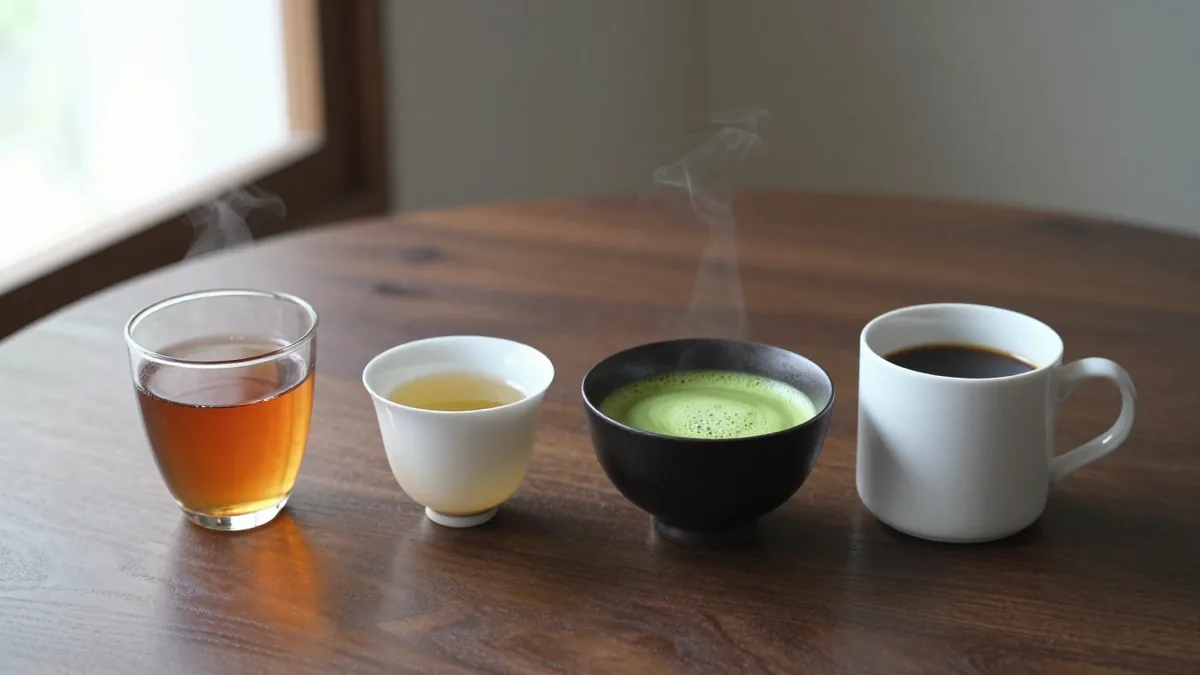
An 8 fl oz cup of brewed black tea has about 47 mg of caffeine and brewed green tea about 28 mg, against about 95 mg for 8 fl oz of brewed coffee, using USDA FoodData Central values. Lab measurements of tea range from 14 to 61 mg per cup, and tea type predicts less than steep time does. A 2 g serving of matcha delivers roughly 38–89 mg because you drink the whole leaf.
The short comparison
Coffee carries about twice the caffeine of black tea per cup and more than three times that of green tea, on the standard USDA reference values. Those values are per 100 g of brewed drink. We converted them to an 8 fl oz cup using USDA's own portion weight of 237 g.
| Drink | Serving | Caffeine (mg) | Source |
|---|---|---|---|
| Black tea, brewed | 8 fl oz (237 g) | 47 | USDA FDC 173227 |
| Oolong tea, brewed | 8 fl oz (237 g) | 38 | USDA FDC 174120 |
| Green tea, brewed | 8 fl oz (237 g) | 28 | USDA FDC 171917 |
| Black tea, decaffeinated | 8 fl oz (237 g) | 2 | USDA FDC 174871 |
| Coffee, brewed | 8 fl oz (237 g) | 95 | USDA FDC 171890 |
| Espresso | 1 fl oz (29.6 g) | 63 | USDA FDC 171891 |
| Matcha, whisked | 2 g powder | 38–89 | Kochman et al., Molecules 2020 |
The USDA rows are single reference values: 20 mg per 100 g for black tea, 12 mg for green tea, 16 mg for oolong, 40 mg for brewed coffee and 212 mg for espresso. The matcha row is computed from a measured range of 18.9–44.4 mg of caffeine per gram of powder.
The FDA's consumer table uses 12 fl oz drinks and lands in the same place: 37 mg for green tea, 71 mg for black tea and 113 to 247 mg for regular brewed coffee. Scaled to 8 fl oz, that is about 25 mg, 47 mg and 75–165 mg.
Get caffeine and decaf notes
How much caffeine each tea type carries, how decaf tea is made, and caffeine-free alternatives. Free, no spam.
No fixed schedule. Unsubscribe anytime.
Why one number per tea type misleads
Tea type is a weak predictor of caffeine. A study of 20 commercial teas in the Journal of Analytical Toxicology found 14 to 61 mg per 6 or 8 oz serving across white, green and black teas, "with no observable trend in caffeine concentration due to the variety of tea". The same study found steep time did change the result, and decaffeinated teas still held up to 12 mg per serving.
The leaf itself is the starting point. Caffeine makes up about 2–5% of the dry weight of tea leaves. Green teas alone span 11.3–24.67 mg per gram, a factor of two before you add water.
White tea is the clearest example of a reputation that does not hold. In a 2025 study, white tea brewed at 80 °C for 2 minutes gave only 5.8 mg per 200 mL. Steep it 5 minutes and it gave 26 mg per 200 mL, more than green or black tea under the same conditions.
Steep time and temperature: measured numbers
The 2025 study by Ayakdaş and Ağagündüz in Foods is useful because it holds the method fixed: 2 g of leaf in 200 mL of water, two temperatures, three times, six tea types. Values are mean caffeine in mg per 200 mL (Foods 2025, 14(13):2313).
| Tea type | 80 °C, 2 min | 80 °C, 5 min | 100 °C, 5 min | 100 °C, 10 min |
|---|---|---|---|---|
| Green | 11 | 23 | 25 | 27 |
| White | 5.8 | 26 | 22 | 31 |
| Oolong | 4 | 11 | 25 | 29 |
| Black | 14 | 23 | 23 | 27 |
| Pu-erh | 13 | 25 | 28 | 40 |
| Yellow | 13.8 | 37 | 42 | 53 |
Sources: Ayakdaş & Ağagündüz, Foods 2025, Table 2.
Three patterns hold up:
- Time matters more than type. Going from 2 to 5 minutes at 80 °C roughly doubled caffeine in green and black tea and more than quadrupled it in white tea.
- Temperature mattered mostly for oolong. The authors found brewing temperature changed caffeine significantly only in oolong, which went from 4 to 14 mg per 200 mL at 2 minutes. Tightly rolled leaves need heat to open.
- Bags extract faster. Black tea in bags gave 39 mg per 200 mL after 10 minutes at 100 °C, against 24 mg for loose leaf. Cut leaf has more surface area.
These numbers are lower than the USDA cup values because 2 g per 200 mL is a light dose of leaf. Use more leaf and caffeine rises with it.
Matcha: you drink the leaf
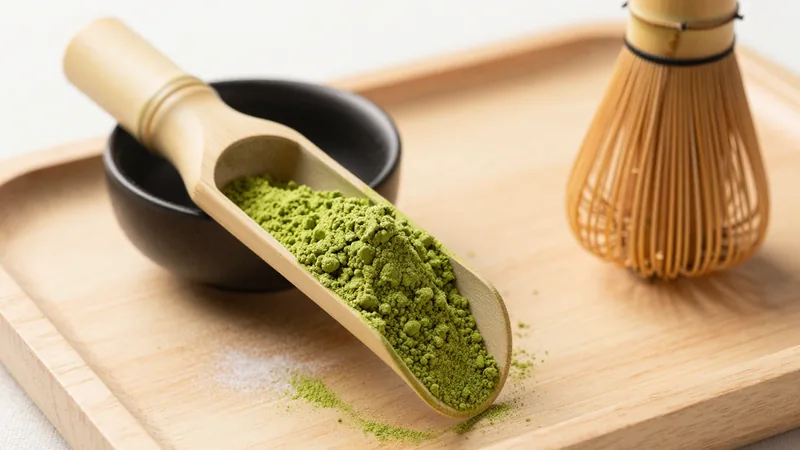
Matcha breaks the steeping rules because there is no steeping. The powder is suspended in water and swallowed, so all of its caffeine reaches you. A review in Molecules reports 18.9 to 44.4 mg of caffeine per gram of matcha, and 10.0–12.0 mg per gram for most coffee beans.
Worked numbers for a 2 g serving:
- Low end: 2 g × 18.9 mg/g = 38 mg, about the same as a cup of oolong.
- High end: 2 g × 44.4 mg/g = 89 mg, close to an 8 fl oz cup of brewed coffee at 95 mg.
- A double-scoop latte at 4 g doubles both figures.
Grade, harvest and shading all shift where a given tin falls in that range. Our matcha grades guide covers how to read the labels.
Gongfu sessions: many small cups from one dose of leaf
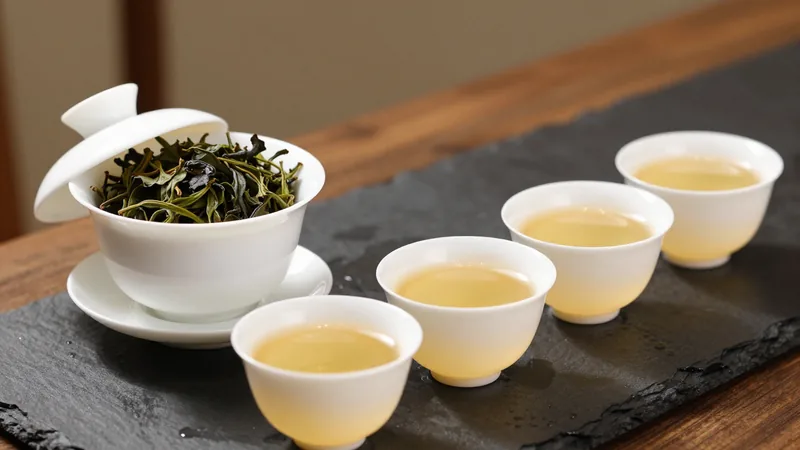
Gongfu brewing uses a lot of leaf and many short infusions. The useful question is total caffeine per session, and the leaf sets the ceiling.
Worked numbers for 7 g of leaf:
- At 2% caffeine: 7 g × 20 mg/g = 140 mg in the leaf.
- At 5% caffeine: 7 g × 50 mg/g = 350 mg in the leaf.
- Not all of it reaches the cup. The 2025 Foods study notes that single infusions may not ensure complete extraction of caffeine.
Most of what does come out arrives early. In a study of Dahongpao rock oolong brewed as 14 infusions from 5 g of leaf in 110 mL of 100 °C water, about 70% of the caffeine leached during the first three brews, and almost none was detected after the fifth. A 2025 study of Bingdao puer brewed the same way found caffeine decreased rapidly after the third brew.
The practical reading: a long gongfu session is front-loaded. If you want less caffeine, the first three infusions are where to cut back, not the tenth. Ratios and timings are in our gongfu brewing guide.
How many cups fit under 400 mg
The FDA cites 400 mg a day as "an amount not generally associated with negative effects" for most adults, and notes that sensitivity varies widely. Using the USDA cup values above:
| Drink | Caffeine per serving (mg) | Servings to reach 400 mg |
|---|---|---|
| Green tea, 8 fl oz | 28 | 14.1 |
| Black tea, 8 fl oz | 47 | 8.4 |
| Espresso, 1 fl oz | 63 | 6.4 |
| Matcha, 2 g (high end) | 89 | 4.5 |
| Brewed coffee, 8 fl oz | 95 | 4.2 |
Sources: USDA FoodData Central, FDA, Kochman et al. 2020.
Treat these as reference points, not a budget. A strong mug of bagged black tea steeped 10 minutes, or a heaped matcha, can sit well above the table values.
L-theanine: the other compound in the cup
Tea also contains L-theanine, an amino acid coffee does not supply. The 2025 Foods study measured it alongside caffeine. Green tea gave 13–17 mg per 200 mL at 80 °C, black tea 12–22 mg, and white and oolong under 5 mg.
Unlike caffeine, L-theanine did not respond to temperature in that study, and levels stopped rising between 5 and 10 minutes. A longer steep adds caffeine faster than it adds L-theanine. Browse specific teas in our tea directory or look up terms in the glossary.
Frequently Asked Questions
Does tea have more caffeine than coffee?
Not per cup. USDA reference values give about 47 mg for 8 fl oz of brewed black tea and 28 mg for green tea, against about 95 mg for brewed coffee. Dry tea leaf (2–5% caffeine) holds more caffeine per gram than coffee beans (10–12 mg/g), but a cup of tea uses far less leaf.
Is white tea lower in caffeine than green or black tea?
Not reliably. A study of 20 teas found no trend by variety, with all types falling between 14 and 61 mg per serving. In a 2025 study, white tea steeped 5 minutes at 80 °C gave 26 mg per 200 mL, slightly more than green or black tea at 23 mg.
How much caffeine is in a cup of matcha?
A 2 g serving contains about 38–89 mg, based on a measured 18.9–44.4 mg per gram of powder. You drink the whole leaf, so all of it is consumed. A 4 g serving doubles that to 76–178 mg.
Does a shorter steep cut caffeine?
Yes. At 80 °C, green tea went from 11 mg per 200 mL at 2 minutes to 23 mg at 5 minutes, and black tea from 14 to 23 mg. In multi-infusion brewing, about 70% of caffeine came out in the first three infusions.
How many cups of tea fit within the FDA's 400 mg figure?
Using USDA values, about 8 cups of 8 fl oz black tea or 14 cups of green tea, against about 4 cups of brewed coffee. Strong or long-steeped tea carries more, so treat those counts as upper bounds.