Taiwan high-mountain oolong (gaoshan) is grown at 1,000 meters or higher. In our catalog as of October 1, 2026, the median price per gram is $0.39 for Ali Shan (10 teas), $0.47 for Shan Lin Xi (10), $0.60 for Li Shan (7) and $0.78 for Da Yu Ling (2). A 7 g gongfu session of median Li Shan costs $4.20.
Taiwan high-mountain oolong is priced by mountain. In our catalog, the higher gardens cost more per gram, though sample sizes for the highest ones are small.
This article prices the five named mountains we can find in the Tea Explorer catalog, 7,306 teas from 40 vendors, fetched 2026-10-01, shows what a session costs, and explains why the origin on the bag is hard to check.
What counts as high-mountain oolong
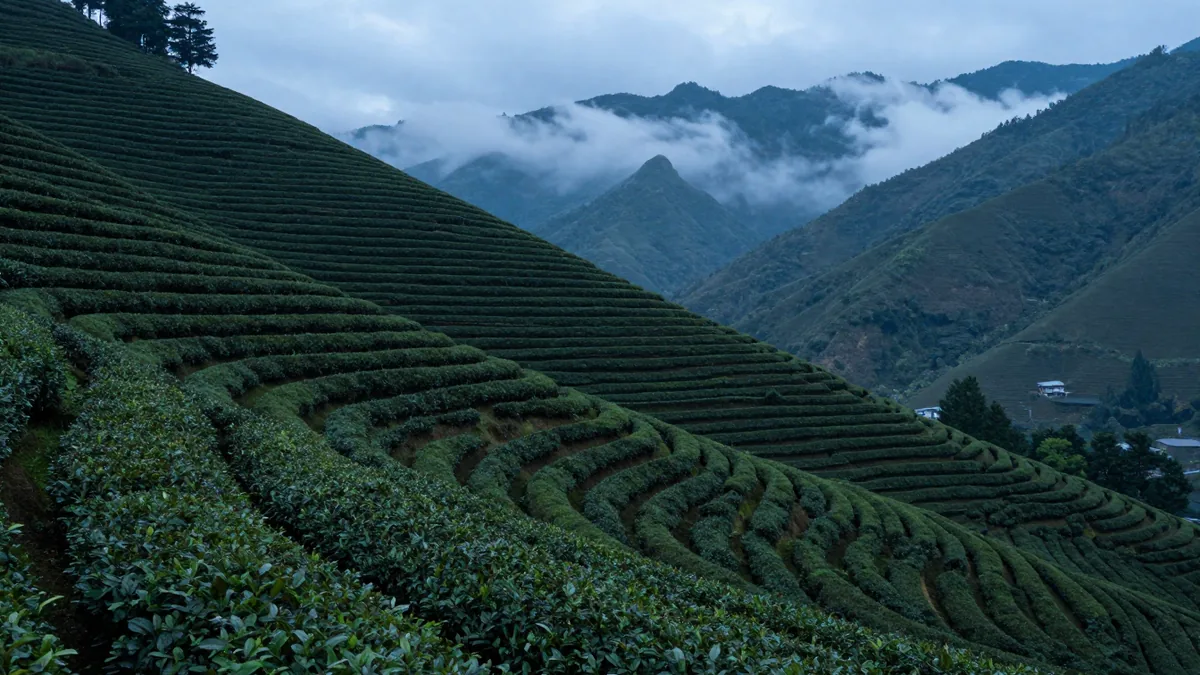
High-mountain tea in Taiwan means tea from gardens at roughly 1,000 meters or more. A 2021 sensory study describes Taiwan's High-Mountain Oolong as coming from "high altitude areas (altitude 1000 m or above)" in Chiayi, Nantou and neighboring counties (PMC, 2021).
High-mountain oolong is usually sold lightly oxidized and rolled. Eco-Cha describes its Shan Lin Xi as having "relatively minimal oxidation of the leaves during processing" (Eco-Cha). If you want the chemistry of oxidation levels, read our oolong oxidation guide. This piece is about price.
The common cultivar is Qing Xin. Path of Cha lists its Da Yu Ling as "Qing Xin (aka Ruan Zhi, TRES #17)" (Path of Cha), and Eco-Cha lists Qing Xin for its Li Shan (Eco-Cha). Wikipedia estimates Qing Xin at "about 60%" of Taiwan's tea plantings (Wikipedia). Jin Xuan, another Taiwanese cultivar, appears in 3 of our 10 Ali Shan listings.
Get the tea newsletter
New tea rooms, brewing notes, and tea worth trying. Free, no spam.
No fixed schedule. Unsubscribe anytime.
The five mountains in our catalog
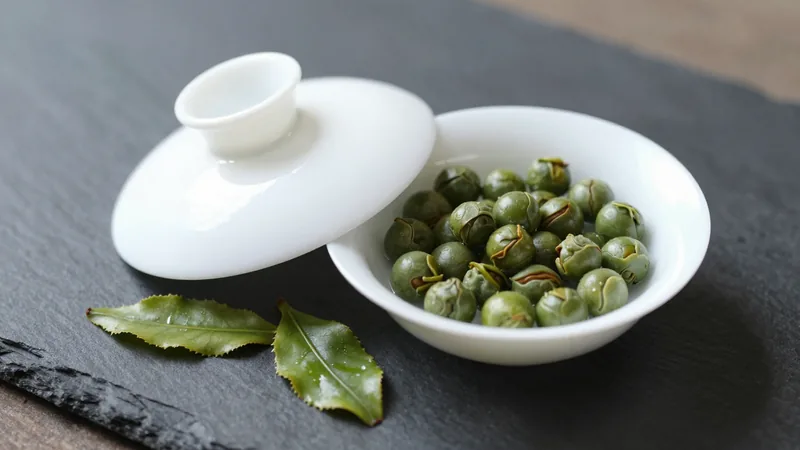
Vendors print the garden elevation on the product page. These are the figures we found on September 30 and October 1, 2026. They are vendor claims for one garden each, not official ranges for the whole mountain.
| Mountain | Area | Vendor-stated garden elevation | Source |
|---|---|---|---|
| Ali Shan | Chiayi | 1,300 m; 1,600 m | Eco-Cha; Red Blossom |
| Shan Lin Xi | Nantou | 1,400 m; 1,500 m | Eco-Cha; Song Tea |
| Li Shan | Taichung (Heping District) | about 2,000 m; 2,100 m | Red Blossom; Eco-Cha |
| Da Yu Ling | Li Shan range | 2,200–2,400 m | Path of Cha |
| Fu Shou Shan | Li Shan range | nearly 2,500 m (peak 2,600 m) | Red Blossom |
Two notes on the table:
- Elevation claims vary. Wikipedia puts Da Yu Ling "above 2,500 meters" (Wikipedia); Path of Cha's garden is 2,200–2,400 m. Both can be true for different gardens.
- Ali Shan is a broad name. Wikipedia calls it "the most widely known general name for lightly oxidized oolong tea" (Wikipedia). Eco-Cha's Alishan comes from Ruifeng Village in Meishan Township (Eco-Cha).
Prices by mountain: catalog data as of October 1, 2026
We filtered oolong rows whose name contains each mountain, then removed milk, GABA, red (heavily oxidized), Tie Guan Yin, scented and roasted-style teas, and samplers. Prices are per gram of the listed package in USD.
| Mountain | Median $/g | Min $/g | Max $/g | Teas (n) | In stock |
|---|---|---|---|---|---|
| Ali Shan | $0.39 | $0.19 | $2.11 | 10 | 5 |
| Shan Lin Xi | $0.47 | $0.31 | $0.80 | 10 | 5 |
| Li Shan | $0.60 | $0.32 | $1.40 | 7 | 5 |
| Fu Shou Shan | $0.65 | $0.65 | $0.65 | 1 | 1 |
| Da Yu Ling | $0.78 | $0.58 | $0.99 | 2 | 1 |
| All five pooled | $0.47 | $0.19 | $2.11 | 30 | |
| All oolong in catalog | $0.43 | 733 | |||
| All Taiwan-origin oolong | $0.35 | 188 |
Source: Tea Explorer catalog, 7,306 teas from 40 vendors, fetched 2026-10-01.
What the numbers say:
- Price rises with elevation, with one exception. The median Li Shan costs 1.5x the median Ali Shan, and Da Yu Ling 2.0x. Fu Shou Shan, a single tea from nearly 2,500 m, sits at $0.65/g, below Da Yu Ling.
- The five named mountains cost 10% more than the median oolong in the catalog, and 33% more than the median Taiwan-origin oolong.
- Cultivar moves Ali Shan prices. The 3 Ali Shan teas labeled Jin Xuan have a median of $0.30/g; the other 7 have a median of $0.43/g.
- Watch outliers. The Ali Shan maximum is Bellocq's No. 07 at $2.11/g, out of stock when we checked. The cheapest is Eco-Cha's Alishan Jin Xuan at $0.19/g.
Sample sizes are small. Da Yu Ling has 2 teas and Fu Shou Shan 1, so read those rows as single data points, not market prices.
Cost per 7 g gongfu session
Our gongfu brewing guide covers ratios. We use 7 g per session here as a working figure for a small gaiwan.
| Mountain | Median $/g | Cost per 7 g session | Cost per 100 g |
|---|---|---|---|
| Ali Shan | $0.39 | $2.74 | $39.15 |
| Shan Lin Xi | $0.47 | $3.27 | $46.78 |
| Li Shan | $0.60 | $4.20 | $60.00 |
| Fu Shou Shan | $0.65 | $4.58 | $65.49 |
| Da Yu Ling | $0.78 | $5.49 | $78.42 |
| All oolong (catalog median) | $0.43 | $2.99 | $42.67 |
Source: medians from the Tea Explorer catalog, 7,306 teas from 40 vendors, fetched 2026-10-01; session cost = median $/g x 7 g.
The gap between Ali Shan and Da Yu Ling is $2.75 per session at the median. Run your own bag through the tea cost calculator to see the per-cup figure across re-steeps.
Spring, winter and winter sprout
Vendors sell high-mountain oolong mainly as spring and winter crops. Red Blossom's Alishan was "hand-gathered in late April" at 1,600 m (Red Blossom). Path of Cha's Da Yu Ling is a May 2026 harvest (Path of Cha).
Winter is split in two. Song Tea explains that "winter harvest" teas are "picked in the late fall," while winter sprout teas "are the only oolongs picked in the winter" (Song Tea). Its Lishan and Shan Lin Xi winter sprouts were both picked in January 2026 (Song Tea, Lishan; Song Tea, Shan Lin Xi).
In our filtered set, 10 teas name a spring harvest, with a median of $0.48/g. Only 3 name winter, with a median of $0.80/g, and two of those three are Song Tea winter sprouts. The winter figure is too thin to call a seasonal premium. It does show that winter sprout is priced as a specialty: Song Tea's Lishan Winter Sprout is $1.40/g, the highest Li Shan price in the catalog.
Why origin is hard to verify: imports and labels
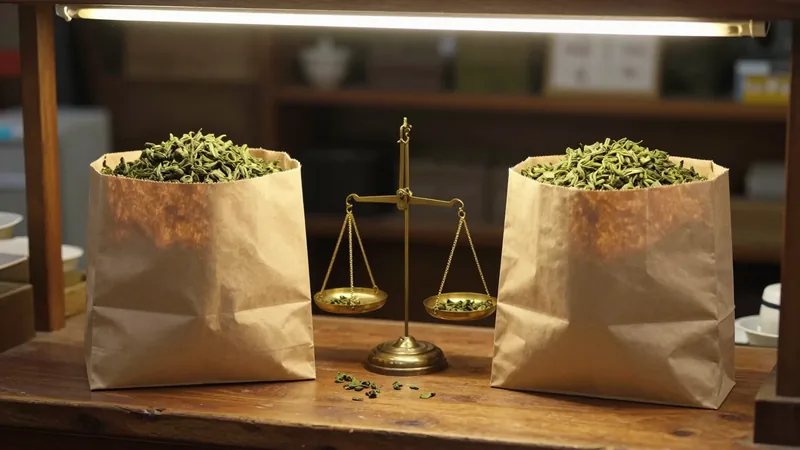
Taiwan imports about as much tea from Vietnam alone as it grows. Dan Bolton reports Taiwan processes about 14,000 metric tons a year from 12,000 hectares of tea farms, and that in 2023 it imported about 14,500 metric tons of mainly green tea from Vietnam (Dan Bolton, 2025).
That gap is the reason for origin rules. Since 2023, Taiwan's Agriculture and Food Agency has required domestic tea to carry a place of origin, a production and sales record, or an organic label. The rules exist so "manufacturers do not mix domestic teas with cheaper, imported tea from regions such as Vietnam" (Taipei Times, 2025).
Enforcement numbers for 2024 (Taipei Times, 2025):
- 501 domestic samples tested: 200 market samples and 301 competition-grade samples.
- Competition-grade teas: 1 of 301 had a fabricated origin, a 99.7% compliance rate.
- Market samples: 4 had undetermined origin and 1 was imported tea mixed with domestic tea, referred to prosecutors.
- Labels: 90 of 1,157 products had unclear labels, a 92.2% compliance rate.
Taiwan Panorama reports that a blend of domestic and foreign tea must list countries of origin in order of proportion, and that geographic certification marks are registered for 15 localities, including Alishan and Lishan (Taiwan Panorama). Lab testing helps: a Taiwanese oolong origin-identification method published in the Journal of Food and Drug Analysis reached 97.1–97.8% accuracy on a 727-sample database (JFDA).
These rules apply to tea sold in Taiwan. A bag in the US labeled "Li Shan" is a vendor claim. Wikipedia's Da Yu Ling entry notes "unscrupulous businessmen selling fake/unqualified tea using Dayuling's brand name" (Wikipedia).
How to buy without overpaying
- Check the price against the table. A "Da Yu Ling" well under the Ali Shan median of $0.39/g deserves a question.
- Look for a garden elevation, harvest month and cultivar on the product page. Every vendor page we cited for elevation names at least a season.
- Start with Ali Shan or Shan Lin Xi. At $2.74 and $3.27 per 7 g session, they are the cheapest way to learn the style.
- Pay up for Li Shan or higher only after a side-by-side. Buy a sample size; Eco-Cha sells 20 g samples of its Alishan ($6), Shan Lin Xi ($7) and Li Shan ($8) (Eco-Cha Alishan; Shan Lin Xi; Li Shan).
- Treat winter sprout as a separate product, not a better spring tea.
Frequently Asked Questions
What makes an oolong "high mountain"?
Garden altitude. Taiwanese high-mountain oolong comes from gardens at 1,000 meters or higher, mainly in Chiayi, Nantou and Taichung. Vendor pages put Ali Shan gardens at 1,300–1,600 m and Li Shan at 2,000–2,100 m.
Is Li Shan worth more than Ali Shan?
It costs more. In our catalog as of October 1, 2026, the median Li Shan is $0.60/g against $0.39/g for Ali Shan, 1.5x as much. Whether the cup is worth $1.46 more per 7 g session is a taste call, so compare samples.
How much does a gongfu session of Da Yu Ling cost?
At the catalog median of $0.78/g, a 7 g session costs $5.49. That median comes from only 2 teas, so a single vendor can move it.
Can imported tea be sold as Taiwanese high-mountain oolong?
In Taiwan, mixing imported tea into a domestic label is illegal, and in 2024 one market sample out of 200 was referred to prosecutors for it. Taiwan imported about 14,500 tons of mainly green tea from Vietnam in 2023, against about 14,000 tons grown at home. Outside Taiwan, the mountain name on a bag is a vendor claim you cannot check.
Is winter high-mountain oolong more expensive than spring?
Our data is too thin to say. 10 spring-labeled teas have a median of $0.48/g; only 3 winter-labeled teas appear, two of them winter sprouts, with a median of $0.80/g.