Most of the world's black tea is priced at weekly auctions where brokers taste every lot, publish a valuation and sell to the highest bidder. Mombasa averaged $2.15/kg in 2025; Colombo sold 238.5 million kg at a volume-weighted Rs 1,183.98/kg; Guwahati sold CTC at Rs 223.30/kg from April to August 2025. At 2.5 g a cup, that is half a cent to about one cent of leaf per cup.
How a tea auction works
The steps are almost the same at every major center. A 2023 study in Agribusiness describes the Indian system, built from interviews with the Tea Board of India and J. Thomas:
- Factory to warehouse. Made tea goes to a registered warehouse. The warehouse keeper issues an arrival and weight report.
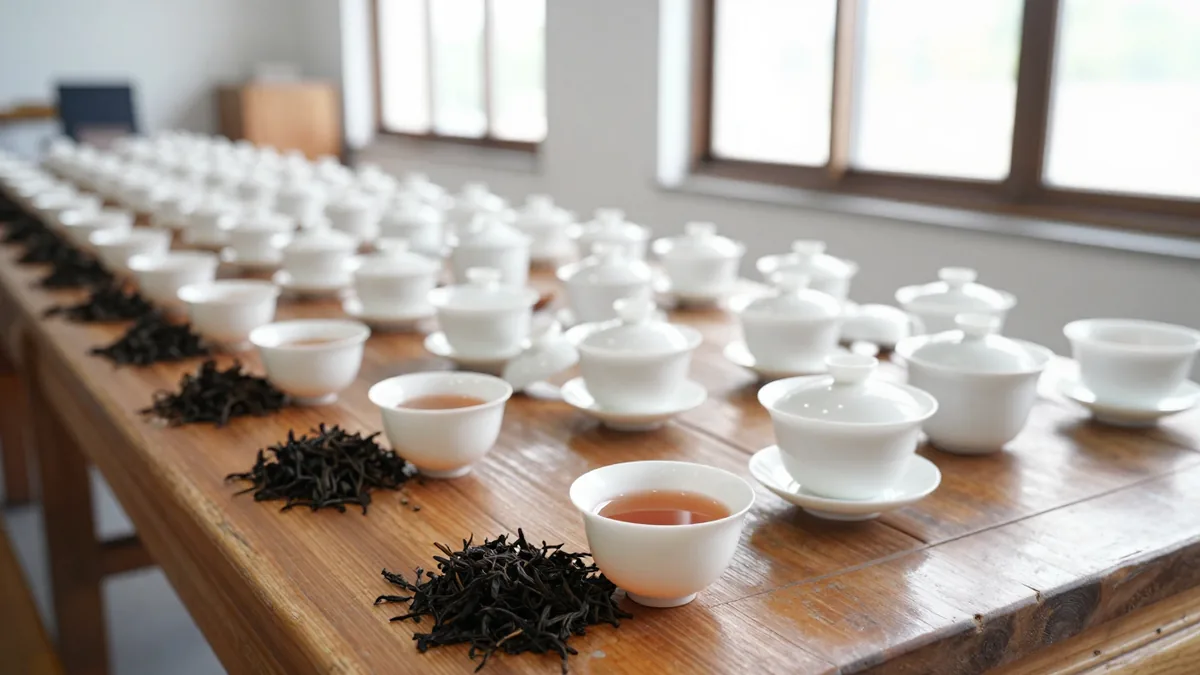
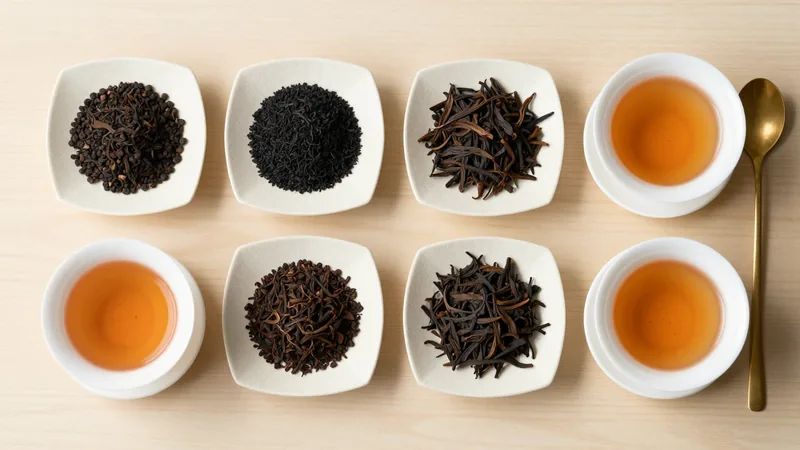
- Broker catalogs and tastes. The auctioneer "catalogs, samples, and evaluates the tea," inspecting quality by tasting and giving a valuation.
- Samples go out. Samples reach buyers "a week ahead of each auction sale," so they can taste and collect orders.
- Bidding. Buyers bid lot by lot. From 1861 to 2009, Indian auctions were "open-outcry ascending prices or English auctions." Today they run on screens.
- Fees. In India the auctioneer charges the seller 1% and the buyer 0.18% of the sale value. The same paper puts Mombasa at 1% from producers and 0.5% from buyers.
The producer never bids. At Mombasa, the East African Tea Trade Association says the producer "appoints a broker as a selling agent" who earns "a commission of a percentage of the sales value." Lots that draw no bid at or above the seller's price stay unsold and come back in a later sale. The share that does sell is the "absorption rate," the number auction reports watch most closely.
The broker's valuation and the buyers' cups are the whole price signal. Our guide to tasting tea covers the ISO method tasting rooms use.
Get the tea newsletter
New tea rooms, brewing notes, and tea worth trying. Free, no spam.
No fixed schedule. Unsubscribe anytime.
The three big auction systems compared
| Auction | Run by | Since | How often | Format now | Recent average | Source |
|---|---|---|---|---|---|---|
| Mombasa, Kenya | East African Tea Trade Association | 1956 | Twice weekly | Digital since 2020 | $2.15/kg (2025) | TBK, EATTA |
| Kolkata, Guwahati, Siliguri and three south Indian centers | Tea Board-registered auctioneers | 1861 | Weekly | Electronic since 2009–2011 | Rs 223.30/kg (Guwahati CTC, Apr–Aug 2025) | Agribusiness, The Hindu |
| Colombo, Sri Lanka | Colombo Tea Traders' Association | 1883 | Weekly, two days | Online since April 4, 2020 | Rs 1,183.98/kg (2025) | Tea & Coffee Trade Journal, Forbes & Walker |
The Colombo average is our volume-weighted mean of the 49 weekly 2025 sales in the Forbes & Walker table.
Scale matters. EATTA says Mombasa "accounts for 32% of global tea exports" and is "the only one dealing in teas from more than one country"; its homepage lists 10 member countries. J. Thomas, the largest Indian broker, calls itself "the largest and oldest existing tea auctioneers in the world, handling about 200 million kgs of tea annually," and says it handles around one third of all tea auctioned in India.
Mombasa: what a price floor did
Mombasa prices are set in US dollars. Bidding moved to dollars in October 1992, with payment "ten working days from the date of sale."
| Year | Average (USD/kg) | Lowest month | Highest month |
|---|---|---|---|
| 2021 | $2.10 | $1.74 (Jul) | $2.55 (Dec) |
| 2022 | $2.49 | $2.36 (Sep) | $2.73 (Feb) |
| 2023 | $2.24 | $2.06 (Jul) | $2.39 (Mar) |
| 2024 | $2.19 | $2.07 (Oct) | $2.29 (Apr) |
| 2025 | $2.15 | $1.91 (May) | $2.27 (Nov) |
Source: Tea Board of Kenya 2025 performance report.
In June 2021, with prices under $2, Kenya set a minimum reserve price of US$2.43/kg. Teas that could not reach it went unsold. Monthly averages stayed below $2.43 in 29 of the 36 months from 2022 to 2024, and unsold stock passed 100 million kg by July 2023, per the Tea Board of Kenya.
EATTA's managing director George Omuga told Business Daily the reserve prices were removed in October 2024. Weekly offers fell from "over 18 million kilogrammes" during the glut to about 13 million, and weekly absorption rose from 47–50% to 85–90%. The Tea Board of Kenya puts the full-year rate at 73% in 2025 against 55% in 2024, on 379.24 million kg sold.
Three other changes happened at the same time:
- Digital trading. Mombasa moved from hammer and outcry to a digital platform in 2020, and the iTTS portal went live on March 31, 2022.
- Direct sales. In May 2025 the government let 142 tea factories export directly instead of only through the auction.
- An orthodox auction. EATTA started a separate orthodox sale on September 24, 2025. It runs twice a month and averaged $3.20–3.41/kg through December, against $2.15 for the main CTC sale (TBK).
Colombo: priced by elevation
Colombo is the oldest of the three. Bids were cried out from 1883 until the first online auction on April 4, 2020. That report counted eight brokers and about 350 registered buyers, with sales over two consecutive days each week. Forbes & Walker, founded in 1881, says it holds 22% of the market.
Ceylon tea is cataloged by elevation, and the averages are reported that way:
| Elevation | Sold in 2025 (million kg) | Volume-weighted average (LKR/kg) |
|---|---|---|
| High grown | 45.09 | Rs 1,103.77 |
| Medium grown | 43.10 | Rs 1,029.76 |
| Low grown | 150.31 | Rs 1,252.27 |
| All elevations | 238.50 | Rs 1,183.98 |
Source: our sums of the Forbes & Walker weekly 2025 table, 49 sales.
- Low-grown leads. It made up 63% of the volume and sold for 13.5% more than high-grown tea. Our Assam, Ceylon and Kenya comparison covers how the elevations taste.
- Weekly swings are small. The all-elevation average ranged from Rs 1,090.19 (25-Jun-2025) to Rs 1,233.85 (26-Nov-2025).
- Less tea per sale. The 2025 sales averaged 4.87 million kg each, against the 6,000–7,000 tonnes a week cited in 2020.
In dollars, the Forbes & Walker mid-2026 review puts the January–June average at SLR 1,158.54 (USD 3.89) in 2025 and SLR 1,162.09 (USD 3.66) in 2026. Rupee prices rose slightly while the dollar value fell.
India: six centers on one screen
India sells only part of its tea at auction. The Agribusiness study says about 47% goes through six auction centers; the rest is sold privately. For Darjeeling, auctions carry only 20–25% of the crop; our Darjeeling flush guide covers why.
Electronic bidding replaced outcry center by center: Coonoor and Coimbatore in May 2009, Kochi in July 2009, Guwahati in January 2010, Kolkata in April 2010 and Siliguri in October 2010. In June 2016 a "Pan-Indian electronic auction" let one registration bid at every center. The study found electronic markets cut prices and short-term price swings by nearly 2%.
Guwahati is the largest CTC center. Its first lot sold on September 25, 1970; that year it sold 9.1 million kg at Rs 5.68/kg. From April 1 to September 25, 2026 it sold 106.31 million kg at Rs 241.17/kg, against 100.07 million kg at Rs 220.29 a year earlier.
Prices can move fast inside a season. The Tea Association of India reported in August 2026 (The Statesman) that average CTC prices fell between Sale 26 and Sale 34:
- Kolkata: Rs 291.27 to Rs 238.77, down 18%.
- Guwahati: Rs 264.89 to Rs 221.57, down 16%.
- Siliguri: Rs 201.8 (Sale 27) to Rs 182.3, down 10%.
Quality spreads are wide. The Hindu reported that orthodox leaf at Guwahati averaged Rs 279.08/kg in April–August 2025 against Rs 223.30 for CTC and dust, and that small garden marks selling under 10,000 kg got Rs 50.71/kg less than large ones. Darjeeling at Kolkata averaged Rs 420.89/kg in 2025.
What auction prices mean for your cup
Auction prices are for bulk leaf. At 2.5 g per cup, a kilogram makes 400 cups.
| Market and period | USD per kg | Leaf cost per 2.5 g cup |
|---|---|---|
| Mombasa CTC, 2025 | $2.15 | $0.0054 |
| Mombasa orthodox, Sept-Dec 2025 (high end) | $3.41 | $0.0085 |
| Colombo, Jan-Jun 2025 | $3.89 | $0.0097 |
| Guwahati CTC and dust, Apr-Aug 2025 | $2.59 | $0.0065 |
| Kolkata Darjeeling, 2025 | $4.83 | $0.0121 |
Sources: prices as cited above; rupee prices converted at 86.11 INR/USD (April–August 2025) and 87.16 INR/USD (2025), the mean of European Central Bank reference cross rates.
Even Darjeeling at auction is about a cent of leaf per cup. Blending, packing, shipping, duties and retail margin make up nearly all of what you pay; our loose leaf vs tea bags cost guide and the tea price index show the retail side.
Frequently Asked Questions
Who sets the price at a tea auction?
Buyers do, by bidding against each other lot by lot. The broker tastes and values each lot and sends samples about a week before the sale, but the hammer price is the highest bid. Lots that do not reach the seller's price stay unsold.
What was the average Mombasa tea auction price in 2025?
$2.15 per kg, down from $2.19 in 2024 and $2.49 in 2022, per the Tea Board of Kenya. Monthly averages ranged from $1.91 in May to $2.27 in November. The new orthodox auction averaged $3.20–3.41/kg from September to December.
Why did Kenya drop its tea reserve price?
The US$2.43/kg floor set in June 2021 left tea unsold when bids were lower, and unsold stock passed 100 million kg by July 2023. After the floor was removed in October 2024, weekly absorption rose from 47–50% to 85–90%, and the 2025 rate was 73% against 55% in 2024.
Are tea auctions still held in person?
Mostly not. India's six centers went electronic between 2009 and 2011, Colombo held its first online auction on April 4, 2020, and Mombasa moved from outcry to a digital platform in 2020.
How much of a tea bag's price is the auction price?
Very little. At 2.5 g a cup, Mombasa's 2025 average of $2.15/kg is $0.0054 of leaf per cup, and Colombo's January–June 2025 average of USD 3.89/kg is $0.0097.