Assam is lowland Indian black tea from the Brahmaputra valley: malty and heavy, and India makes over 80% of its tea by CTC for tea bags and milk tea. Ceylon is Sri Lankan, about 90% orthodox, and changes with elevation from strong low-grown leaf to pale Nuwara Eliya. Kenya grows at 1,500–2,700 m, makes about 97% of its tea by CTC and exported 652.80 million kg in 2025, more than India and Sri Lanka combined. In our catalog the median loose Assam costs $0.175/g and Ceylon $0.212/g.
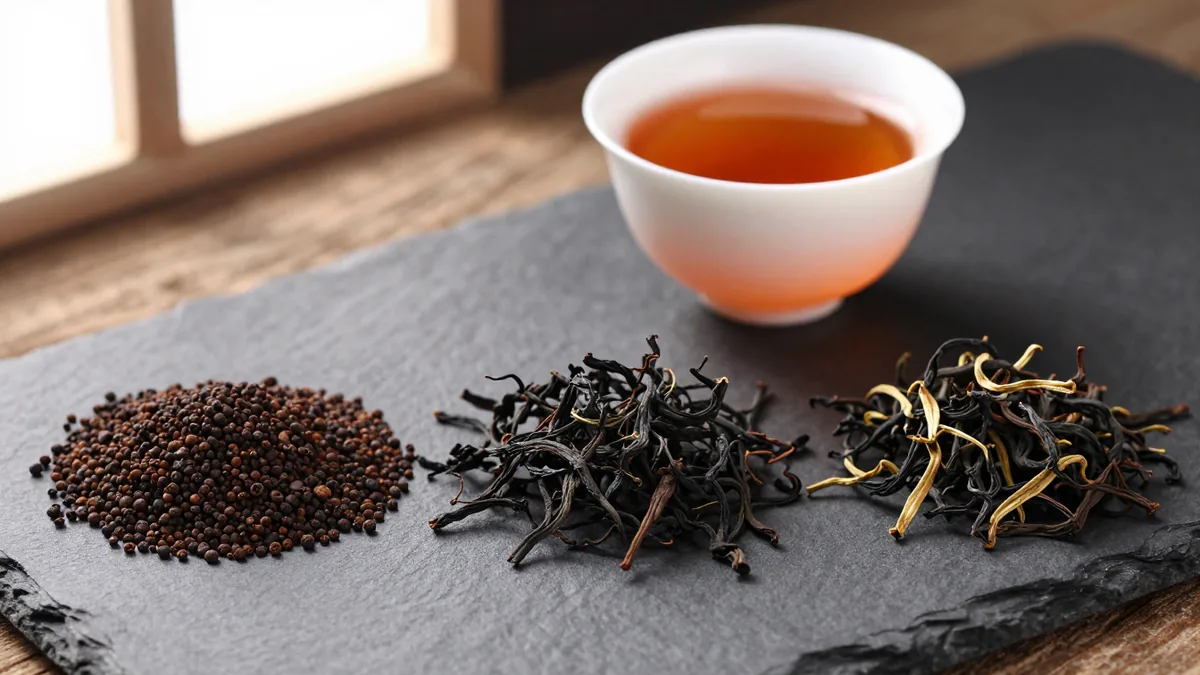
The three origins differ mainly in altitude and in how the leaf is processed: orthodox rolling keeps the leaf in strips, CTC (crush, tear, curl) cuts it into pellets that brew dark and fast for tea bags. Grade codes like BOP and FTGFOP are covered in how to read a tea label; this page compares the origins themselves.
The three origins in one table
| Assam (India) | Ceylon (Sri Lanka) | Kenya | |
|---|---|---|---|
| 2025 production, million kg | 687.76 (Assam); 1,370 (all India) | 262.76 | 550.37 |
| 2025 exports, million kg | 280.40 (all India) | 257.44 | 652.80 |
| Export price, USD per kg | 3.51 (all India, FY2024-25) | 5.85 (FOB, 2025) | 2.21 (2025) |
| CTC share of output | over 80% (all India) | 9.4% (2025) | about 97% (2025) |
| Growing altitude | at or near sea level | low-grown below 600 m; Nuwara Eliya town at 1,868 m | 1,500–2,700 m |
| Catalog listings (in stock, priced) | 35 | 17 | 2 |
| Catalog median, USD per gram | 0.175 | 0.212 | 0.118 (n=2) |
Sources: Assam production and share from the Tea Board of India via PIB; India 2025 exports from Tea Board provisional data via Business Standard; India FY2024-25 export value from PIB; Sri Lanka production and process split are our sums of the Sri Lanka Tea Board monthly statistics; Sri Lanka exports and FOB price from Forbes & Walker via Daily FT; Kenya from the Tea Board of Kenya 2025 performance report and growing-area page; India CTC share from Wikipedia: Crush, tear, curl; catalog from the Tea Explorer catalog, 7,306 teas from 40 vendors, fetched 2026-10-01, as of October 1, 2026 (/tea-price-index).
Three things stand out. Kenya ships the most tea of the three by a wide margin. Sri Lanka gets about 2.6 times Kenya's price per kilo at export (5.85 vs 2.21 USD). And Assam alone grew 687.76 million kg in 2025, more than Kenya's whole crop of 550.37 million kg.
Get origin and garden notes
Where tea is grown, how each region makes it, and the next origin explainer. Free, no spam.
No fixed schedule. Unsubscribe anytime.
Assam: lowland assamica, built for milk

Assam tea comes from Camellia sinensis var. assamica, the large-leaf variety, grown mostly at or near sea level on the floodplain of the Brahmaputra River. The Tea Board of India describes the cup as "full-bodied, strong and malty" and calls Assam "the single largest contiguous tea-growing region in the world."
- Scale: Assam produced 687.76 million kg in 2025, 50.2% of India's output (PIB). That puts all-India production near 1,370 million kg.
- Process: CTC was invented for this region. The first CTC machine ran in 1930 at the Amgoorie Tea Garden in Assam, and over 80% of India's tea is now CTC (Wikipedia).
- Exports: India shipped a record 280.40 million kg in 2025, up from 256.17 million kg in 2024 (Business Standard).
The CTC version is what goes into Indian chai and most breakfast tea bags. Harney & Sons Fine Teas CTC Assam is the cheapest Assam in our catalog at $0.0705/g; Harney describes it as having "a striking amber color, rich flavor, and a full body." Orthodox Assam keeps the leaf whole and the gold buds visible. At the top end, Harney & Sons Fine Teas Assam Golden Tips is pure buds at $1.32/g, which Harney says is "lighter and sweeter" than most Assams.
Our 35 in-stock loose Assams run from $0.0705 to $1.32 per gram with a median of $0.1754. At 2.5 g per cup that is about $0.44 per cup at the median. For milk tea and masala chai, see our chai recipe.
Ceylon: elevation decides the cup
Sri Lanka is an orthodox origin. The Sri Lanka Tea Board calls its producers "the custodians of the traditional, orthodox method of black tea production." Its own monthly figures add up to 235.77 million kg orthodox, 24.65 million kg CTC and 2.33 million kg green tea in 2025, so CTC was 9.4% of output (SLTB statistics).
Ceylon is sold by elevation band and by district. The 2025 split, summed from the same SLTB monthly series:
| Elevation band | 2025 production, million kg | Share | 2024, million kg |
|---|---|---|---|
| High grown | 56.22 | 21.4% | 56.38 |
| Medium grown | 47.71 | 18.2% | 46.1 |
| Low grown | 158.83 | 60.4% | 158.32 |
| Total | 262.76 | 100% | 260.8 |
Source: our sums of the twelve monthly releases per year in the Sri Lanka Tea Board statistics, fetched October 1, 2026.
Low-grown tea is 60.4% of the crop, so most Ceylon in a supermarket box is low-grown. The SLTB's tasting notes by district:
- Nuwara Eliya, highest district, town at 1,868 m: "the lightest (palest) of all the types of Ceylon Tea," "delicately fragrant" (SLTB).
- Dimbula, all estates above 1,250 m: "refreshingly mellow," with "a fine golden-orange hue" (SLTB).
- Uva, hit by both monsoons: "exotically aromatic" (SLTB).
- Ruhuna, low-grown, below 600 m: long leaf and "full-flavoured black tea" (SLTB).
Production dipped to 249.69 million kg in 2022, the year of Sri Lanka's economic crisis, and has recovered to 262.76 million kg. Sri Lanka exported 257.44 million kg in 2025 at an average 5.85 USD per kg FOB (Daily FT).
Our 17 in-stock single-origin Ceylons have a median of $0.2116/g. Harney & Sons Fine Teas Uva Highlands costs $0.1058/g; Smith Teamaker Ceylon Dimbula is $0.1646/g, and Smith notes Dimbula is "often used in Earl Grey and other blends" (see our Earl Grey guide).
Kenya: highland CTC at volume

Kenyan tea grows on highlands at "1500 – 2700 meters above the sea level," around Mt Kenya, the Aberdares, Nyambene Hills, Kericho and Kisii, with 1,200–1,500 mm of rain a year (Tea Board of Kenya). That is higher than most Ceylon estates and far above Assam.
The 2025 numbers, all from the Tea Board of Kenya 2025 report:
- Production: 550.37 million kg, down 8.04% from 598.47 million kg, blamed on weather.
- Exports: 652.80 million kg, up 9.81%, larger than production because unsold stocks from 2023 and 2024 shipped. That is 102.43 million kg more than the year's crop.
- Processing: specialty tea was 2.82% of output, nearly all of it black orthodox. The rest is CTC, so CTC is roughly 97%.
- Buyers: Pakistan took 36% of exports, then Egypt (13.9%) and the UK (8.6%).
Kenya exported 652.80 million kg against 537.84 million kg for India and Sri Lanka together. The Tea Board of Kenya's 2023 brochure calls Kenya "the third largest producer and the leading exporter of Tea in the world (23%)." The East African Tea Trade Association says the Mombasa auction "is the largest black CTC tea auction in the world."
Mombasa auction averages, USD per kg (Tea Board of Kenya):
| Year | 2021 | 2022 | 2023 | 2024 | 2025 |
|---|---|---|---|---|---|
| Average auction price | 2.10 | 2.49 | 2.24 | 2.19 | 2.15 |
A new auction for specialty and orthodox teas opened in September 2025; those lots sold at 3.20–3.41 USD per kg, about 50% above the CTC average.
Kenyan tea is rare as a named loose-leaf origin in the US. Our catalog lists 5 Kenyan black teas, only 2 in stock with a price: Harney & Sons Fine Teas Kenya Milima at $0.0794/g and What-Cha Kenya Handrolled Black Tea at $0.1565/g. Both are orthodox, not CTC. Harney says Milima grows "at more than 6,000 feet" and brews "light-bodied and tends toward citrus." Milima's retail price is about 37 times the 2025 Mombasa average, though auction lots are mostly CTC and sold in bulk.
Prices compared: export dock vs your cup
| Origin | Export price, USD per kg | Catalog median, USD per gram | Per 2.5 g cup at median |
|---|---|---|---|
| Kenya | 2.21 | 0.118 (2 teas) | $0.29 |
| India (Assam in catalog) | 3.51 | 0.175 | $0.44 |
| Sri Lanka | 5.85 | 0.212 | $0.53 |
| All in-stock black tea, any origin | n/a | 0.260 | $0.65 |
Sources: export prices as in the first table; catalog medians from the Tea Explorer catalog, 7,306 teas from 40 vendors, fetched 2026-10-01, as of October 1, 2026.
The order holds at both ends: Kenya cheapest, Sri Lanka most expensive. All three sit below the catalog median for black tea of any origin ($0.26/g), which is pulled up by Chinese and Taiwanese blacks. Per-cup costs at other leaf weights are in the tea cost calculator.
Which one to buy
- Milk, sugar, chai: CTC Assam. CTC is built to brew dark fast, and Harney says its CTC Assam "takes milk and sugar." It costs $0.18 per 2.5 g cup.
- Plain black tea, no milk: orthodox Assam (TGFOP or FTGFOP grades) or a Dimbula, which the SLTB calls "refreshingly mellow."
- Full-flavored Ceylon: low-grown tea such as Ruhuna. Low-grown was 60.4% of the island's 2025 crop.
- Lightest, most aromatic: Nuwara Eliya, the palest Ceylon by the SLTB's own description.
- Cheapest strong tea: Kenyan CTC, mostly sold inside blends and tea bags rather than as a named loose origin.
Frequently Asked Questions
Is Assam stronger than Ceylon?
Usually, yes. India's Tea Board describes Assam as "full-bodied, strong and malty," and over 80% of Indian tea is CTC, which brews dark and fast. Most Ceylon is orthodox: CTC was 9.4% of Sri Lanka's 2025 output. The SLTB describes low-grown Ruhuna tea, from below 600 m, as "full-flavoured."
Is Kenya the largest tea exporter?
The Tea Board of Kenya calls Kenya "the leading exporter of Tea in the world." In 2025 Kenya exported 652.80 million kg, against 280.40 million kg for India and 257.44 million kg for Sri Lanka.
Why is Kenyan tea cheap?
Most of it is CTC sold in bulk at the Mombasa auction, which averaged 2.15 USD per kg in 2025. Sri Lankan exports averaged 5.85 USD per kg; about 90% of its crop is orthodox, and 116.25 million kg of its 2025 exports shipped as retail packets.
How much does loose Assam cost per cup?
The median in-stock loose Assam in our catalog is $0.1754 per gram, or about $0.44 for a 2.5 g cup, as of October 1, 2026. Listings run from $0.0705/g (CTC) to $1.32/g (golden tips).
What elevation is high-grown Ceylon?
The Sri Lanka Tea Board puts every Dimbula estate above 1,250 m, and Nuwara Eliya's town sits at 1,868 m. Low-grown Ruhuna tea is grown below 600 m. High-grown tea was 56.22 million kg, or 21.4% of Sri Lanka's 2025 output.