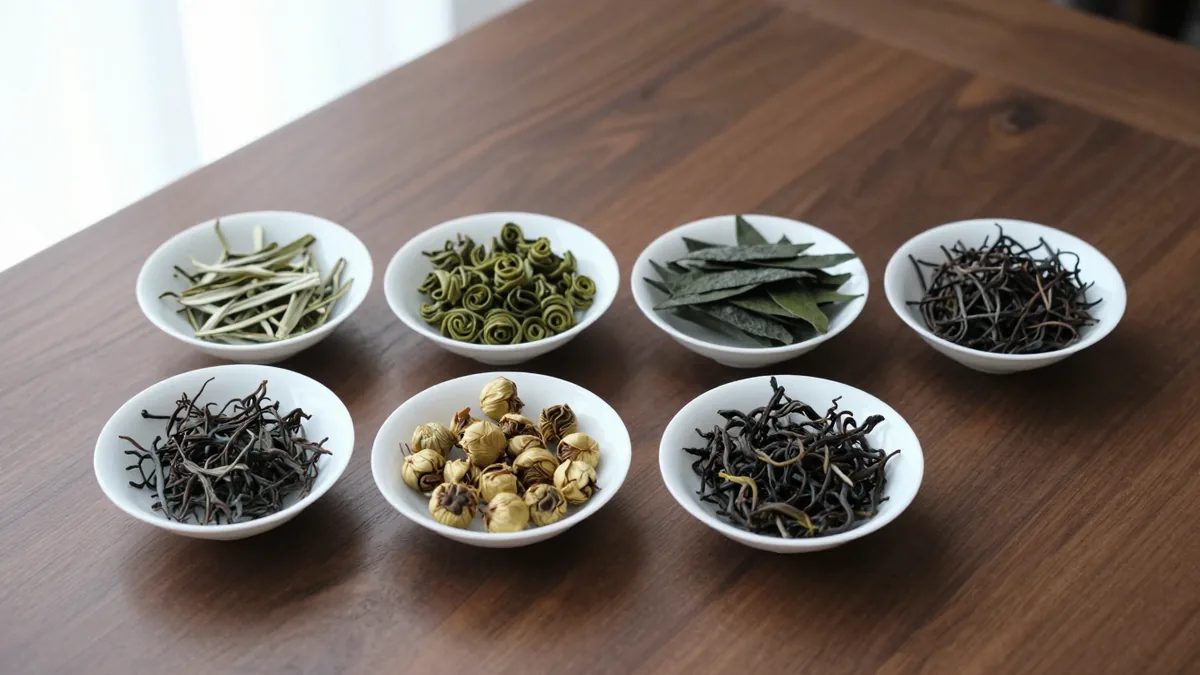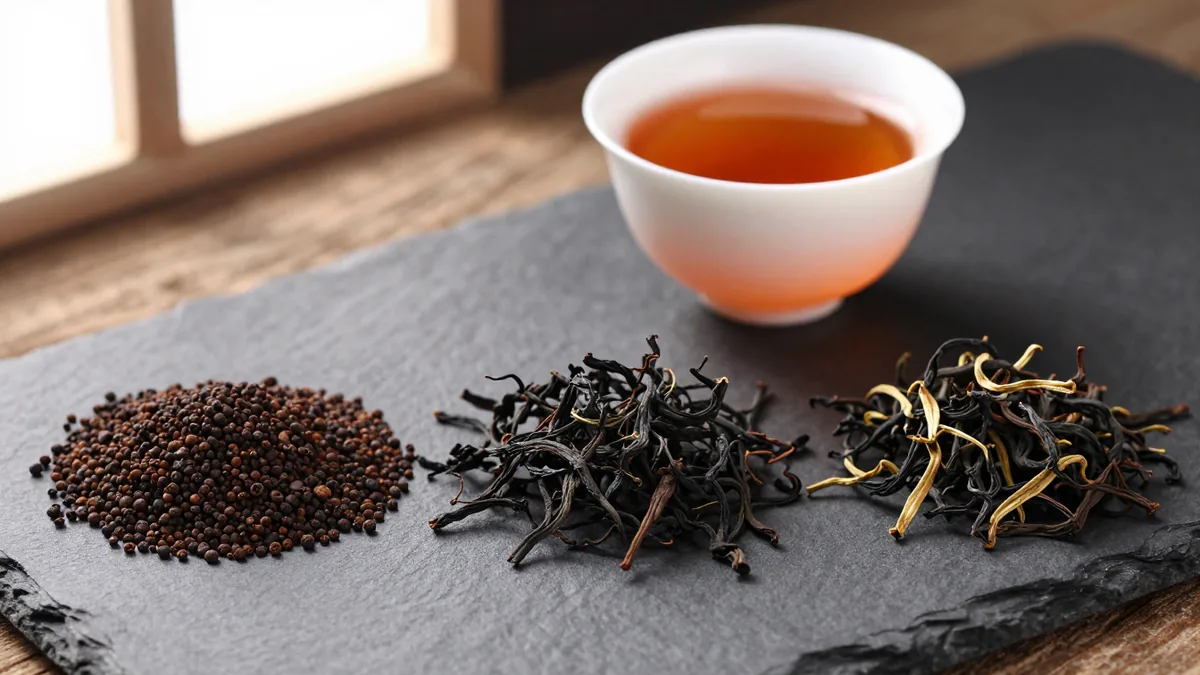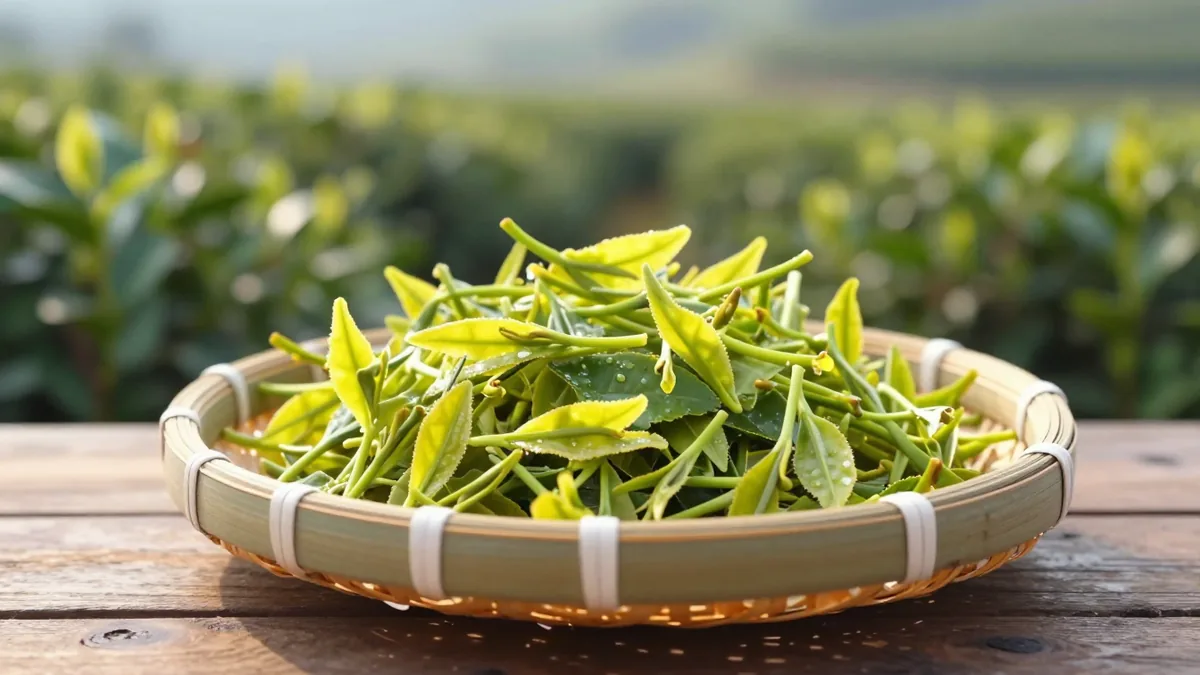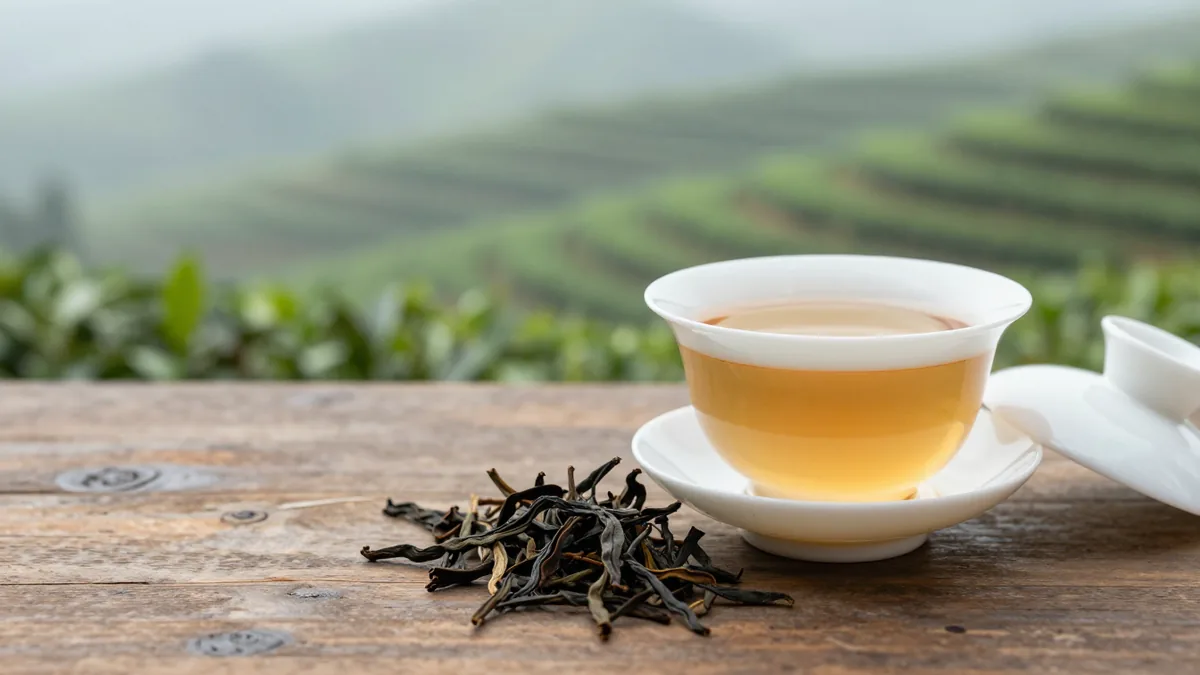
Dancong oolong comes from Phoenix Mountain (Fenghuang Shan) near Chaozhou, Guangdong, and is sold under ten signature aroma names plus cultivar names such as Ya Shi Xiang (Duck Shit) and Song Zhong. As of October 1, 2026, the Tea Explorer catalog, 7,306 teas from 40 vendors, fetched 2026-10-01, lists 196 dancong oolongs from 17 vendors at a median $0.62 per gram, 1.4 times the $0.44 median for all oolong. Mi Lan Xiang (honey orchid) is the most-stocked aroma name with 31 listings.
What "dancong" means
Dancong (单丛) means "single bush." Historically it was the top grade of Phoenix oolong: leaves from large old trees were picked tree by tree and processed tree by tree, then blended, according to Tea Drunk's naming guide.
That practice has mostly ended. Tea from a single giant tree is now sold as Dan Zhu (single tree), and most other tea is picked and blended before processing. Most teas labeled "dancong" today are single-cultivar Phoenix oolongs, not single-bush teas in the old sense (Tea Drunk).
- Where: Fenghuang Mountain, about 30 km from Chaozhou city, main peak 1,497.8 m (Zheng et al., Scientific Reports 2024).
- How old: the cultivar group has a recorded history of more than 700 years (Kun et al., Food Chemistry: X 2025).
- Copies: Rao Ping, next to Chaozhou, is now a large growing area and is often described as a hub for knockoff Phoenix oolong (Tea Drunk).
Oxidation and roast basics are covered in our oolong oxidation guide. This article covers the names.
Get origin and garden notes
Where tea is grown, how each region makes it, and the next origin explainer. Free, no spam.
No fixed schedule. Unsubscribe anytime.
Aroma names vs cultivar names
Phoenix oolongs carry two kinds of names. Cultivar names (Ba Xian, Song Zhong, Ya Shi Xiang, Ju Duo Zai) identify the plant, the way "Chardonnay" identifies a grape. Aroma names (xiang xing, 香型) describe the scent of the finished tea.
The aroma system was an attempt to standardize names by fragrance alone. It produced the "10 Signature Fragrances of Dan Cong" (Tea Drunk). Three points from the same source matter when buying:
- Tea named after its aroma is generally rated below tea named after its cultivar.
- Bai Ye, a cheap, high-yield cultivar, is often sold as Mi Lan Xiang (honey orchid).
- Wu Ye, another economical cultivar, is often sold as Ya Shi Xiang.
So a "Mi Lan Xiang" label tells you the intended scent, not the plant.
The ten signature aromas, with catalog prices
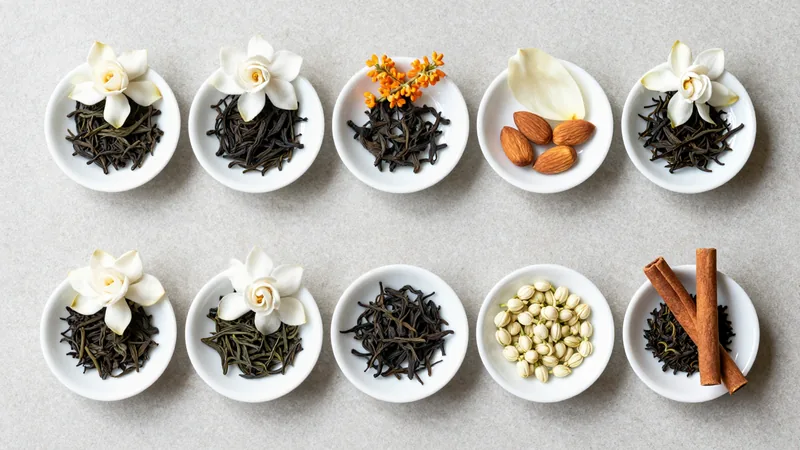
The ten names come from Tea Drunk's list. Scent notes are vendor tasting notes, linked to the product page; where we found no vendor note, the column gives the literal meaning of the name. Counts and medians are from the Tea Explorer catalog, 7,306 teas from 40 vendors, fetched 2026-10-01, as of October 1, 2026. "Priced" counts only in-stock listings of 20 g or more with a known weight (the price index rule).
| Aroma name | Named after | Scent notes | Listings | Priced | Median $/g |
|---|---|---|---|---|---|
| Huang Zhi Xiang (黄枝香) | gardenia (yellow sprig) | Restrained floral, golden butter (Tea Drunk) | 8 | 5 | $0.42 |
| Zhi Lan Xiang (芝兰香) | orchid | Elegant, subtle fruit, bright metallic (Tea Drunk) | 7 | 4 | $0.78 |
| Mi Lan Xiang (蜜兰香) | honey orchid | Nectarine, honeyed apricot, orchid (Rishi); Tea Drunk ties the name to waxy honeycomb | 31 | 26 | $0.61 |
| Gui Hua Xiang (桂花香) | osmanthus | Named for osmanthus flower | 2 | 2 | $0.41 |
| Yu Lan Xiang (玉兰香) | magnolia | Named for magnolia | 3 | 2 | $0.45 |
| Xing Ren Xiang (杏仁香) | almond (apricot kernel) | Floral, almond blossom (Red Blossom); toasted almond, light wood (Wuyi Origin) | 12 | 9 | $0.64 |
| Ye Lai Xiang (夜来香) | night-blooming jasmine | Named for night-blooming jasmine | 3 | 3 | $0.42 |
| Jiang Hua Xiang (姜花香) | ginger flower | Ginger flower, sandalwood, thick texture (Tea Habitat) | 4 | 3 | $0.66 |
| Mo Li Xiang (茉莉香) | jasmine | Named for jasmine | 2 | 1 | $0.27 |
| Rou Gui Xiang (肉桂香) | cinnamon | Brown sugar, cinnamon bark, woody (Tea Habitat) | 2 | 2 | $1.46 |
Sources: names from Tea Drunk; counts and medians from the Tea Explorer catalog. A listing can match two names (a "Thunder Tree Zhi Lan Xiang" is both a Lei Kou Chai cultivar and a Zhi Lan aroma), so the counts overlap.
Mi Lan Xiang has by far the most listings. Gui Hua, Yu Lan, Ye Lai and Mo Li each have 3 or fewer in our catalog under those names; many sellers label by cultivar instead, or use their own English names such as "Honeyed Pomelo," "Sweet Potato" and "Parasol" (all white2tea).
Ya Shi Xiang and the cultivar names
Ya Shi Xiang (鸭屎香, "duck shit fragrance") is the best-known dancong name and is not one of the ten aromas. It is a cultivar.
The usual story, as told by Wuyi Origin: the mother tree grew near Xiaping Kengtou village in yellow loam that locals called "duck-shit soil," and the farmer gave the tea an ugly name so neighbors would not take cuttings. There were efforts to rename it Silver Flower Fragrance; the old name stuck (Tea Drunk).
The cup does not match the name. A 2025 sensory study of three Phoenix oolongs described the Yashi sample as coconut milk-like, Huangzhi as flowery and sweet, and Milan as fruity and sweet. Jasmine lactone, (Z)-jasmone, linalool and gamma-hexalactone separated the three (Song et al., Food Research International 2025).
Other cultivar names you will see:
- Song Zhong: traced by legend to the last Song emperor; Red Blossom says its lot grows at 1,000 m on Wudong and is oxidized to about 30% before several light charcoal roasts.
- Ba Xian (Eight Immortals): supposedly named because only eight trees were left at one point (Tea Drunk).
- Ju Duo Zai: the true "almond" cultivar, with tiny fuzzy-edged leaves and a nuttier, heavier cup (Tea Drunk).
| Cultivar | Listings | Priced | Median $/g |
|---|---|---|---|
| Ya Shi Xiang (Duck Shit) | 16 | 13 | $0.41 |
| Song Zhong | 10 | 6 | $1.34 |
| Ba Xian (Eight Immortals) | 7 | 5 | $0.58 |
| Ao Fu Hou | 5 | 4 | $1.61 |
| Bai Ye | 2 | 1 | $0.31 |
Source: Tea Explorer catalog, name matching, as of October 1, 2026.
What the chemistry says about aroma types
Lab work backs up the idea that the names describe real differences. A 2023 study from the Guangdong Academy of Agricultural Sciences ran 10 well-known Phoenix fragrance types against Tieguanyin. It found 172 volatile compounds common to all samples; indole, hotrienol, benzyl nitrile and jasmine lactone were the most abundant across the ten types, and 20 aroma-active compounds served as markers for the different fragrance types (Qin et al., Food Research International 2023).
A 2024 study from Hanshan Normal University in Chaozhou broke five Phoenix teas into chemical classes. The share of each class differs sharply by type:
| Compound class (% of aroma) | Zhuye | Tuofu | Jianghuaxiang | Juduo | Yashixiang |
|---|---|---|---|---|---|
| Alcohols | 52.13 | 60.16 | 62.41 | 31.88 | 26.84 |
| Ketones | 12.90 | 20.47 | 9.88 | 9.30 | 35.87 |
| Lactones | 3.19 | 10.86 | 0 | 18.41 | 6.25 |
| Heterocycles | 11.45 | 0 | 13.11 | 10.83 | 20.93 |
| Nitrogen compounds | 2.18 | 0 | 5.68 | 16.08 | 2.62 |
Source: Zheng et al., Scientific Reports 2024, Table 2 (0 = not detected). Leaves came from roughly 10-year-old plants on Fenghuang Mountain, spring 2022.
Two readings from that table: the ginger-flower type (Jianghuaxiang) is the most alcohol-heavy at 62.41%, and Yashixiang carries the most ketones at 35.87%, almost 3 times Zhuye's 12.90%.
A 2026 comparison of Bai Ye, Da Wu Ye and Ya Shi Xiang found all three sweet, floral and fruity, with different top markers: 3-methylnonane-2,4-dione for Bai Ye, (Z)-3-hexenal for Da Wu Ye and 3-octanone for Ya Shi Xiang (Shi et al., Food Chemistry 2026).
The empty cup matters too. A 2025 study found the lingering cup aroma of Phoenix oolong strongest in nectar, ginger-like and floral notes, and confirmed 17 key odorants by recombination (Kun et al., 2025). Smell the empty cup after each pour; our tasting protocol explains how.
Processing, altitude and tree age
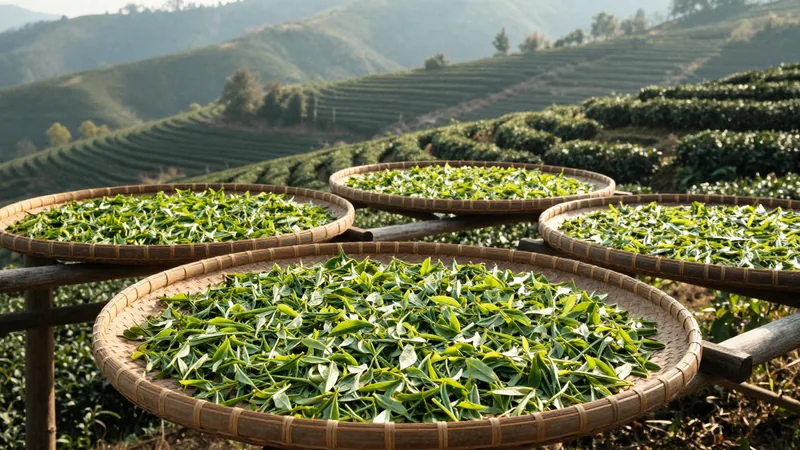
Phoenix oolong follows the standard oolong sequence: solar withering, indoor withering, shaking, de-enzyming, rolling and drying (Kun et al., 2025). Roasting comes after, and vendors describe it lot by lot:
- Wuyi Origin: Ya Shi Xiang from Dongjiao village, about 800 m, around 40-year-old bushes, lower-medium roast in two firings.
- Wuyi Origin: Xing Ren Xiang from Wudong village, about 1,200 m, bushes over 60 years old, medium roast.
- Yunnan Sourcing: "Cinnamon Aroma" from 60- to 120-year-old trees at 1,150 m, roasted in clay jars, rested a week, then roasted twice more.
- What-Cha: Ya Shi Xiang triple roasted, from 60-year-old bushes.
- Red Blossom: "nong xiang" style, mid-oxidized to 25–30%.
Altitude and age figures are vendor claims. We found no independent registry of tree ages. "Lao cong" (old bush) on a label is a seller's statement, not a certified grade.
Buying and brewing dancong
The Tea Explorer catalog, 7,306 teas from 40 vendors, fetched 2026-10-01, as of October 1, 2026, has 196 Phoenix oolong listings from 17 vendors; 142 meet the price-index rule. Their median is $0.62/g against $0.44/g for all 490 priced oolongs.
- Cheapest priced: Phoenix Village "Mi Xiang" Shui Xian Oolong Tea from Yunnan Sourcing Tea Shop, $0.13/g.
- Most expensive priced: 2024 Mi Lan Xiang 2nd Prize Winner - Honey Orchid (1 oz) from Tea Habitat, $5.97/g.
- Dancong black teas: 8 more listings are black teas made from dancong cultivars (Milan Red, Duck Shit black); they are not counted above.
Brewing: Red Blossom recommends 1 g per 1 fl oz of water at 210°F for 30 seconds, a flash brew that pulls aroma before the tannins. In a 100 ml gaiwan that is 3.4 g, which costs $2.10 at the median price, $0.44 at the cheapest and $20.19 at the most expensive, before you count re-steeps. Our gongfu brewing guide covers the gaiwan steps.
Practical rules:
- Buy by cultivar when you want a specific tea; buy by aroma name when you want a style.
- Expect a cheap "Mi Lan Xiang" to be Bai Ye, and a cheap "Ya Shi" to possibly be Wu Ye.
- Compare two or three names side by side at the same weight and time. Small 25–30 g bags make that cheap.
Frequently Asked Questions
What are the ten dancong aroma types?
The ten signature fragrances are Huang Zhi Xiang (gardenia), Zhi Lan Xiang (orchid), Mi Lan Xiang (honey orchid), Gui Hua Xiang (osmanthus), Yu Lan Xiang (magnolia), Xing Ren Xiang (almond), Ye Lai Xiang (night-blooming jasmine), Jiang Hua Xiang (ginger flower), Mo Li Xiang (jasmine) and Rou Gui Xiang (cinnamon). Mi Lan Xiang is the most common in our catalog with 31 listings as of October 1, 2026.
Is Ya Shi Xiang one of the ten aromas?
No. Ya Shi Xiang (duck shit fragrance) is a cultivar name, not one of the ten aroma names. Our catalog lists 16 Ya Shi Xiang teas at a median $0.41 per gram as of October 1, 2026.
How much does dancong oolong cost?
The median priced Phoenix oolong in our catalog is $0.62 per gram, 1.4 times the $0.44 median for all oolong, as of October 1, 2026. A 100 ml gaiwan at 1 g per fl oz uses 3.4 g, about $2.10 per session at that median.
Does "dancong" still mean a single bush?
Rarely. Tea from one tree is now usually sold as Dan Zhu (single tree), and most "dancong" on the market is a single cultivar picked from many plants (Tea Drunk).