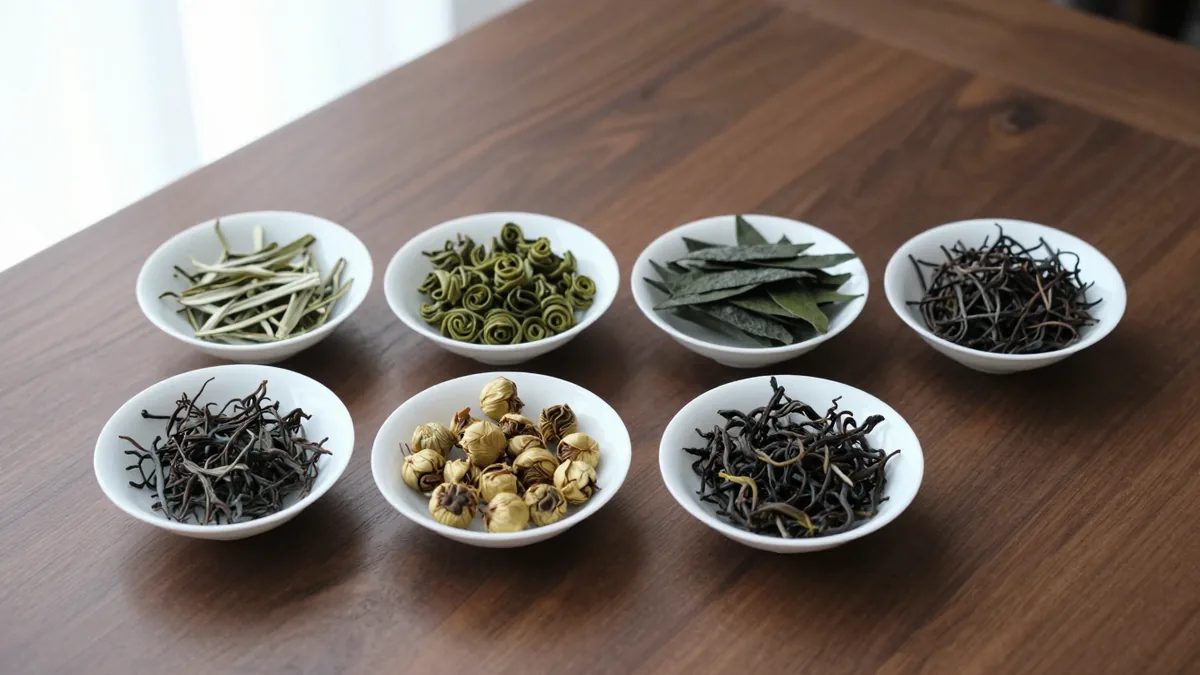
There is no single official list of China's ten famous teas. The 1959 list is the one most often quoted, and lists printed in 1999, 2001 and 2002 swap teas in and out: 15 names appear across those four lists, and 5 of them appear on all four. In the Tea Explorer catalog, 7,306 teas from 40 vendors, fetched 2026-10-01, the teas on these lists have median prices from $0.21 per gram (Xinyang Maojian) to $1.22 per gram (Lu'an Guapian), and West Lake-labeled Longjing costs 6.9 times as much as other Longjing.
There is no official list
The phrase Zhongguo shi da mingcha gets quoted as if one authority signed off on it. None did. Wikipedia's English entry says plainly that "no authoritative lists exists per se" (Wikipedia: China Famous Tea). The Chinese entry says the same thing in different words: versions differ, and several exist (zh.wikipedia: 中国十大名茶).
The four dated lists that circulate most:
- 1959: a national famous-tea review, the version most English sources copy (Wikipedia).
- 1999: Liberation Daily, January 16. As printed it names only 9 teas (zh.wikipedia).
- 2001: Associated Press and the New York Daily News, March 26 (zh.wikipedia).
- 2002: Hong Kong's Wen Wei Po, January 18 (zh.wikipedia).
| Tea | Type | Province | 1959 | 1999 | 2001 | 2002 | Lists |
|---|---|---|---|---|---|---|---|
| Xihu Longjing | Green | Zhejiang | Yes | Yes | Yes | Yes | 4 |
| Dongting Biluochun | Green | Jiangsu | Yes | Yes | Yes | Yes | 4 |
| Huangshan Maofeng | Green | Anhui | Yes | Yes* | Yes | Yes | 4 |
| Lu'an Guapian | Green | Anhui | Yes | Yes | Yes | Yes | 4 |
| Anxi Tieguanyin | Oolong | Fujian | Yes | Yes** | Yes | Yes | 4 |
| Lushan Yunwu | Green | Jiangxi | Yes | Yes | Yes | No | 3 |
| Xinyang Maojian | Green | Henan | Yes | No | Yes | Yes | 3 |
| Qimen (Keemun) black | Black | Anhui | Yes | Yes | No | Yes | 3 |
| Junshan Yinzhen | Yellow | Hunan | Yes | No | No | Yes | 2 |
| Wuyi Yancha (Da Hong Pao) | Oolong | Fujian | Yes | No | No | Yes | 2 |
| Duyun Maojian | Green | Guizhou | No | No | Yes | Yes | 2 |
| Taiping Houkui | Green | Anhui | No | Yes | No | No | 1 |
| Yunnan Puer | Dark | Yunnan | No | Yes | No | No | 1 |
| Mengding Ganlu | Green | Sichuan | No | No | Yes | No | 1 |
| Yinhao jasmine | Scented green | n/a | No | No | Yes | No | 1 |
Sources: Wikipedia, 1959 list; zh.wikipedia, 1999/2001/2002 lists. \Printed as "Tunxi green (Huangshan Maofeng)". \\*Printed as "Xiping oolong"; Xiping town in Anxi county is Tieguanyin's origin (zh.wikipedia: 安溪铁观音).
Five teas appear on all four lists, two of them under other names in 1999. Three more appear on three lists. Anhui province places five teas on the table, more than any other province.
Get origin and garden notes
Where tea is grown, how each region makes it, and the next origin explainer. Free, no spam.
No fixed schedule. Unsubscribe anytime.
What these teas cost in our catalog
We matched product names in the catalog for each tea, kept rows with a price per gram and at least 20 g of tea, and dropped samplers, matcha, scented versions and Taiwan-made Tieguanyin. "Per mug" uses 3 g of leaf.
| Tea | Listings | Vendors | Median $/g | Range $/g | Per 3 g mug |
|---|---|---|---|---|---|
| Xihu Longjing (any Longjing label) | 25 | 15 | $0.47 | $0.12–$4.96 | $1.41 |
| Biluochun (any origin) | 12 | 6 | $0.33 | $0.10–$1.56 | $0.99 |
| Huangshan Maofeng | 1 | 1 | $0.52 | single listing | $1.56 |
| Lu'an Guapian | 3 | 3 | $1.22 | $0.21–$2.14 | $3.66 |
| Junshan Yinzhen | 1 | 1 | out of stock | single listing | n/a |
| Xinyang Maojian | 3 | 2 | $0.21 | $0.15–$2.14 | $0.63 |
| Taiping Houkui | 7 | 7 | $0.65 | $0.32–$1.30 | $1.95 |
| Da Hong Pao | 23 | 12 | $0.48 | $0.15–$2.16 | $1.44 |
| Tieguanyin (mainland) | 30 | 12 | $0.30 | $0.12–$1.29 | $0.90 |
| Qimen (Keemun) | 17 | 11 | $0.30 | $0.10–$1.73 | $0.90 |
| Lushan Yunwu | 4 | 3 | $0.25 | $0.14–$2.07 | $0.75 |
| Duyun Maojian | 0 | 0 | none listed | n/a | n/a |
Source: Tea Explorer catalog, 7,306 teas from 40 vendors, fetched 2026-10-01, as of October 1, 2026. For comparison, the median for all green tea in the catalog is $0.31/g (484 listings), oolong $0.42/g and black $0.26/g (/teas).
Treat the Huangshan Maofeng, Lu'an, Junshan, Xinyang and Lushan rows as thin data, not a market price. Price your own order with the tea cost calculator.
The eastern greens: Longjing, Biluochun, Huangshan, Lu'an, Houkui
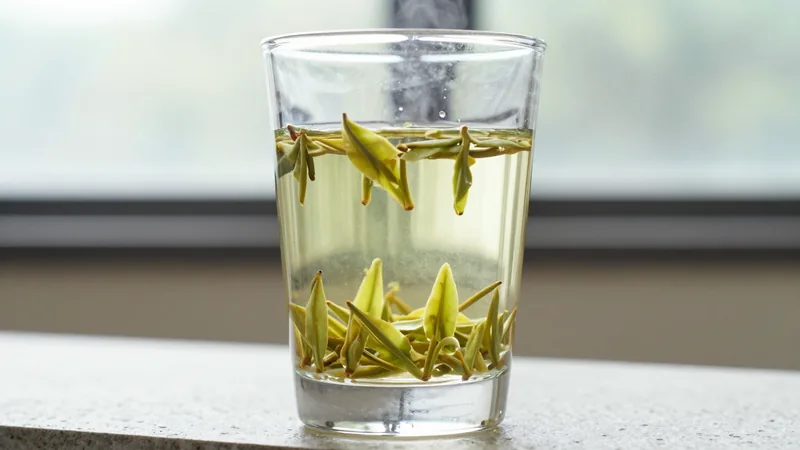
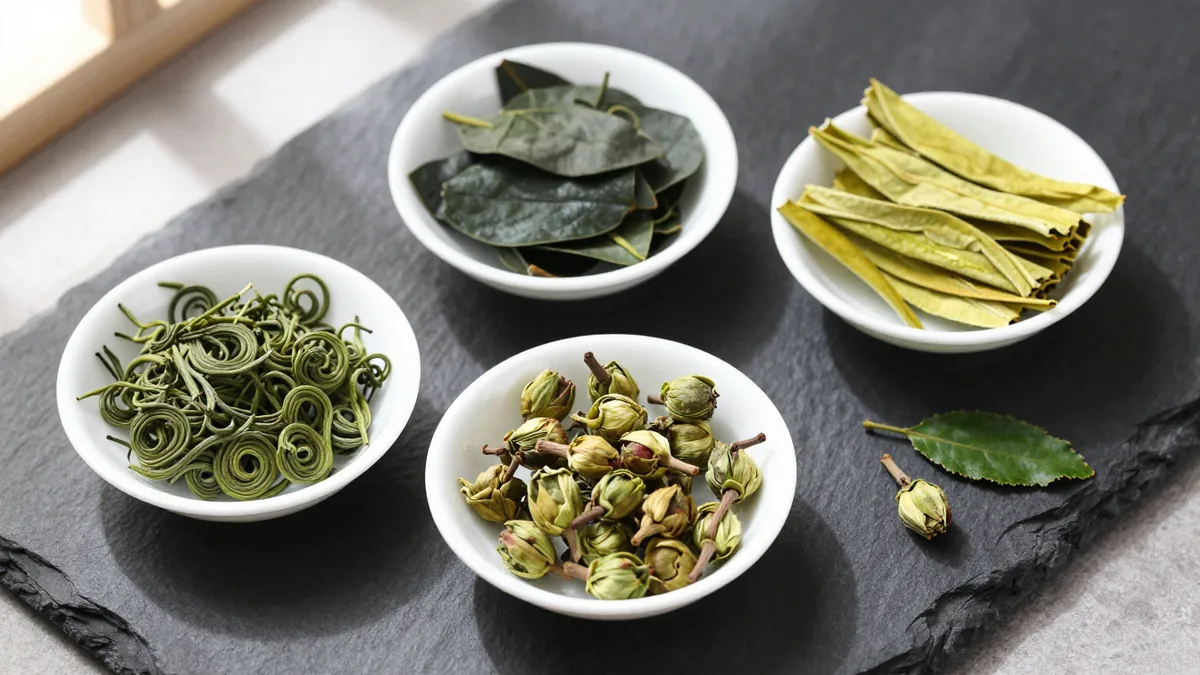
Xihu Longjing (Dragon Well), Zhejiang. Pan-fired, pressed into flat, light-green blades (Wikipedia: Longjing). Only tea from a 168 km² protected zone around West Lake may carry the West Lake name, and the name has been a registered geographical-indication certification mark since 2011 (zh.wikipedia: 西湖龙井). Premium lots are Mingqian, picked before Qingming on April 5; Yuqian lots are picked before Grain Rain in mid-April (Wikipedia). In our catalog the 6 listings that name West Lake, Shi Feng, Meijiawu or Lion Peak have a median of $2.48/g; the other 19 Longjing listings sit at $0.36/g. The range runs from $0.12/g for a Hangzhou Longjing to $4.96/g for a Xi Hu Longjing.
Dongting Biluochun, Jiangsu. Rolled into tight spirals with visible white hairs, from the Dongting hills by Lake Tai (Wikipedia: Biluochun). One kilogram holds 14,000 to 15,000 shoots (Wikipedia). The name travels: Biluochun is also made in Zhejiang, Sichuan and Taiwan (Wikipedia). Only 2 of our 12 Biluochun listings say Jiangsu or Dongting, and one of them is $1.56/g, well above the $0.33 median.
Huangshan Maofeng, Anhui. "Yellow Mountain Fur Peak": a bud and one leaf, covered in fine hairs, picked in early spring before Qingming (Wikipedia: Huangshan Maofeng). The catalog has one listing, at $0.52/g.
Lu'an Guapian, Anhui. Made from leaves, not buds. It uses the second leaf, removes the central vein and pan-fries the leaf into a flat melon-seed shape (Wikipedia: Lu'an Melon Seed). Our three listings run from $0.21/g to $2.14/g.
Taiping Houkui, Anhui. Shoots reach 15 cm, two flat leaves clasping a bud, picked from the Shidacha cultivar (Wikipedia: Taiping houkui). Origin is the Houkeng area of Huangshan district, and it took a top gold award at the 1915 Panama-Pacific Exposition (zh.wikipedia: 太平猴魁). At $0.65/g it has the highest median of any tea here with 7 or more listings.
The inland greens: Xinyang, Lushan, Duyun
Xinyang Maojian, Henan. Thin, even, downy needles; the best lots come from mid-April picking (Wikipedia: Xinyang Maojian). The 1915 Panama-Pacific Exposition gave it a gold medal (zh.wikipedia).
Lushan Yunwu, Jiangxi. "Cloud and mist" tea from Mount Lu, grown mainly above 800 m, where fog covers the slopes up to 195 days a year (zh.wikipedia: 庐山云雾茶). It is a Chinese geographical-indication product (zh.wikipedia). Catalog median $0.25/g across 4 listings.
Duyun Maojian, Guizhou. Known for its "three yellows": yellowish dry leaf, liquor and infused leaf (Wikipedia: Duyun Maojian). Its processing is one of the techniques covered by the 2022 UNESCO listing of traditional Chinese tea processing (Wikipedia; UNESCO). None of our 40 vendors lists it.
Junshan Yinzhen: the yellow tea
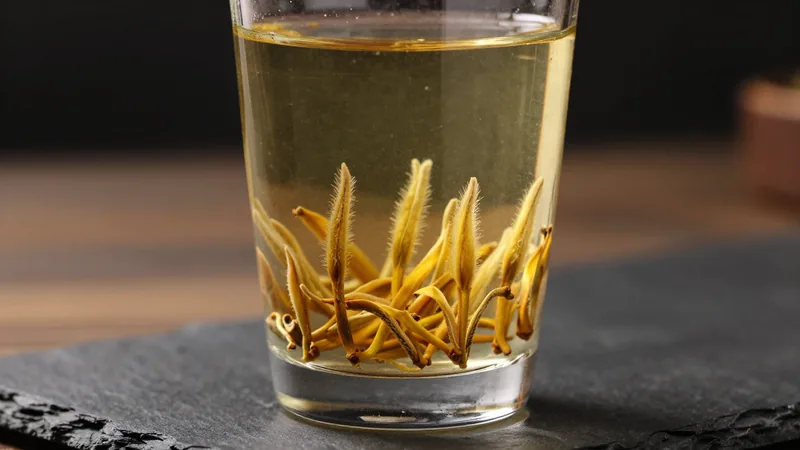
Junshan Yinzhen is a yellow tea from Junshan Island in Dongting Lake, Hunan (zh.wikipedia: 君山银针). Only the first buds are picked, around Qingming. The buds are then wrapped and sealed to yellow (men huang) before final drying. In a glass the buds stand upright (zh.wikipedia).
Tea from around the lake is not supposed to carry the name (Wikipedia: Junshan Yinzhen). Our catalog has one listing, BELLOCQ's, out of stock at $1.02/g. Yellow tea as a category has only 25 priced listings, median $0.46/g.
The oolongs and the black: Da Hong Pao, Tieguanyin, Qimen
Oxidation and roasting for the two oolongs are covered in oolong oxidation explained. This section is origin and price only.
Wuyi Yancha / Da Hong Pao, Fujian. "Rock tea" from the Wuyi Mountains. Growers grade by site: zheng yan from the rocky core is ranked highest, then ban yan from the edges, then zhou cha from fields and streambeds (zh.wikipedia: 武夷岩茶). Da Hong Pao is one of four famous Wuyi bushes, with Tie Luo Han, Bai Ji Guan and Shui Jin Gui (zh.wikipedia). Catalog: 23 listings from 12 vendors, median $0.48/g.
Anxi Tieguanyin, Fujian. Origin is Xiping town in Anxi county. Autumn tea is 40–45% of the year's output and is rated best; spring tea is 15–25% (zh.wikipedia: 安溪铁观音). Excluding Taiwan's Muzha versions, we found 30 listings, median $0.30/g, the cheapest per gram of the oolongs here.
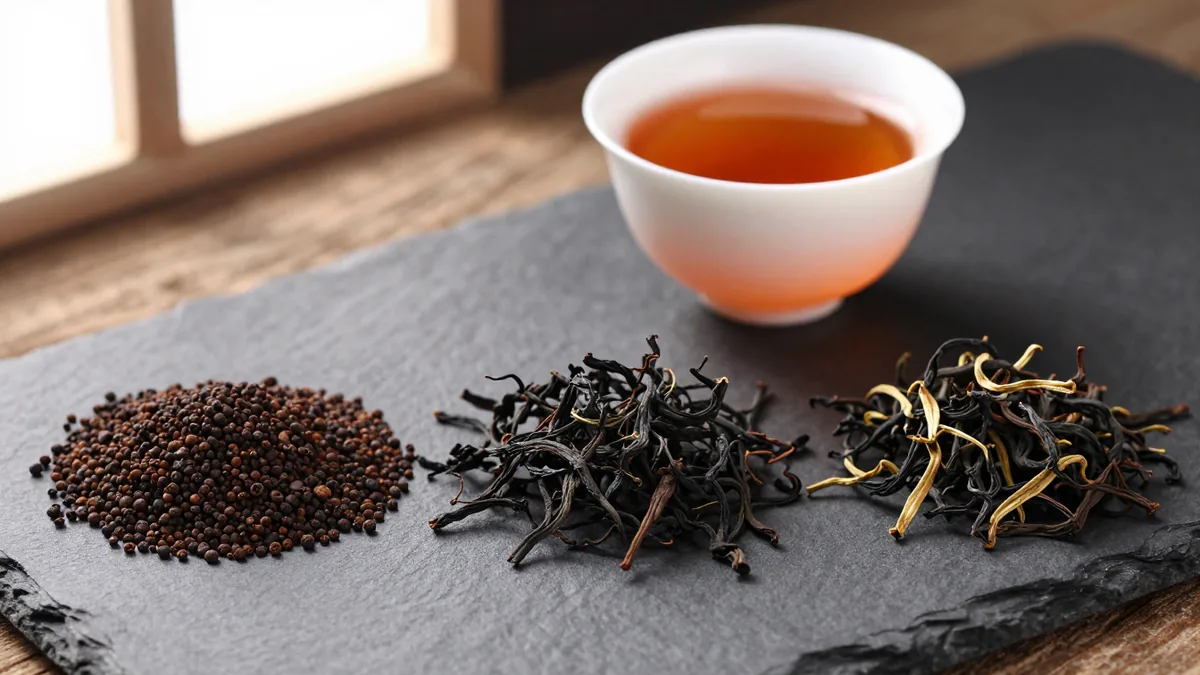
Qimen (Keemun) black, Anhui. The only black tea on the lists, first made in 1875 in Qimen county using methods borrowed from Fujian (Wikipedia: Keemun). Mao Feng is the earlier, lighter grade; Hao Ya is the stronger one (Wikipedia). Catalog median $0.30/g across 17 listings, close to the $0.26/g median for all black tea.
How to buy one without overpaying
- Check the origin, not the name. A Biluochun from Yunnan or a Longjing from outside Zhejiang is a style, not the listed tea. In our catalog, 10 of 12 Biluochun listings come from somewhere else or do not say.
- Pay for place names when they are specific. West Lake-labeled Longjing medians $2.48/g against $0.36/g for the rest.
- Use the harvest date. Mingqian means picked before Qingming on April 5, the premium window for Longjing. Look for a 2026 harvest year on spring greens.
- Do the per-mug math. At 3 g a mug, the Longjing median is $1.41 and the Xi Hu top end is $14.89. Water temperatures for green, yellow, oolong and black are in the steeping chart.
Frequently Asked Questions
Is there an official list of China's ten famous teas?
No. Wikipedia notes that no authoritative list exists. The 1959 list is the most quoted, but lists printed in 1999, 2001 and 2002 differ, and together the four name 15 teas.
Which teas appear on every list?
Xihu Longjing, Dongting Biluochun, Huangshan Maofeng, Lu'an Guapian and Anxi Tieguanyin appear on all four lists we compared, with the 1999 list naming Huangshan Maofeng as Tunxi green and Tieguanyin as Xiping oolong. Xinyang Maojian, Lushan Yunwu and Qimen black appear on three.
Which of the famous teas is the most expensive?
Lu'an Guapian has the highest median, $1.22/g, but on only 3 listings. Among teas with 7 or more listings, Taiping Houkui is highest at $0.65/g. West Lake-labeled Longjing is higher, with a median of $2.48/g across 6 listings and a top price of $4.96/g.
Where can I buy Duyun Maojian or Junshan Yinzhen?
Not from our 40 vendors right now. Duyun Maojian has no listings, and the single Junshan Yinzhen listing was out of stock on October 1, 2026.