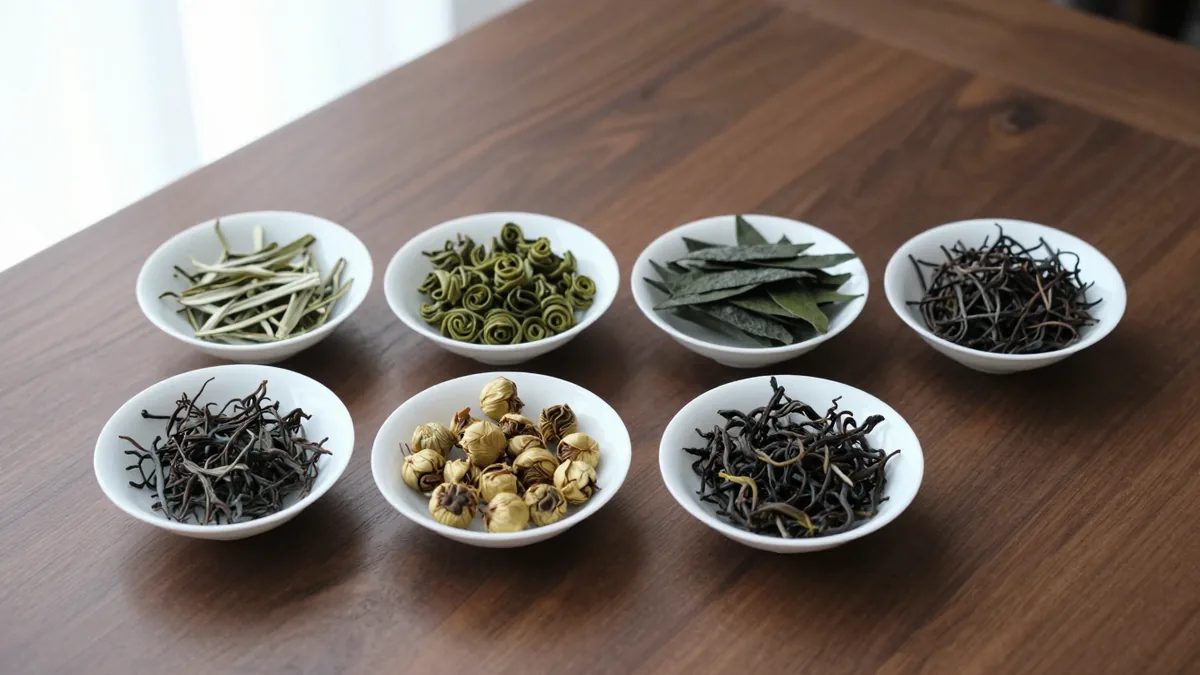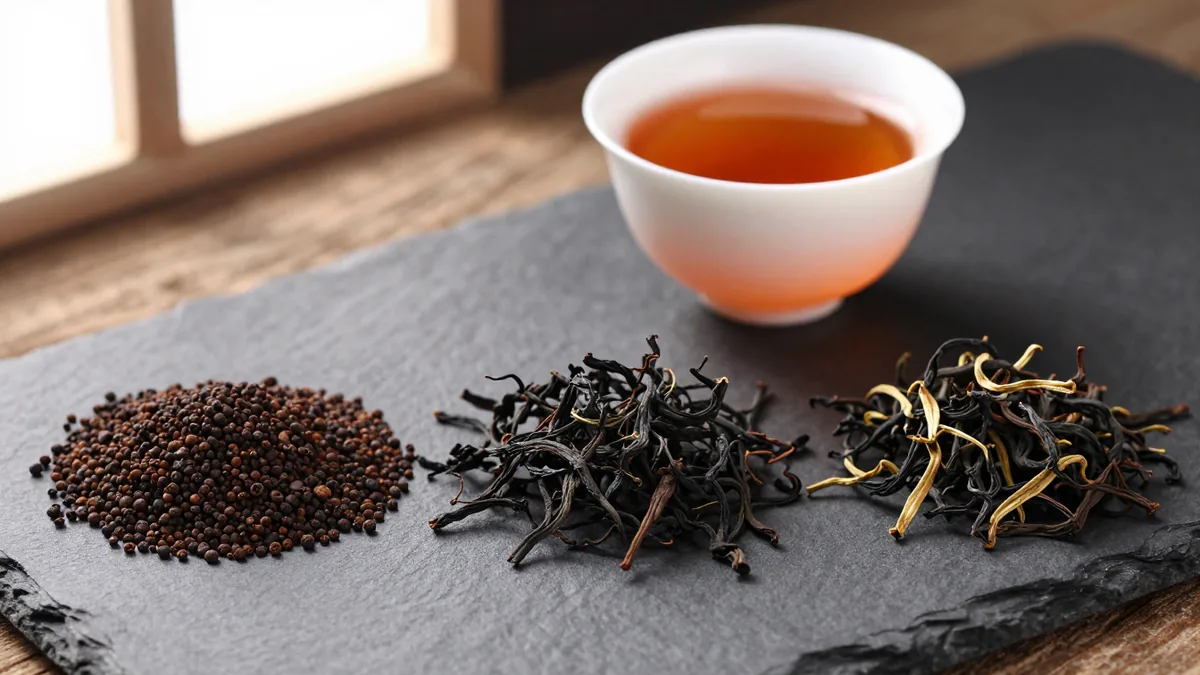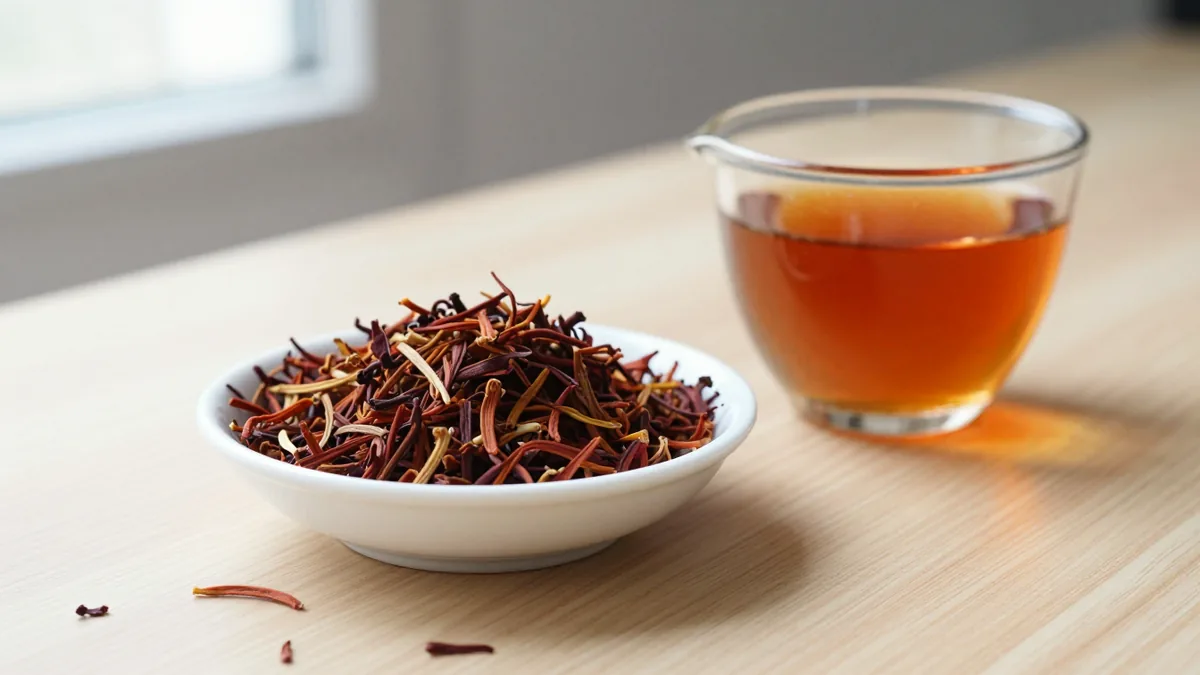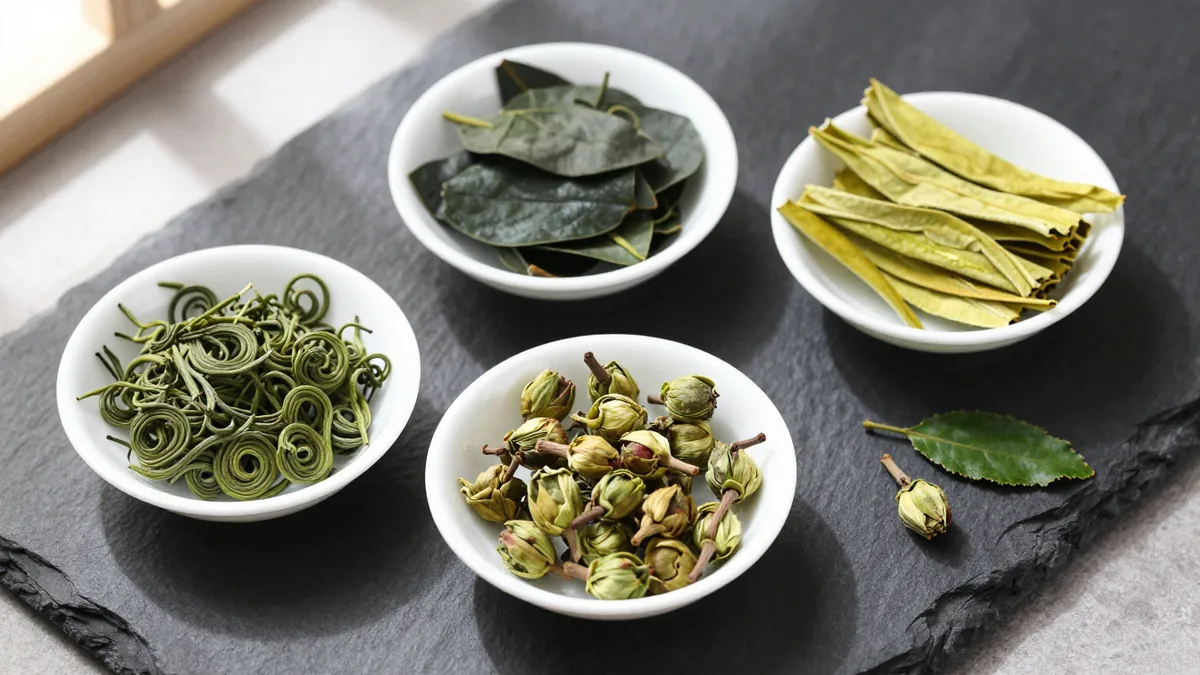
Chinese green teas are split by how the leaf is heated to stop oxidation: pan-fired (chaoqing) teas like Biluochun are fried in an iron pan at about 120°C, while baked (hongqing) teas like Huangshan Maofeng and Anji Bai Cha are dried with hot air. Anji Bai Cha comes from an albino cultivar that, in one 2025 study, carried 2.1 times the theanine of a standard cultivar (9.08 vs 4.25 mg/g). As of October 1, 2026, Chinese green teas in our catalog have a median of $0.35 per gram, and province labels run from $0.18 (Yunnan) to $0.70 (Sichuan).
Our ten famous teas guide gives each tea one paragraph. This article covers how five greens are made and what they cost by origin and harvest label.
Pan-fired, baked, steamed: the kill-green step
Every green tea is heated early to stop the leaf's enzymes from oxidizing it. That step is called shaqing, "kill green." Chinese sources sort green tea into four kinds by how it is done: pan-fired (chaoqing), steamed (zhengqing), baked (hongqing) and sun-dried (shaiqing) (zh.wikipedia: 绿茶).
- Pan-fired. Fresh leaf is tossed in an iron pan at about 120°C until it goes soft enough to shape. Mainland China and Taiwan make mostly pan-fired green tea (zh.wikipedia: 绿茶).
- Steamed. Japan makes its green tea mostly by steaming (zh.wikipedia: 绿茶). Our Japanese green tea guide covers the steamed side.
- Baked. The leaf is still killed with heat, then dried with hot air in stages instead of finished in the pan. Huangshan Maofeng is described in the research literature as "a famous baked green tea" (Zhang et al. 2025, Food Chemistry), and Anhui greens "typically undergo multi-stage baking" (Yu et al. 2026, Food Chemistry: X).
The same 2026 study tasted Lu'an Guapian next to Taiping Houkui and found Lu'an "roasted-floral" while Houkui read as "fresh-floral" with orchid notes (Yu et al. 2026). The authors tie the roasted, fatty side of Lu'an's profile to repeated baking (Yu et al. 2026).
Get origin and garden notes
Where tea is grown, how each region makes it, and the next origin explainer. Free, no spam.
No fixed schedule. Unsubscribe anytime.
The five teas side by side
| Tea | Province | Cultivar | Kill-green and drying | Leaf shape | Catalog listings | Median $/g |
|---|---|---|---|---|---|---|
| Dongting Biluochun | Jiangsu | Local Dongting tea populations | Pan-fired; rolled and dried in the same pan | Tight spiral, downy | 11 (any origin) | $0.31 |
| Huangshan Maofeng | Anhui | Not specified in our sources | Baked | Bud and leaf, slightly flat and curved | 1 | $0.52 |
| Anji Bai Cha | Zhejiang | Baiye No. 1 (albino) | Kill-green, then two bakes | Long, narrow, folded | 5 | $0.74 |
| Lu'an Guapian | Anhui | Several varieties | Two pans, then charcoal roasting | Flat oval single leaf, no bud or stem | 3 | $1.22 |
| Taiping Houkui | Anhui | Shidacha | Oven-dried | Flat, two leaves around a bud | 7 | $0.65 |
Sources: processing and shape from zh.wikipedia: 碧螺春, Plants 2023 (Biluochun populations), Food Chem 2025, zh.wikipedia: 黄山毛峰, IJMS 2023 (Baiye No. 1), zh.wikipedia: 安吉白茶, Wikipedia: Anji bai cha, Food Chem X 2024 (Lu'an), Food Chem X 2026 (Lu'an roasting), Wikipedia: Taiping houkui. Prices: Tea Explorer catalog, 7,306 teas from 40 vendors, fetched 2026-10-01, as of October 1, 2026; listings with at least 20 g and a price per gram, scented teas and samplers excluded. Huangshan Maofeng and Lu'an are thin data: 1 and 3 listings.
Biluochun: fired, rolled and balled in one pan
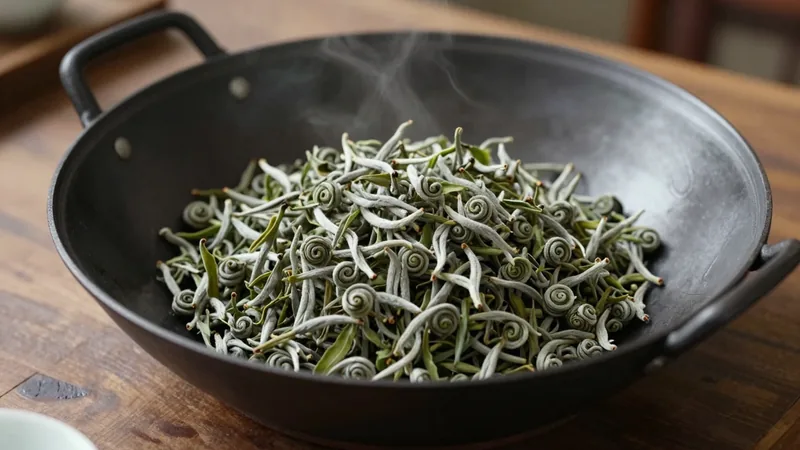
Dongting Biluochun is picked from the spring equinox to Grain Rain, as one bud and one leaf. Pickers work in the morning, sort out poor leaves around midday, and fire the tea in the afternoon and evening (zh.wikipedia: 碧螺春).
The whole make happens in one pan, in three steps: kill-green, fry-and-roll, then rubbing the leaf into balls while it dries (zh.wikipedia: 碧螺春). That last step is the key one: it raises the white down (zh.wikipedia: 碧螺春). English Wikipedia lists seven grades, and the two lowest are called Chao Qing I and II (Wikipedia: Biluochun).
The fruit-tree claim. The Chinese Wikipedia entry credits Biluochun's famous fragrance to tea bushes planted between fruit trees, naming plum and loquat, and to the local red soil (zh.wikipedia: 碧螺春). Treat that as tradition, not a tested result. A 2023 genome study of 95 Dongting tea plants looked at the plants' own genetics for catechins and caffeine; it did not test intercropping (Lei et al. 2023, Plants).
Origin matters for price. Of our 11 Biluochun listings, 3 say Jiangsu (median $0.34/g) and 4 are made in Yunnan (median $0.15/g). The single priciest is a 2026 Dongting lot at $1.56/g. In the broad sense, "Biluochun" means any green tea made with the Biluochun technique, from small-leaf or large-leaf plants (zh.wikipedia: 碧螺春).
Huangshan Maofeng: baked, and graded by the bud
Huangshan Maofeng was first made in 1875 by Xie Zheng'an, a merchant in Fuxi village, Shexian county; he named it for the white down and the pointed bud (zh.wikipedia: 黄山毛峰). The best lots are picked before Qingming, taking only the new bud and the leaf next to it (Wikipedia: Huangshan Maofeng).
"Sparrow tongue" (queshe). The original 1875 batch was shaped "like a sparrow's tongue" (zh.wikipedia: 黄山毛峰), and the Chinese green tea entry uses queshe as the name of the top grade of Huangshan Maofeng (zh.wikipedia: 绿茶).
The 2025 aroma study describes its flavor as "clean and fresh" and found that hexanal, cis-3-hexenyl butyrate and geraniol rose with the grade of the tea (Zhang et al. 2025). Our catalog has 1 listing, at $0.52/g.
Anji Bai Cha: a green tea from a white-leaf plant
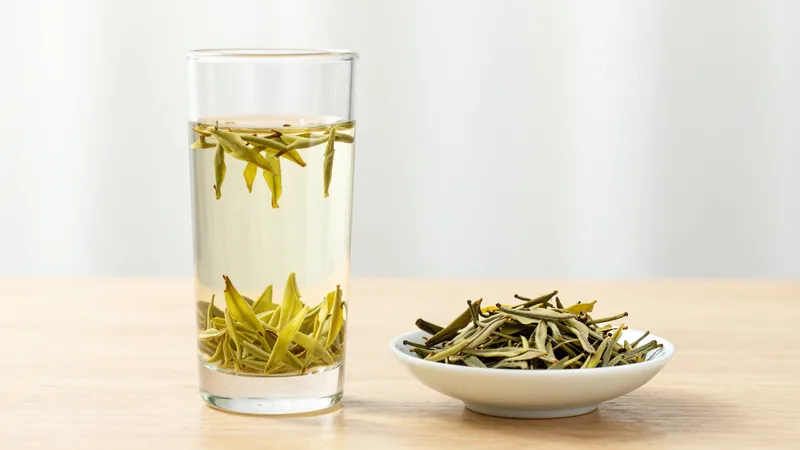
Anji Bai Cha is a green tea. The "white" is the leaf color in the field. It is made from Baiye No. 1, a cultivar "often referred to as Anji Baicha or White Leaf No. 1," whose new shoots turn white when spring temperatures stay below 20°C (Xu et al. 2023, IJMS). As the weather warms, the leaves turn green again (Wikipedia: Anji bai cha).
The picking window is about 30 days, usually April 15 to May 15, and the leaf is spread, killed, cooled and baked twice (zh.wikipedia: 安吉白茶). Anji Bai Cha became a Chinese geographical-indication product on April 6, 2004 (zh.wikipedia: 安吉白茶).
Amino acids and theanine. Whiter leaves have more amino acids (Zeng et al. 2019, J Food Sci). A 2025 study grew Baiye No. 1 and the standard cultivar Fudingdabai in the same Guizhou garden and processed both the same way (Li et al. 2025, Food Chemistry: X):
| Compound (mg per g dry leaf) | Baiye No. 1 | Fudingdabai | Ratio |
|---|---|---|---|
| Total amino acids | 17.13 | 11.13 | 1.54x |
| L-theanine | 9.08 | 4.25 | 2.14x |
| Caffeine | 30.09 | 32.22 | 0.93x |
Source: Li et al. 2025, Food Chemistry: X. The samples were processed as white tea, not green, so read the ratios, not the absolute numbers. At 3 g of leaf, that is about 27.2 mg of theanine in the leaf against 12.8 mg; how much ends up in the cup depends on steeping. Our L-theanine article covers what those doses do.
Anji vs elsewhere. All 5 Anji Bai Cha listings in the catalog say Zhejiang. Prices run $0.29–$1.60 per gram, median $0.74, from Yunnan Sourcing at $0.29 to a Tea Habitat first pick at $1.60. The cultivar itself is planted well outside Anji; the 2025 study sourced it from Guizhou (Li et al. 2025).
Lu'an Guapian: one leaf, no bud, three fires
Lu'an Guapian is the odd one out. "Unlike other green teas that include both harvested buds and leaves," it is made from a single leaf (Food Chem X 2024). Stems and buds are discarded (Zhang et al. 2022, Foods).
Picking. In mid-April, when a shoot carries a bud and four to five leaves, pickers take the leaves and leave the bud and two leaves on the bush to keep growing (Zhang et al. 2022). For scale, stems make up about 35% of normally plucked tea, and most Chinese teas process leaf and stem together (Zhang et al. 2022).
Firing. One study's traditional method: a pan at 110–120°C for 85–100 seconds, straight into a second pan at 90–100°C for 90–100 seconds, then drying (Food Chem X 2024). The full traditional finish adds three roasts (Food Chem X 2026):
- "Gross fire" at 70–90°C to make raw tea.
- A day later, "light fire" at 80–100°C over smoldering charcoal.
- After 3–5 days of rest, "high fire" at about 300°C: two workers lift a bamboo roaster over charcoal 120–180 times for about 1.5 hours, until moisture is below 6%.
The same paper cites earlier work showing high-fire roasting raised γ-hexalactone and 2- and 3-methylbutanal (Food Chem X 2026). Our 3 listings run from Yunnan Sourcing at $0.21/g to Tea Drunk at $2.14/g.
Taiping Houkui, briefly. Two flat leaves clasp a downy bud, shoots run up to 15 cm, and the leaf is oven-made from the Shidacha variety (Wikipedia: Taiping houkui). Catalog median $0.65/g across 7 listings.
Mingqian and Yuqian: what the harvest label is worth
Qingming usually starts April 4 or 5 (Wikipedia: Qingming)); Guyu, "Grain Rain," starts around April 20 (Wikipedia: Guyu)). Tea picked before Qingming is Mingqian; tea picked before Guyu is Yuqian (zh.wikipedia: 绿茶).
Most vendors do not tag harvest timing, so we compared inside one shop that does. Jing Tea Shop tags 10 of its 19 Chinese greens Mingqian or Qingming. Their median is $0.52/g against $0.41/g for its other 9 greens, 1.27 times as much. Different teas sit in each group, so read this as a rough premium, not a controlled test.
What Chinese greens cost by province
| Province (catalog label) | Listings | Vendors | Median $/g | Per 3 g mug |
|---|---|---|---|---|
| Sichuan | 11 | 5 | $0.70 | $2.10 |
| Anhui | 22 | 8 | $0.50 | $1.50 |
| Zhejiang | 35 | 16 | $0.40 | $1.20 |
| Jiangsu | 3 | 3 | $0.34 | $1.02 |
| Fujian | 6 | 6 | $0.32 | $0.96 |
| Yunnan | 32 | 7 | $0.18 | $0.54 |
Source: Tea Explorer catalog, 7,306 teas from 40 vendors, fetched 2026-10-01, as of October 1, 2026. Rows are Chinese green teas with at least 20 g and a price per gram; scented teas and samplers excluded. All 156 Chinese greens have a median of $0.35/g.
Sichuan tops the table at $0.70/g across 11 listings; Yunnan is cheapest at $0.18/g across 32. Anhui's 22 listings include 7 Taiping Houkui. Price an order in the tea cost calculator.
Frequently Asked Questions
Is Anji Bai Cha a white tea?
No. It is a green tea made from Baiye No. 1, an albino cultivar whose spring shoots turn white below about 20°C. In a 2025 study the cultivar had 17.13 mg/g of amino acids against 11.13 mg/g for a standard cultivar, and theanine is the amino acid linked to tea's umami taste.
What is the difference between pan-fired and baked green tea?
Pan-fired (chaoqing) tea is killed and shaped in an iron pan at about 120°C, as with Biluochun. Baked (hongqing) tea is dried with hot air in stages, as with Huangshan Maofeng and Anji Bai Cha. Lu'an Guapian uses pans first and then three charcoal roasts, the last at about 300°C.
Why does Lu'an Guapian have no buds?
It is made from single leaves only. In mid-April pickers take leaves from shoots carrying a bud and four to five leaves, and the stems and buds are discarded. Most other Chinese greens use bud-and-leaf sets.
Is Biluochun from Yunnan the real thing?
It is Biluochun in the broad sense: any green tea made with the Biluochun technique. Dongting Biluochun is the narrow, original sense. In our catalog, Jiangsu-labeled Biluochun has a median of $0.34/g and Yunnan-made Biluochun $0.15/g, as of October 1, 2026.
What does Mingqian mean on a label?
Picked before Qingming, which usually starts April 4 or 5. At Jing Tea Shop, Mingqian-tagged greens have a median of $0.52/g against $0.41/g for its other Chinese greens.