Rooibos (Aspalathus linearis) grows naturally only in South Africa's Cederberg region and has been an EU Protected Designation of Origin since May 2021. Honeybush is a different plant genus, Cyclopia, with 23 known species, and most of it is still harvested from the wild. Both are caffeine-free. Green (unfermented) rooibos brewed in one study with 12 times the aspalathin of the usual red rooibos, 79.5 vs 6.6 mg/L. In the Tea Explorer catalog, 7,306 teas from 40 vendors, fetched 2026-10-01, plain rooibos has a median price of $0.11 per gram, about $0.26 for a 2.5 g cup.
What rooibos is and where it grows
Rooibos is a fynbos shrub, Aspalathus linearis, not a tea plant. The SA Rooibos Council says the Cederberg region north-west of Cape Town is "the only place in the world where Rooibos grows naturally." Its producing towns are Clanwilliam, Graafwater, Citrusdal, Van Rhynsdorp, Nieuwoudtville and Wupperthal.
The name is now legally tied to that place. Rooibos was entered on the EU register as a Protected Designation of Origin in May 2021, so only rooibos grown and processed in the defined area can be sold as "Rooibos" in the EU (SA Rooibos Council). A paper in Plants by Hussein et al. describes it as the first African food to get that protection (Hussein et al., Plants).
The industry numbers, all from the SA Rooibos Council:
- Production: about 22,600 tons in 2023. At the industry's 2.5 g one-cup serving, that is roughly 9 billion cups.
- Jobs: about 8,000 workers in farming and processing.
- Exports: more than 50 countries. Japan, France, Germany, the Netherlands and the UK were the largest buyers in 2023.
- Home market: South Africans drink about half of a typical 20,000-tonne year (SARC FAQ).
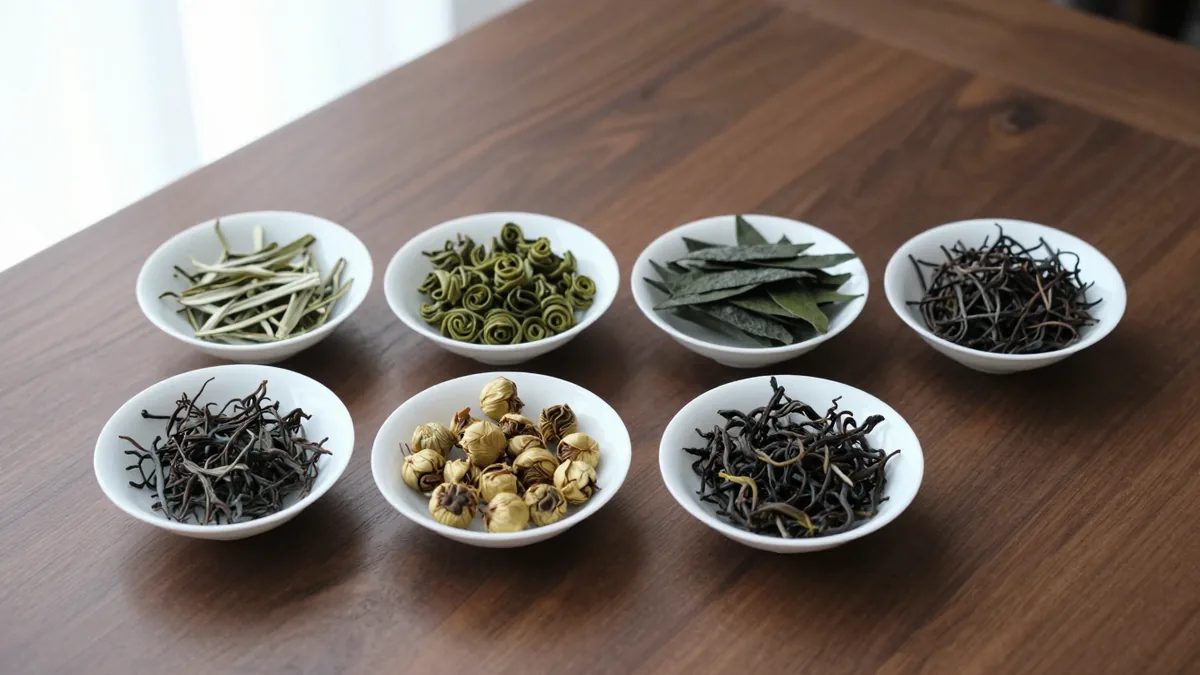
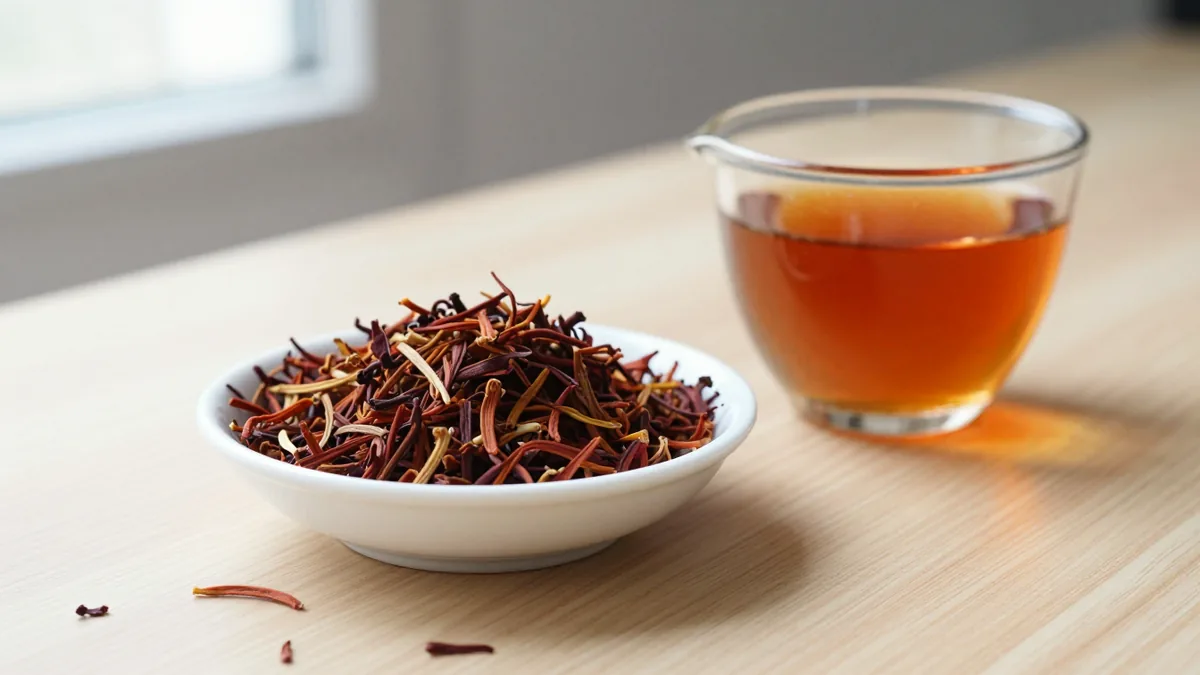
Farming is slow. A field is first cut about 18 months after planting, the shrubs are cut back to about 30 cm each summer, and the planting is replaced after three to five harvests. The cut shoots are chopped to under 4 mm, which is why rooibos looks like short red needles (SARC FAQ).
Get origin and garden notes
Where tea is grown, how each region makes it, and the next origin explainer. Free, no spam.
No fixed schedule. Unsubscribe anytime.
Red vs green rooibos: one processing step apart
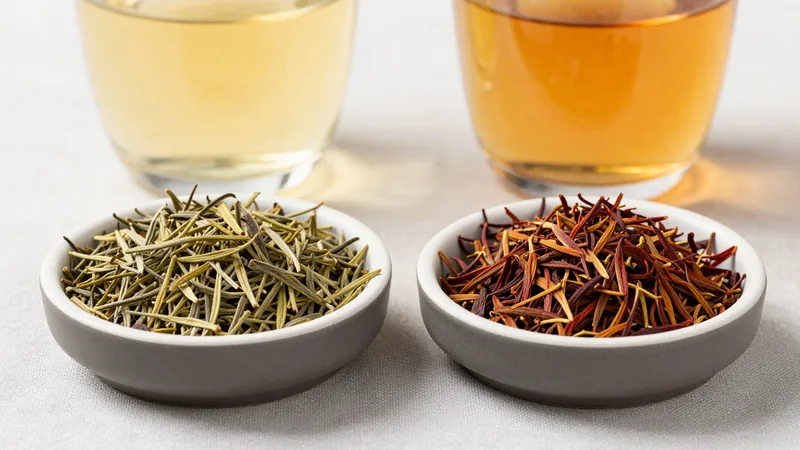
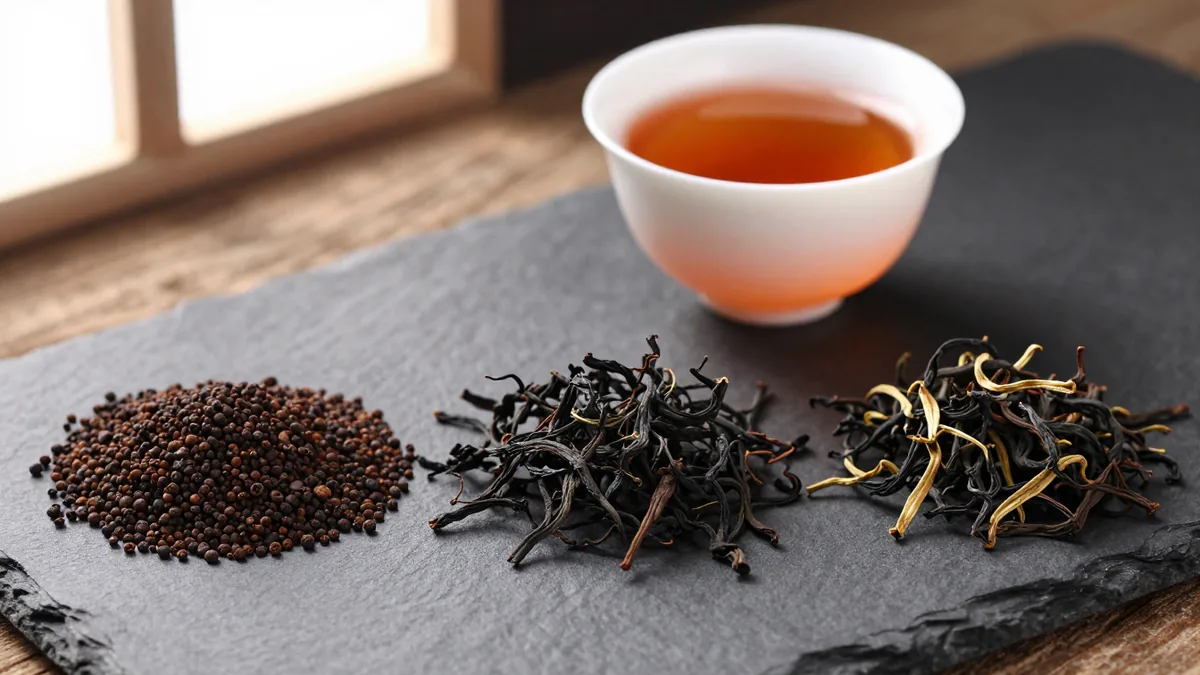
Red and green rooibos come from the same plant. For traditional (red) rooibos, the chopped shoots are bruised and left in heaps to oxidise, then sun-dried. For green rooibos, the shoots are dried straight away to stop oxidation (SARC FAQ). Both are steam pasteurised before packing.
The rooibos trade calls the oxidation step "fermentation", but no microbes are involved. Experiments with heat-treated leaf, its enzymes inactivated at 170 °C, showed the plant's own enzymes drive the reaction, which breaks down the two signature dihydrochalcones, aspalathin and nothofagin (De Beer et al., 2019). By the end, aspalathin and its relatives fall to under 10% of their starting level (Hussein et al., Plants). Oxidised aspalathin is what produces the red-brown colour (Heinrich et al., 2012).
The cup shows the difference. A 2019 study brewed 12 production batches of each type at 2.5 g per 200 ml (Damiani et al., 2019, Antioxidants):
| Measure (regular brew, boiling water, 5 min) | Green rooibos | Red rooibos |
|---|---|---|
| Aspalathin, mg/L (luteolin equivalents) | 79.5 | 6.6 |
| Total polyphenols, mg GAE/L | 508.7 | 387.9 |
| Flavour | grassy | sweet, honey, woody |
Source: Damiani et al., 2019. Aspalathin ratio 79.5 / 6.6 = 12.0.
The same study describes red rooibos as "slightly sweet" with "honey, woody and herbal-floral notes" and green rooibos as mostly grassy. The council says green rooibos tastes "reminiscent of green tea" and that most of it is exported (SARC FAQ). Supply is small: a 2018 review of aspalathin research names "the limited supply of green rooibos" as a constraint (Johnson et al., 2018). None of the rooibos listings in our catalog is sold as green rooibos.
Honeybush: a different plant, mostly picked wild
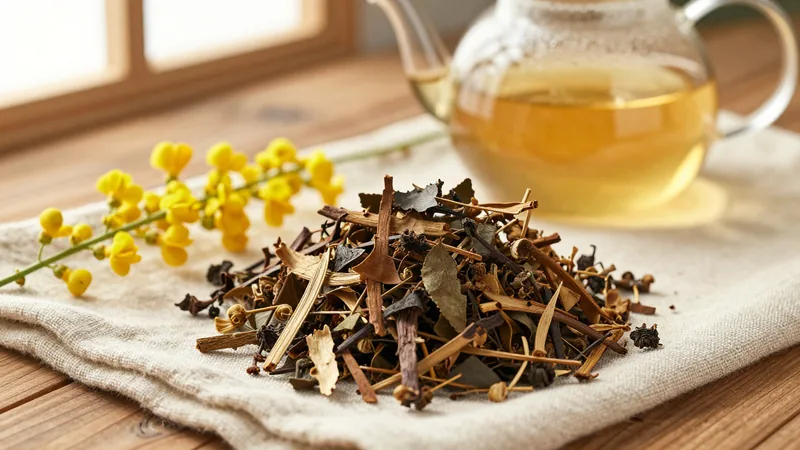
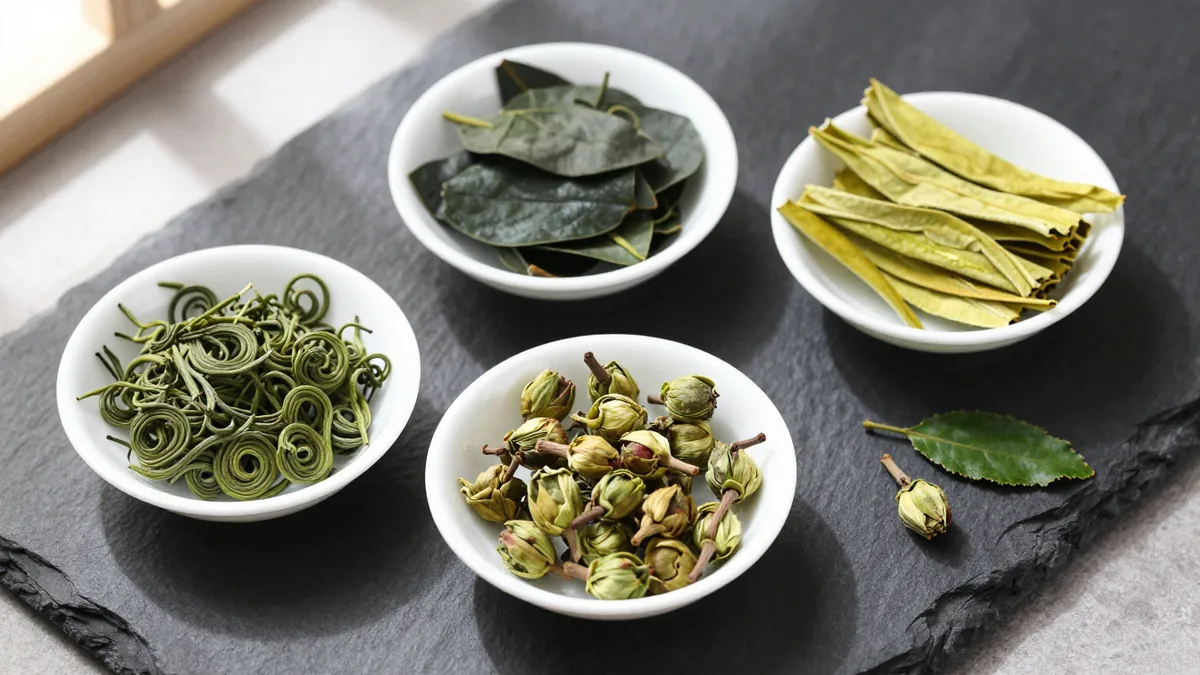
Honeybush is the common name for Cyclopia, a legume genus with 23 known species (Stander et al., 2019). It grows from the Cederberg north of Citrusdal south to the Cape Peninsula and east to Port Elizabeth (Gqeberha) in the Eastern Cape (Ajuwon et al., 2018). So the two plants overlap at one end of honeybush's range, but honeybush runs much farther east.
Supply is the big difference. The honeybush industry "relies on raw material sourced predominantly from wild populations", and an estimated 85% of wild-harvested honeybush is one species, C. intermedia (Galuszynski & Potts, 2020). Wild supply cannot keep up with demand, so growers are moving it into fields in the Western and Eastern Cape (Galuszynski, 2021).
You can see both models in the shop listings. Harney & Sons says its honeybush is collected by hand "from uncultivated bushes rather than managed gardens" (Harney & Sons). Rare Tea Company's honeybush is cultivated at Friemersheim in the Western Cape (Rare Tea Company).
The chemistry differs too. Rooibos is defined by aspalathin, orientin and isoorientin. Honeybush carries the xanthones mangiferin and isomangiferin plus the flavanones eriocitrin, narirutin and hesperidin (Joubert et al., 2009).
Rooibos vs honeybush at a glance
| Rooibos | Honeybush | |
|---|---|---|
| Plant | Aspalathus linearis, one species | Cyclopia, 23 known species |
| Where it grows | Cederberg region, Western Cape | Cederberg to Cape Peninsula and Eastern Cape |
| Supply | Farmed; about 22,600 t in 2023 | Mostly wild-harvested; 85% of wild harvest is C. intermedia |
| Signature compounds | Aspalathin, nothofagin, orientin | Mangiferin, hesperidin, eriocitrin |
| Caffeine | None | None |
| Tannin | About 3.2–4.4% | "Very low" |
| EU protected origin | PDO since May 2021 | No registration found |
| Catalog median (as of October 1, 2026) | $0.11/g plain (5 listings) | $0.21/g (2 listings) |
Sources: SARC, Stander et al., Galuszynski & Potts, Joubert et al., Ajuwon et al., Tea Explorer catalog, 7,306 teas from 40 vendors, fetched 2026-10-01.
How to brew rooibos and honeybush
Use boiling or near-boiling water and steep about 5 minutes. Neither plant has caffeine, and rooibos has only about 3.2–4.4% tannin (Ajuwon et al., 2018).
| Source | Leaf | Water | Steep |
|---|---|---|---|
| Rooibos industry one-cup serving | 2.5 g | 200 ml | not set |
| Rishi, Rooibos | 1 tbsp | 8 oz (237 ml), 195 °F | 5–7 min |
| Harney & Sons, Pure Wild Honeybush | not stated | 212 °F | 5 min |
| Rare Tea Company, Honeybush | 2.5 g | 150 ml, 100 °C | 90 s–3 min, at least 2 infusions |
Industry serving: Damiani et al., 2019.
The Damiani study also tested how brewing method changes what ends up in the cup. "Regular" is boiling water poured over the leaf and left 5 minutes. "Cold" is room-temperature water, then 8 hours in the fridge. "Boiled" is 5 minutes of actual boiling.
| Total polyphenols, mg GAE/L | Cold, 8 h | Regular, 5 min | Boiled, 5 min |
|---|---|---|---|
| Green rooibos | 614.1 | 508.7 | 1,019.0 |
| Red rooibos | 265.4 | 387.9 | 692.4 |
Source: Damiani et al., 2019.
Three practical points from those numbers:
- Simmering doubles extraction. Boiling for 5 minutes gave 2.0 times the polyphenols of a regular brew for green rooibos and 1.8 times for red.
- Cold brew holds up for green rooibos, not red. Cold green rooibos beat the hot regular brew (614.1 vs 508.7). Cold red rooibos came in 32% lower than hot.
- Dose by weight. 2.5 g per 200 ml is about 1.25 g per 100 ml, close to a Western black-tea mug. For other ratios see how many grams of tea per cup and the tea ratio calculator.
What rooibos and honeybush cost
As of October 1, 2026, our catalog (Tea Explorer catalog, 7,306 teas from 40 vendors, fetched 2026-10-01) has 48 rooibos-type rows, 30 of them with a weight of at least 20 g and a price per gram. Their median is $0.16/g. Split by product:
- Plain rooibos: 6 listings, median $0.11/g (5 priced), from $0.10/g to $0.14/g.
- Flavoured rooibos blends: 40 listings, median $0.21/g (23 priced).
- Honeybush: 2 listings, median $0.21/g (2 priced).
- Rooibos chai: 11 more listings are classed as chai.
At 2.5 g a cup, plain rooibos works out to $0.26, against $0.65 for the catalog's median black tea ($0.26/g, 824 listings). Flavouring is where the money goes: the median blend costs 1.9 times plain rooibos per gram.
| Type | Listing | Grams | Price | $/g | Per 2.5 g cup |
|---|---|---|---|---|---|
| Rooibos | Harney & Sons Fine Teas: Organic Rooibos | 113.4 | $11.00 | $0.10 | $0.24 |
| Rooibos | Golden Moon Tea: Organic Rooibos | 70.9 | $6.99 | $0.10 | $0.25 |
| Rooibos | Rishi Tea & Botanicals: Rooibos | 113.4 | $12.00 | $0.11 | $0.26 |
| Rooibos | The Steeping Room: Organic Rooibos from South Africa | 113.4 | $12.80 | $0.11 | $0.28 |
| Rooibos | BELLOCQ: No. 02, Rooibos | 114 | $16.00 | $0.14 | $0.35 |
| Honeybush | Harney & Sons Fine Teas: Pure Wild Honeybush | 113.4 | $11.50 | $0.10 | $0.25 |
| Honeybush | Rare Tea Company: South African Honeybush | 75 | $23.91 | $0.32 | $0.80 |
Source: Tea Explorer catalog, 7,306 teas from 40 vendors, fetched 2026-10-01, as of October 1, 2026. Listings of 20 g or more with a weight; per-cup cost at 2.5 g. For your own dose and price, use the tea cost calculator.
What the health research shows
Less than the marketing suggests. A 2023 scoping review of rooibos trials in people found 18 publications with 488 participants in total, and noted that most of what is known "originates from animal and cell culture studies" (Afrifa et al., 2023, J Public Health Afr). The human studies reported better lipid profiles, antioxidant status and blood glucose, but with small samples and doses from 200 to 1,200 ml.
Aspalathin itself is poorly absorbed, and a 2018 review flags possible interactions with some prescription drugs for blood sugar and cholesterol (Johnson et al., 2018). If you take those medicines and plan to drink green rooibos or extracts daily, ask your doctor. For a plain caffeine-free evening cup, the facts that matter are simpler: no caffeine, no kilojoules and 7.6 mg of sodium per 200 ml serving (SARC).
If you are choosing a first loose-leaf tea and want caffeine, see best tea for beginners.
Frequently Asked Questions
Does rooibos or honeybush contain caffeine?
No. The SA Rooibos Council lists rooibos as naturally caffeine free, and honeybush is caffeine-free as well. Both work as an evening cup. A 2.5 g, 200 ml serving of rooibos also has 0 kJ and 7.6 mg sodium.
Is green rooibos healthier than red rooibos?
Green rooibos keeps more aspalathin: 79.5 vs 6.6 mg/L in one 2019 study, about 12 times more. Fermentation cuts aspalathin to under 10% of its starting level. Whether that changes health outcomes in people is not established; the human evidence covers 18 publications and 488 participants.
Where does rooibos come from?
Only South Africa's Cederberg region, north-west of Cape Town. Since May 2021, "Rooibos" has been an EU Protected Designation of Origin, so only rooibos grown and processed there can carry the name in the EU. Production was about 22,600 tons in 2023.
How long should I steep rooibos?
Use boiling or near-boiling water and steep 5–7 minutes at about 2.5 g per 200 ml. Simmering for 5 minutes roughly doubled the polyphenols in one study. Honeybush takes 90 seconds to 5 minutes at boiling, depending on the seller.
How much does rooibos cost per cup?
As of October 1, 2026, plain rooibos in our catalog has a median of $0.11 per gram, or $0.26 for a 2.5 g cup. Flavoured rooibos blends have a median of $0.21 per gram.