All Japanese green teas start as steamed leaf. The differences are shade, steaming time and what happens after drying: sencha gets full sun, kabusecha about 7 days of cover, gyokuro about 20 days, and hojicha is roasted over strong heat. Sencha was 48.1% of Japan's 2025 output and gyokuro 1.0%. In our catalog, the median in-stock sencha costs $0.30 per gram and the median gyokuro $0.80, as of October 1, 2026.
Japan's tea industry has a written naming standard. The Japan Tea Central Association's labeling definitions set out what each name means, and this guide follows them. For matcha and its grades, see our matcha grades guide. For fixing a bitter cup, see why green tea tastes bitter.
Japanese Green Tea Types at a Glance
Brewing settings below come from the Ministry of Agriculture, Forestry and Fisheries (MAFF) brewing manual unless a cell says otherwise. Prices are per gram, in-stock loose leaf only, from the Tea Explorer catalog, 7,306 teas from 40 vendors, fetched 2026-10-01.
| Type | Shade before harvest | Processing | Water and time | Median $/g | Teas |
|---|---|---|---|---|---|
| Sencha | None | Steamed, rolled, dried | 70 °C (high grade) or 90 °C, 1 min 30 s | $0.30 | 53 |
| Fukamushi sencha | None | Steamed 2× as long or more | Same temperature, 30 s | in sencha | – |
| Kabusecha | About 7 days | Made like sencha | 175 °F (79 °C), 1 min (Kettl) | $0.64 | 3 |
| Gyokuro | About 20 days | Made like sencha | 50–60 °C, 2 min 30 s | $0.80 | 19 |
| Hojicha | None | Sencha or bancha roasted over strong heat | Boiling, 30 s | $0.29 | 17 |
| Genmaicha | None | Sencha or bancha plus roasted rice | Boiling, 30 s | $0.17 | 17 |
| Bancha | None | Hard, mature or between-season leaf | Boiling, 30 s | $0.10 | 4 |
| Kukicha | None | Stems sorted out during finishing | 185 °F (85 °C), 1 min (Rishi) | $0.20 | 8 |
| Tamaryokucha | None | Steamed or pan-fired, no final shaping roll | 70 °C or 90 °C, 1 min 30 s | not enough listings | – |
Sources: JTCA definitions, MAFF brewing manual, Tea Explorer catalog, as of October 1, 2026. Kabusecha has only 3 in-stock listings; including sold-out listings, 9 kabusecha teas have a median of $0.49 per gram.
Get the tea newsletter
New tea rooms, brewing notes, and tea worth trying. Free, no spam.
No fixed schedule. Unsubscribe anytime.
Sencha: Steaming Time Sets the Style
Sencha is the default. The JTCA defines it as leaf that is steamed, rolled and dried, with no shading step. MAFF's 2026 industry report puts it at 48.1% of Japan's 2025 crude tea (aracha) output.
The first variable is how long the fresh leaf is steamed. The JTCA defines fukamushi (deep-steamed) sencha as leaf steamed for at least twice the time of regular sencha. MAFF's manual says 2–3 times longer. One Canadian importer lists typical times as:
- Asamushi (light steam): 20–40 seconds
- Chumushi (medium): 40–80 seconds
- Fukamushi (deep): 80–200 seconds
Longer steaming breaks the leaf into smaller pieces. That is why MAFF cuts the fukamushi steep to 30 seconds, against 1 minute 30 seconds for regular sencha, and suggests pouring fast because of the fine particles. Its leaf rate for fukamushi is about 2 g per 60 mL, a little stronger than the 2–3 g per 100 mL it gives for sencha.
MAFF splits sencha by grade, not by steaming: 70 °C for high-quality sencha and 90 °C for middle grade. Each second steep uses slightly hotter water for about half the time: 45 seconds for sencha, 20 seconds for fukamushi.
Shade: Kabusecha and Gyokuro
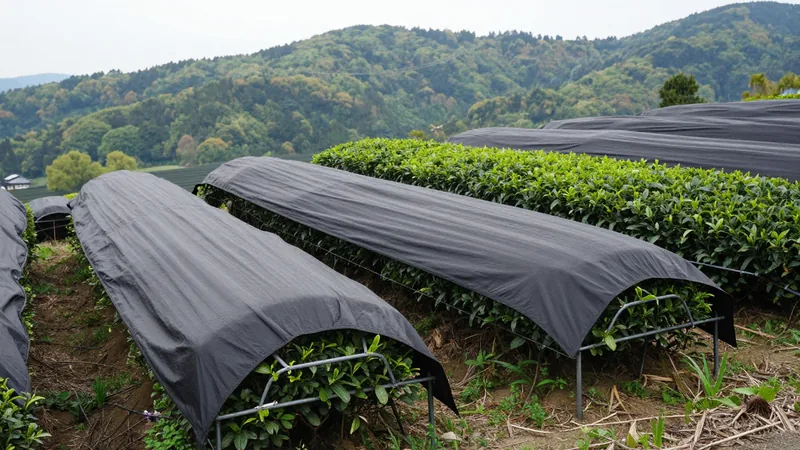
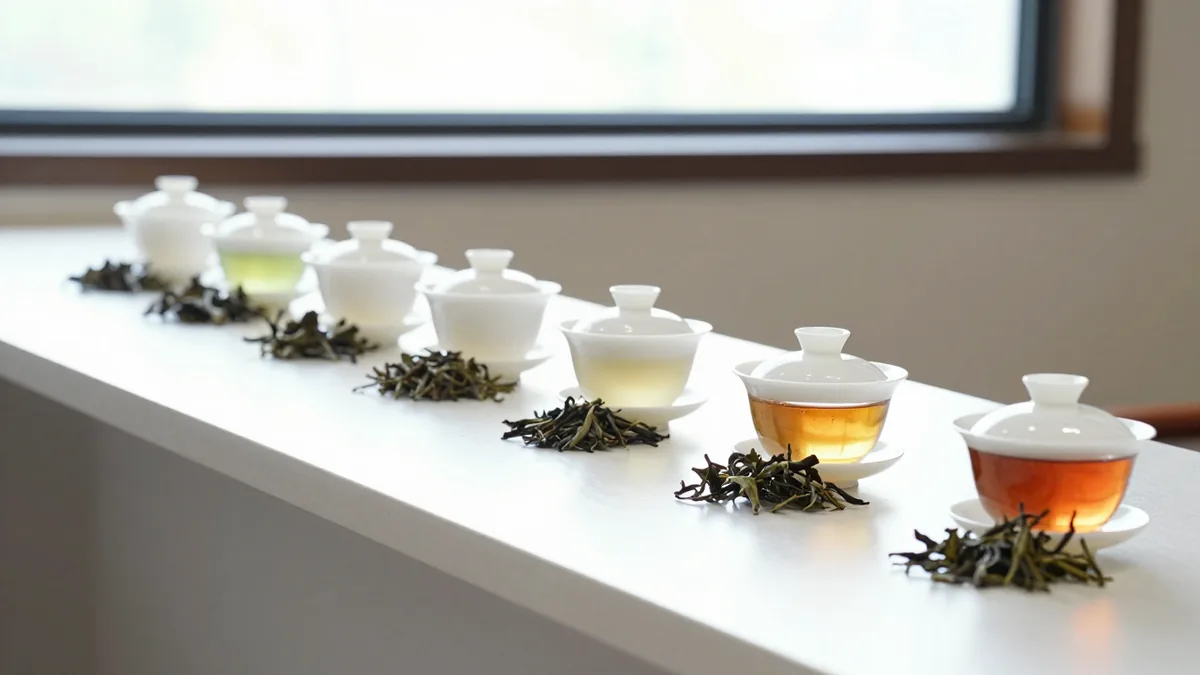
Shading is the only thing that separates sencha, kabusecha and gyokuro in the JTCA definitions. All three are processed the same way after picking.
- Kabusecha: covered with straw or shade cloth for about 7 days before picking.
- Gyokuro: covered for about 20 days, from when the first-flush buds start to grow, until sunlight is almost completely blocked.
Real practice runs longer than the JTCA's 7 days for kabusecha. The Global Japanese Tea Association says growers shade it for 10 to 20 days, with the cloth laid directly on the bushes, while gyokuro and tencha go under a raised frame. Kettl's Ayame kabuse sencha from Yame is shaded for ten days.
Both shaded teas are small. In 2025, gyokuro was 1.0% of Japan's crude tea output and kabusecha 2.0%. Mie leads kabusecha and gyokuro production, Kyoto is second in gyokuro, and Fukuoka is third.
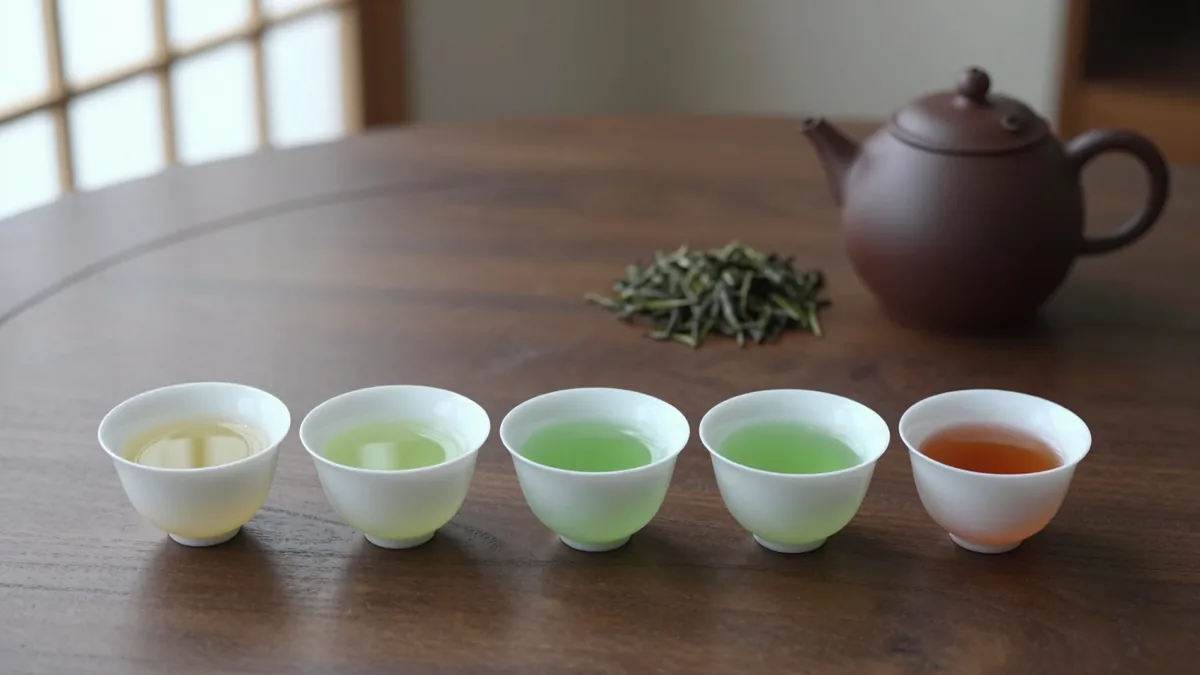
Gyokuro gets the coolest water of any Japanese tea. MAFF's method is 10 g of leaf for 3 people, water at 50–60 °C, steeped 150 seconds, served in 40 mL cups from a 90 mL pot. The low temperature pulls out the umami from theanine while holding back bitterness. Kabusecha sits between the two: Kettl brews its kabusecha with 5–6 g in 180 mL at 175 °F for 1 minute.
Farm prices follow the shade. MAFF's 2025 average crude-tea prices were ¥3,699/kg for gyokuro, ¥2,387/kg for kabusecha and ¥1,746/kg for sencha. That puts gyokuro at 2.1× the price of sencha at the farm gate, and kabusecha at 1.4×.
Roasted and Blended: Hojicha, Genmaicha, Bancha, Kukicha
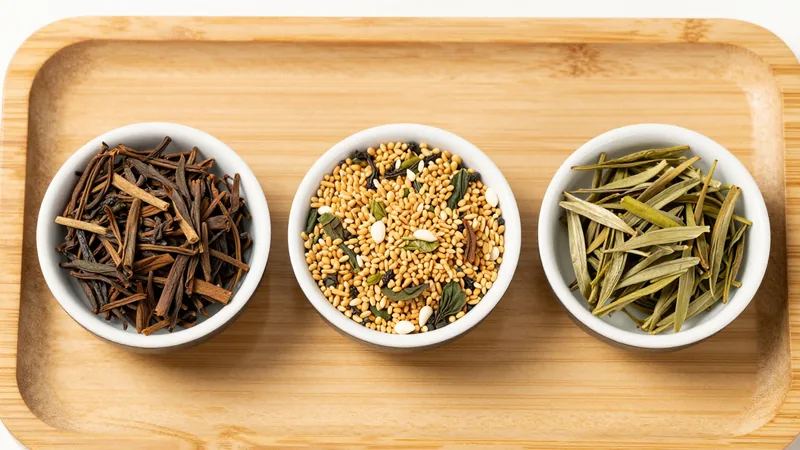
These four are built from cheaper leaf or byproducts, and three of them take boiling water. The JTCA definitions:
- Bancha: made from leaf that has grown hard, old leaf and stems, or leaf picked between the main harvests.
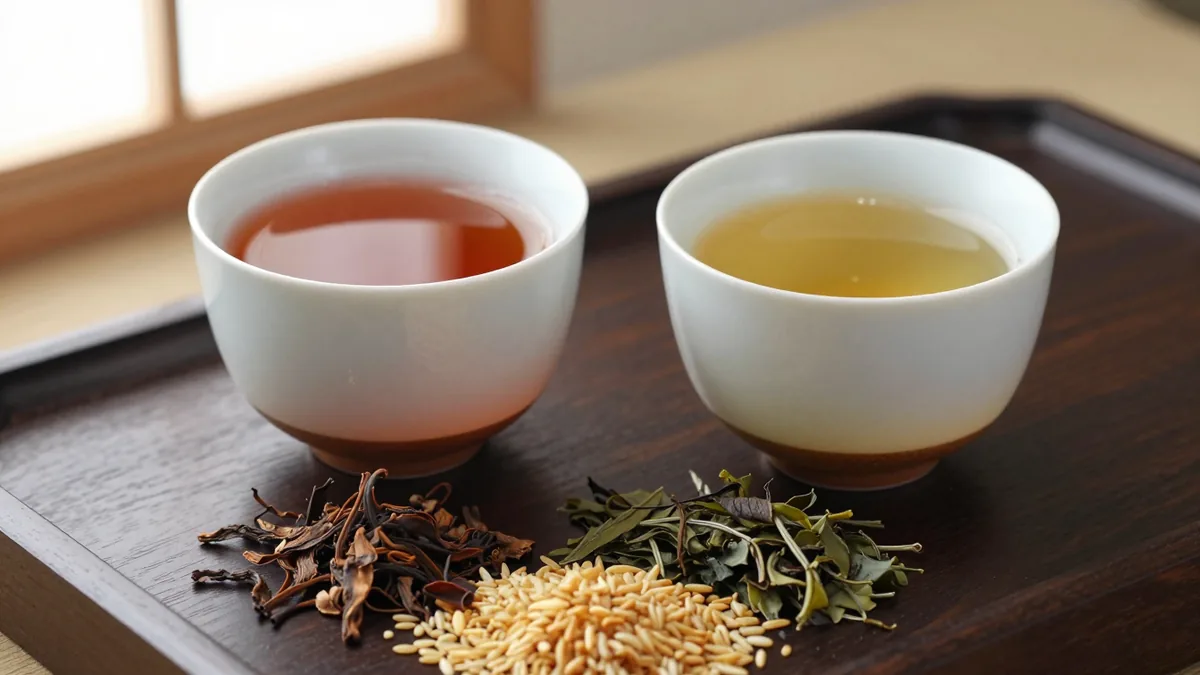
- Hojicha: sencha or bancha roasted over strong heat. Roasting turns the leaf brown and the cup reddish.
- Genmaicha: sencha or bancha with roasted rice added.
- Kukicha (stem tea): stems and leaf stalks sorted out during finishing.
MAFF treats bancha, hojicha and genmaicha as one brewing group. It uses 2–3 g per 100 mL, boiling water and a 30-second steep. The second steep gets boiling water and is poured straight out with no wait. MAFF's reason: these teas are drunk for roasted or rice aroma, and boiling water extracts the most of it.
Green kukicha is closer to sencha. Rishi brews its kukicha at 185 °F with 4 g per 8 oz for 1 minute, then 45 seconds for later steeps.
Bancha is where Japan's output is growing. MAFF's counts show first-flush tea falling from 40,682 t in 2008 to 25,213 t in 2025, while fourth-flush and autumn-winter bancha, used mostly for bottled drinks, reached 22,614 t.
Tamaryokucha: The Curled Leaf
Tamaryokucha skips the final shaping roll that gives sencha its needle shape, so the leaf dries in loose curls. The JTCA recognizes two versions: a steamed one (also called guricha) and a pan-fired one where the steaming step is replaced by firing in a pan.
It is 2.0% of national output, made mainly in Saga, Nagasaki and Kumamoto. Miyazaki is Japan's top producer of pan-fired kamairicha. MAFF brews tamaryokucha like sencha: 70 °C for high quality, 90 °C for middle, 1 minute 30 seconds. It notes that pan-fired leaf breaks down less and gives several steady infusions. Our catalog has too few tamaryokucha listings to price.
Where Japanese Tea Comes From
Kagoshima is now Japan's largest tea prefecture by output. In 2025 it made 30,000 t of crude tea against Shizuoka's 24,100 t, out of 75,100 t nationally. That is 40% of the country's tea from one prefecture. MAFF calls 2024 and 2025 the first time Kagoshima has topped the table since records began.
The 2024 numbers were closer: 27,000 t for Kagoshima and 25,800 t for Shizuoka. The Global Japanese Tea Association credits Kagoshima's summer harvests for bottled drinks and its yield of 1,680 kg per 10 ares, against 1,030 kg in Shizuoka.
Shizuoka still grows the most tea by area, 11,600 ha against Kagoshima's 8,040 ha, and its output is mostly fukamushi sencha. Kagoshima ranks first in tencha, the leaf ground into matcha. Tencha output in 2025 was about 3.2 times its 2014 level, and it was 8.6% of all crude tea.
What Each Type Costs
The retail gap between types is wider than the farm gap. At the farm, gyokuro is 2.1× sencha. In our catalog, the median in-stock gyokuro ($0.80/g) is 2.6× the median sencha ($0.30/g), as of October 1, 2026.
Per pot, using MAFF's standard 10 g of leaf:
| Type | Leaf | Median $/g | Cost per pot | Serves |
|---|---|---|---|---|
| Sencha | 10 g | $0.30 | $3.02 | 5 cups of 100–150 mL |
| Gyokuro | 10 g | $0.80 | $8.00 | 3 cups of 40 mL |
| Hojicha | 10 g | $0.29 | $2.90 | 5 large cups |
| Genmaicha | 10 g | $0.17 | $1.69 | 5 large cups |
Sources: MAFF brewing manual for leaf and cup sizes; Tea Explorer catalog for prices, as of October 1, 2026.
Ranges inside each type are wide. In-stock sencha runs from $0.12 to $0.76 per gram across 12 vendors, and gyokuro from $0.36 to $2.60 across 8. Genmaicha is the cheapest daily option at a median of $0.17/g, and bancha is lower still at $0.10/g, though only 4 bancha listings were in stock. Every leaf above also responds to the water you use, covered in our water guide.
Frequently Asked Questions
What is the difference between sencha and gyokuro?
Shade. Gyokuro bushes are covered for about 20 days before the first-flush harvest, while sencha grows in full sun; both are then steamed, rolled and dried the same way. MAFF brews gyokuro at 50–60 °C for 150 seconds and high-grade sencha at 70 °C for 90 seconds. Our catalog median is $0.80/g for gyokuro and $0.30/g for sencha.
Is kabusecha the same as gyokuro?
No. Kabusecha is shaded for a shorter time, about 7 days under the JTCA definition and 10–20 days in practice, with cloth laid directly on the bushes. Gyokuro gets about 20 days under a raised frame. In 2025 kabusecha was 2.0% of Japan's crude tea output and gyokuro 1.0%.
Which Japanese green teas take boiling water?
Hojicha, genmaicha and bancha. MAFF uses 2–3 g per 100 mL, boiling water and a 30-second steep, then boiling water again for an immediate second pour. Sencha, kabusecha and gyokuro need water between 50 and 90 °C depending on type and grade.
What is fukamushi sencha?
Deep-steamed sencha. The JTCA defines it as sencha steamed at least twice as long as regular sencha, and MAFF says 2–3 times as long. The broken leaf extracts fast, so MAFF steeps it 30 seconds instead of 90.
Which prefecture produces the most Japanese tea?
Kagoshima, since 2024. It made 30,000 t of crude tea in 2025 against Shizuoka's 24,100 t, out of 75,100 t nationally, according to MAFF. Shizuoka still has the largest tea acreage at 11,600 ha.