Green tea turns bitter when water is too hot or the steep runs too long, because catechins and caffeine come out faster than the sweet amino acids. Ito En brews high-grade sencha at 80 °C for about 30 seconds and gyokuro at 50 °C for about 120 seconds. Each pour into a cold cup drops the water about 10 °C, so two pours take boiling water to roughly 80 °C.
What makes green tea bitter
Two groups of compounds do most of the work. A Scientific Reports study of tea taste states that bitterness "is mainly due to catechins and caffeine," and that catechins make up about 30% of the dry weight of tea leaves. The same paper credits about 70% of tea's umami to amino acids, mainly theanine and glutamic acid.
Catechins also cause astringency, the dry, puckering feel on the tongue. EGCG is the most abundant one. In six green teas analyzed in a 2021 study, EGCG made up 40–48% of total catechins.
So a good cup is a balance. You want the amino acids out and the catechins held back. Temperature and time decide that balance.
Get brewing and teaware notes
Steep times, water temperatures, leaf ratios, and teaware that is worth buying. Free, no spam.
No fixed schedule. Unsubscribe anytime.
Temperature decides what dissolves first
Japanese tea maker Ito En puts the split at 80 °C. Its brewing guide says catechins "will be drawn out at temperatures over 80 degrees C," while theanine needs only around 50 °C to dissolve. For sencha that is "not very astringent," it recommends about 70 °C. For gyokuro it goes lower.
Lab data shows how fast catechins respond to heat. A study of Turkish green tea brewed 1.6 g of leaf in 110 mL of water and measured EGCG over time (J Food Sci Technol 2015):
| Brewing temperature | Peak EGCG (mg/100 mL) | Time to peak |
|---|---|---|
| 75 °C | 40.04 | 20 min |
| 85 °C | 50.69 | 3 min |
| 95 °C | 40.92 | 2 min |
Sources: Saklar et al., J Food Sci Technol 2015.
At 75 °C the tea took 20 minutes to reach a lower peak than 85 °C hit in 3. Total catechins followed the same path: 74.53 mg/100 mL after 1 minute at 75 °C, against a maximum of 97.71 mg/100 mL after 3 minutes at 85 °C.
The 95 °C peak is lower because EGCG converts to a different form at high heat. A 2019 study in Molecules saw the same thing: total catechins peaked at 95 °C after 10 minutes, then the epi-form catechins fell while the non-epi forms rose. Boiling water does not just extract more. It changes what is in the cup.
Time: the second dial
Long steeps are where green tea goes harsh. In the Turkish study, panel scores were "very low for 30 and 45 min brewing at 85 and 95 °C due to the bitter taste and dark colour". The best-rated cup was 85 °C for 3 minutes.
Caffeine, the other bitter compound, also climbs with time. In a 2025 study using 2 g of green tea in 200 mL at 80 °C, caffeine rose from 11 mg per 200 mL at 2 minutes to 23 mg at 5 minutes. Three extra minutes doubled it.
Japanese guidance keeps the first steep short for exactly this reason. Ito En's table uses 30 seconds for sencha and bancha, 40 seconds for shincha, and 120 seconds only for gyokuro at 50 °C. For the second pot of sencha, it says the water should be slightly hotter and the infusion shorter.
Temperature, leaf and time by tea type
Different green teas need different settings. Shade-grown gyokuro is rich in amino acids and gets cool water. Roasted and late-harvest teas such as hojicha and bancha get near-boiling water.
| Tea | Leaf | Water | Temperature | Time | Leaf per 100 mL |
|---|---|---|---|---|---|
| Gyokuro | 6 g | 100 mL | 50 °C | ~120 s | 6 g |
| Sencha, high grade | 4 g | 200 mL | 80 °C | ~30 s | 2 g |
| Sencha, standard | 4 g | 200 mL | 80–90 °C | ~30 s | 2 g |
| Shincha | 4 g | 150–200 mL | 70–80 °C | ~40 s | 2–2.7 g |
| Bancha | 4 g | 200 mL | 95 °C | ~30 s | 2 g |
| Hojicha, genmaicha | per vendor | per vendor | near 100 °C | short | – |
| Longjing (glass) | 3–5 g | 100 mL | 75–80 °C | 1.5–3 min | 3–5 g |
Sources: Japanese teas from Ito En; Longjing from Vicony Teas.
Gyokuro shows how leaf, heat and time trade off. It uses three times the leaf per 100 mL of standard sencha, but water 30 °C cooler. The extra leaf supplies flavor and the low temperature keeps catechins in the leaf.
If your sencha is bitter at 4 g per 200 mL, lower the temperature before you cut the leaf. Less leaf at the same heat gives a thin cup that is still harsh.
Hitting a temperature without a variable kettle
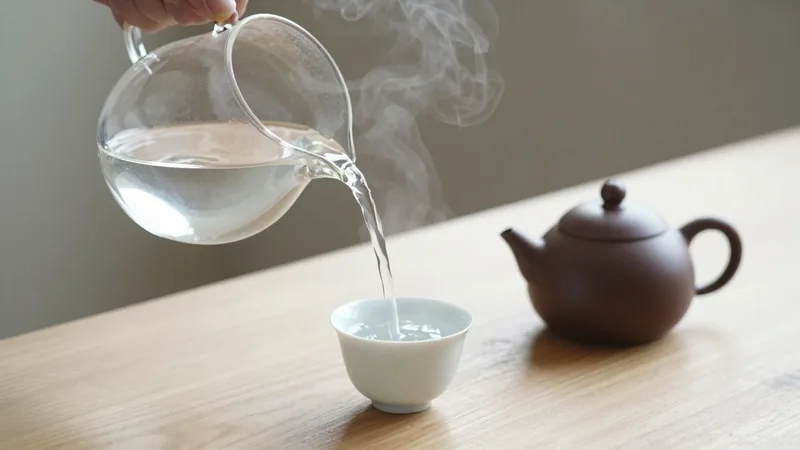
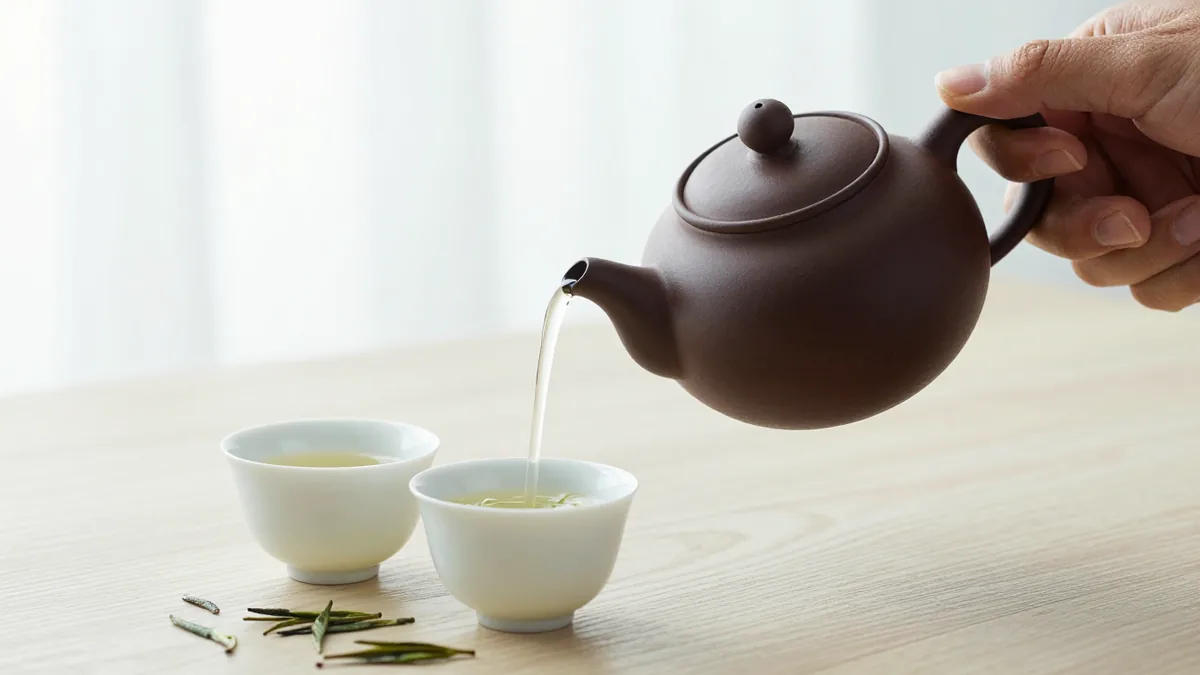
Ito En's method uses the cups as a cooling step: pour boiled water into the serving cups first, then into the pot. Its guide notes the temperature "will fall 10 degrees after being put into a cup".
Working from that rule of thumb:
- Bancha, hojicha (95–100 °C): pour straight from the kettle.
- Standard sencha (about 90 °C): one pour into a cup, then into the pot.
- High-grade sencha (about 80 °C): two transfers between vessels.
- Mild sencha or shincha (about 70 °C): two to three transfers.
- Gyokuro (about 50 °C): let the water sit in the cups until the cup is comfortable to hold, or use a thermometer once to learn the timing in your kitchen.
The 10 °C figure depends on how much water, how thick and cold the cup is, and room temperature. It is a starting point. A cheap probe thermometer checks it in a minute.
Pre-pouring also measures the water. If you fill two 100 mL cups, you have the 200 mL that Ito En's sencha method calls for.
Water hardness and a brown, flat cup
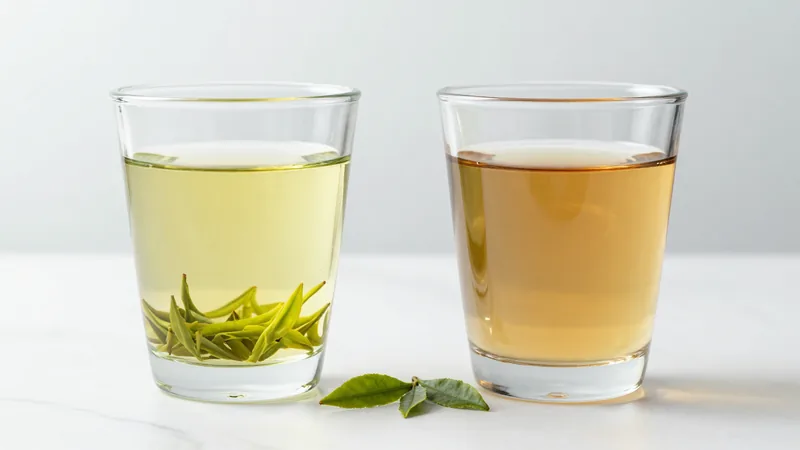
Hard, alkaline tap water damages green tea. A 2021 study in Molecules brewed green tea with synthetic waters from 21 to 338 ppm hardness (as CaCO3) and found total catechin yield fell as hardness rose. EGCG and EGC oxidized and the tea turned brown.
The study's thresholds are specific:
- Browning started once the tea was above pH 6.3 and the water above 42 ppm hardness.
- Tea pH ran from 6.0 with very soft water to 7.1 with very hard water.
- Boiling raised water pH by 0.5 to 1.0 units as carbon dioxide left.
Japanese brewing advice assumes soft water. The same paper notes that 92% of Japan has water under 90 ppm hardness, while 42% of Western Europe has water above 270 ppm. If your tea looks dull or brown within minutes, try bottled or filtered soft water before changing anything else. Losing catechins can make the cup taste less bitter, but the brown color and flat taste come with it.
Troubleshooting table
Match the symptom, check the cause, change one thing at a time.
| Symptom | Likely cause | Fix |
|---|---|---|
| Bitter, sharp | Water above 80 °C or steep over 1 min for sencha | 70–80 °C, about 30 s (Ito En) |
| Dry, puckering | Catechins drawn out above 80 °C | Drop to about 70 °C, keep 30 s |
| Bitter gyokuro | Brewed like sencha | 6 g, 100 mL, 50 °C, about 120 s |
| Harsh second cup | Same time as first steep | Slightly hotter, shorter steep |
| Thin, flat | Too little leaf | 4 g per 200 mL for sencha |
| Brown, dull liquor | Hard, alkaline water | Water under 42 ppm hardness (Molecules 2021) |
| Very bitter and dark | Leaf left in water 30+ min | Decant all liquid at the end of each steep (J Food Sci Technol 2015) |
Cold water is the other way to keep catechins in the leaf. Ratios and times are in our cold brew tea guide. For Chinese greens brewed in a gaiwan, see the gongfu brewing guide. If bitterness bothers you because of caffeine, our caffeine comparison has the numbers by steep time. More methods are in the brewing guides.
Frequently Asked Questions
Why does my green tea taste bitter?
The water is too hot or the leaf sat too long. Ito En says catechins, the main bitter and astringent compounds, come out above 80 °C, while sweet theanine dissolves around 50 °C. Try 70–80 °C for about 30 seconds with 4 g of sencha in 200 mL.
What temperature should I use for green tea?
It depends on the tea. Ito En uses 50 °C for gyokuro, 80 °C for high-grade sencha, 70–80 °C for shincha and 95 °C for bancha. Chinese Longjing brewed in a glass is commonly brewed at 75–80 °C.
Can I use boiling water for green tea?
Only for roasted or late-harvest teas such as hojicha, genmaicha and bancha. For sencha and gyokuro, pour boiling water into cups first. Each transfer drops the temperature about 10 °C, so two transfers reach roughly 80 °C.
Does steeping green tea longer make it more bitter?
Yes. In a 2025 study, green tea caffeine went from 11 to 23 mg per 200 mL between 2 and 5 minutes at 80 °C. In a separate study, tasters scored green tea very low after 30 and 45 minutes at 85 and 95 °C because of bitterness and dark colour.
Why did my green tea turn brown?
Hard, alkaline water oxidizes EGCG and EGC. One study found browning began once tea pH was above 6.3 and water hardness above 42 ppm. Soft or filtered water keeps the liquor yellow-green.