Use 8–12 g of loose tea per liter of cold water and steep it in the fridge: 4–6 hours for Japanese green tea, 6–8 hours for white and light oolong, 8–12 hours for black tea and rooibos (Valley of Tea chart). Cold water at 10°C pulls out about half the caffeine and a fifth of the EGCG that an 80°C brew does (NARO, 2018). Drink it within 3 days (Iowa State Extension).
The base ratio: 8–12 g per liter
Cold brew needs more leaf per liter than a long hot steep would, because cold water extracts slowly. Most vendor guides land between 8 and 12 g per liter.
- Kettl (Japanese green tea): about 10 g of loose green tea per liter, which it also gives as 1.1 g per 4 oz.
- Valley of Tea: 8–12 g per liter depending on type, with fluffy white tea at the top of the range.
- Lab protocol: a 2015 study in the Journal of Food Science and Technology cold-brewed green tea at 8 g/L and black and oolong at 7 g/L, 12 hours at 4°C.
Start at 10 g per liter. Go up to 12 g if the result tastes thin. Go down to 8 g if it turns bitter. For hot tea, the green tea bitterness guide explains why temperature matters more than time.
Get brewing and teaware notes
Steep times, water temperatures, leaf ratios, and teaware that is worth buying. Free, no spam.
No fixed schedule. Unsubscribe anytime.
Ratios and fridge times by tea type
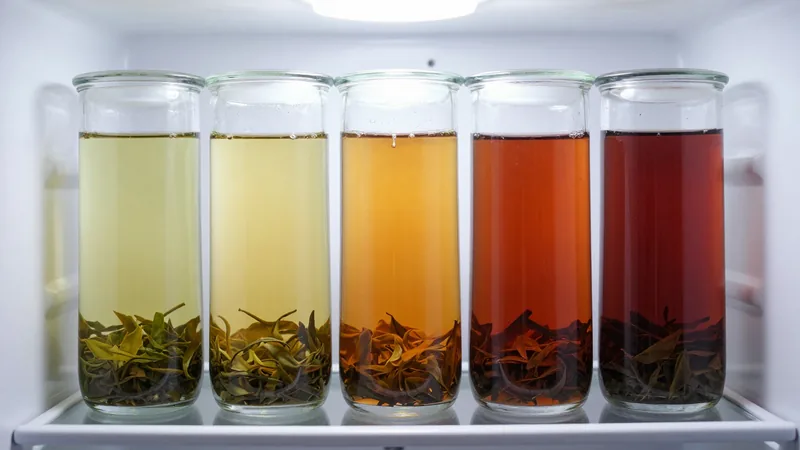
These are starting points from one vendor chart, cross-checked against two others. Steep covered, in the fridge, then strain the leaves out.
| Tea type | Grams per liter | Hours in fridge | Notes |
|---|---|---|---|
| Japanese green (sencha) | 8–10 | 4–6 | Kettl suggests 8–12 h for sencha at 10 g/L |
| Chinese green | 8 | 6–8 | |
| White | 10–12 | 6–8 | Bulky leaf: weigh it, do not scoop it |
| Light oolong | 8–10 | 6–8 | |
| Dark (roasted) oolong | 8–10 | 8–10 | |
| Black | 10 | 8–12 | Overnight is the simplest schedule |
| Flower/fruit herbal (hibiscus) | 10–12 | 6–8 | Valley of Tea's hibiscus guide uses 8–12 h |
| Rooibos | 10 | 8–12 | No caffeine |
Sources: Valley of Tea cold brew chart; sencha note from Kettl; hibiscus note from Valley of Tea hibiscus guide.
Vendors disagree on time more than on ratio. Rishi's cold brew page says green and white teas are ready after 2–4 hours and black and oolong need 6–8 hours, shorter than the chart above. Iowa State Extension gives a general window of six hours to overnight. Taste at the low end of the range, then leave it longer if it is weak. Our cold brew ratio reference keeps the same numbers in one table.
Worked numbers: a 1 L pitcher and a 2 L batch
Weigh the leaf. A kitchen scale that reads to 1 g is enough.
1 L pitcher of sencha: 10 g leaf, 1 L cold water, 5 hours in the fridge. That is 1 g per 100 ml.
2 L batch of black tea: 2 × 10 g = 20 g leaf, 2 L water, overnight (8–12 hours).
2 L batch of white tea: 2 × 10–12 g = 20–24 g leaf, 6–8 hours.
Tea bags hold less than people assume, and the amount varies by brand. Two label checks:
- A 100-count box of Lipton black tea bags lists a net weight of 8 oz: 226.8 g / 100 = 2.27 g per bag.
- A 20-count box of Bigelow Classic green tea lists 0.91 oz: 25.8 g / 20 = 1.29 g per bag.
| Batch | Leaf needed | Lipton-size bags (2.27 g) | Bigelow green bags (1.29 g) |
|---|---|---|---|
| 1 L at 10 g/L | 10 g | 4–5 | 8 |
| 2 L at 10 g/L | 20 g | 9 | 15–16 |
| 2 L at 12 g/L | 24 g | 10–11 | 18–19 |
Bag weights from the Lipton and Bigelow retail listings; bag counts are leaf needed divided by grams per bag, rounded.
Divide your target grams by the net weight on your own box divided by its bag count. The "one bag per cup" habit can leave a cold brew at half strength.
Why cold brew tastes softer: caffeine and catechins
Cold water extracts the bitter compounds slowly. A 2018 review by Manami Monobe of Japan's National Agriculture and Food Research Organization (NARO) reports that sencha steeped in 10°C water for 1 hour reached about 50% of the caffeine, 20% of the EGCG and 70% of the EGC of an 80°C, 2-minute infusion. Further steeping did not raise those levels.
In iced water at 0.5°C, caffeine stayed under 20% of the hot infusion. Amino acids such as theanine reached about 80% of the hot level after 1 hour, which is why cold-brewed sencha tastes sweeter and more savory than bitter.
The Lantano study measured catechins per gram of leaf after 12 hours at 4°C. EGCG came out about level with a hot brew for green tea (4.13 vs 4.09 mg/g) and roughly four times higher for oolong (2.45 vs 0.62 mg/g). The authors concluded that hot infusion extracts fast but degrades compounds, while "cold infusion extracted higher level of healthy molecules with slow kinetic".
The two findings fit together. Cold water lowers caffeine and EGCG in the first hours; long steeps let some catechins catch up. Cold brew also usually uses less leaf per liter than a strong iced-tea concentrate. Our caffeine guide has hot-brew caffeine ranges by tea type.
Food safety: brew in the fridge, not the sun
Brewing in the refrigerator keeps tea out of the temperature range where bacteria grow. Sun tea does not.
- Ohio State University Extension: sun tea will not get hotter than 130°F, which is not hot enough to kill bacteria in the water or on the leaves. A thick or syrupy texture may mean Alcaligenes viscolactis, a ropy bacterium.
- Iowa State University Extension: brewed tea should not be held at room temperature for more than 8 hours; consume refrigerated tea within three days.
- Valley of Tea's cold brew guide: the tea keeps 2–3 days in the fridge, with the best flavor in the first 24 hours.
Practical rules: use a clean, lidded pitcher; strain the leaves out when the time is up; date the pitcher; pour it out after day 3. Make 1 L at a time if you drink less than a liter in two days.
The flash-chill alternative
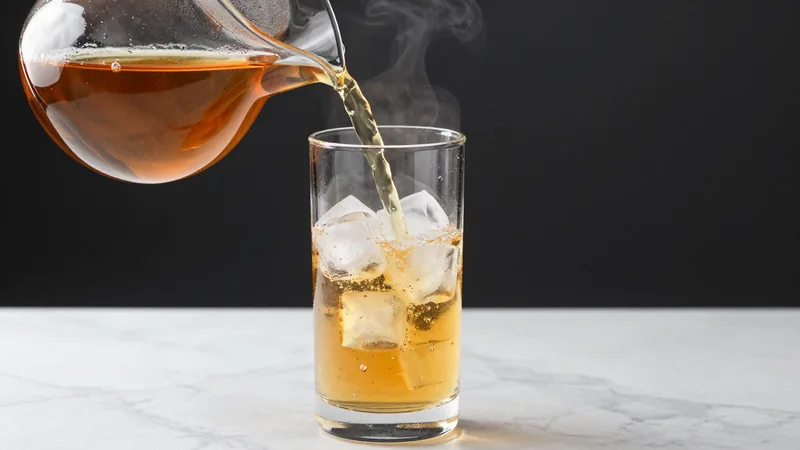
When you want iced tea in 10 minutes rather than 8 hours, brew a strong hot concentrate and pour it over ice. The ice dilutes it to normal strength and cools it fast.
- Kettl's hojicha method: 10 g of leaf in 300 ml of boiling water for 1 minute, then poured over ice.
- Rishi's flash-chill rule: 1.5 teaspoons of leaf per 8 oz of water, slightly more than a hot brew, then straight into an ice-filled pitcher.
- Lantano's "hot + ice" protocol: 30 g/L at 80°C for 3–5 minutes, then 0.4 kg of ice. That is 2.5 times the 12 g/L hot-brew ratio in the same study.
In the Lantano study, the hot + ice method gave the highest EGCG for green tea: 7.36 mg/g, against 4.09 for hot and 4.13 for cold. It also gave the highest caffeine for green and black tea. If you want low caffeine, cold brew. If you want speed and maximum catechins, flash-chill. For how oxidation level changes which oolong to pick, see the oolong oxidation guide.
Frequently Asked Questions
How much loose tea do I use for 1 liter of cold brew?
Use 8–12 g. Start at 10 g for green, black and oolong, and 10–12 g for bulky white tea. Weigh it, because a scoop of white tea weighs far less than a scoop of rolled oolong.
How long should cold brew tea steep in the fridge?
Japanese green tea needs 4–6 hours, white and light oolong 6–8 hours, and black tea and rooibos 8–12 hours. Iowa State Extension gives six hours to overnight as a general range. Taste early and steep longer if it is weak.
Does cold brew tea have less caffeine?
Yes, at the same leaf weight and in the first hours. Sencha steeped 1 hour at 10°C reached about 50% of the caffeine of an 80°C, 2-minute brew, and under 20% in iced water. Flash-chilled tea brewed hot at 30 g/L had the highest caffeine in the Lantano study.
How many tea bags make 1 liter of cold brew?
At 10 g per liter, use 4–5 Lipton-size black tea bags (2.27 g each) or 8 Bigelow green tea bags (1.29 g each). Check the net weight on your box and divide by the bag count to get your own grams per bag.
How long does cold brew tea last?
Strain out the leaves and drink it within 3 days, per Iowa State Extension. Flavor is best in the first 24 hours. Never leave brewed tea at room temperature for more than 8 hours.