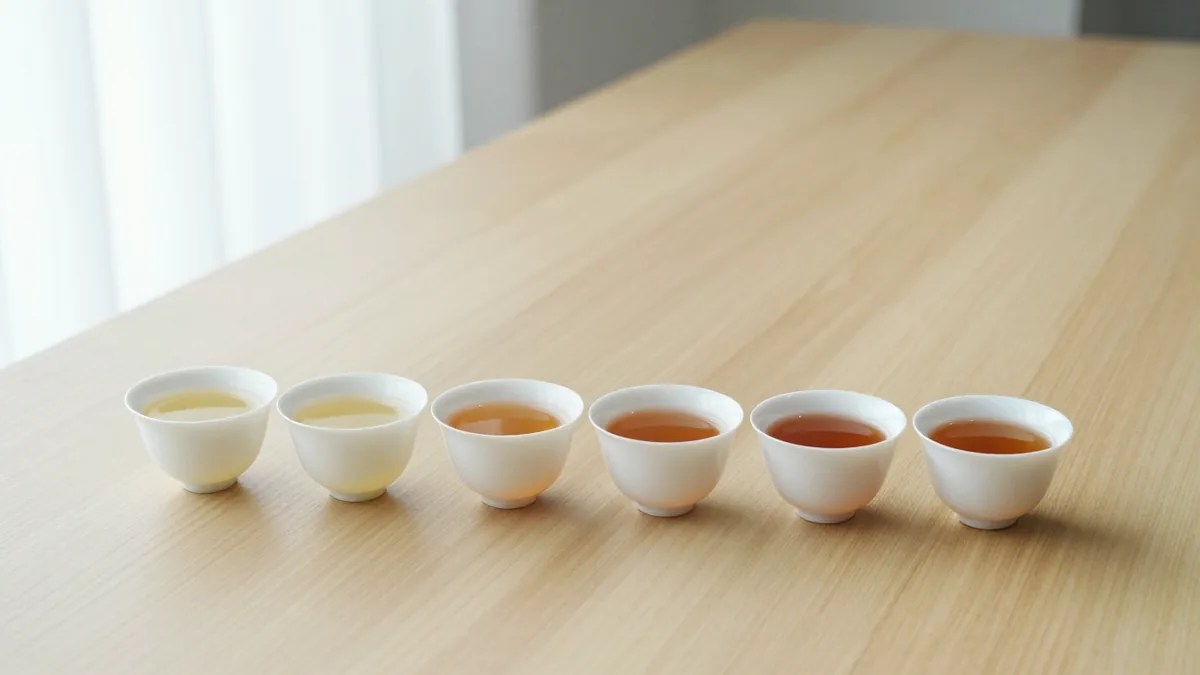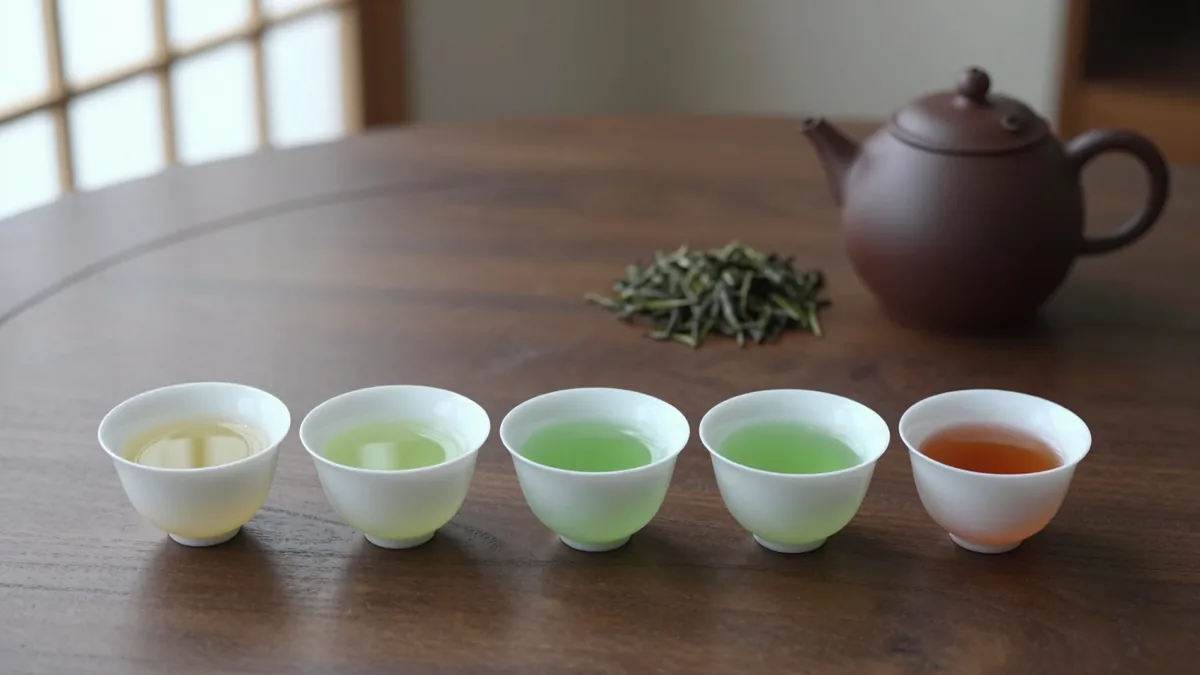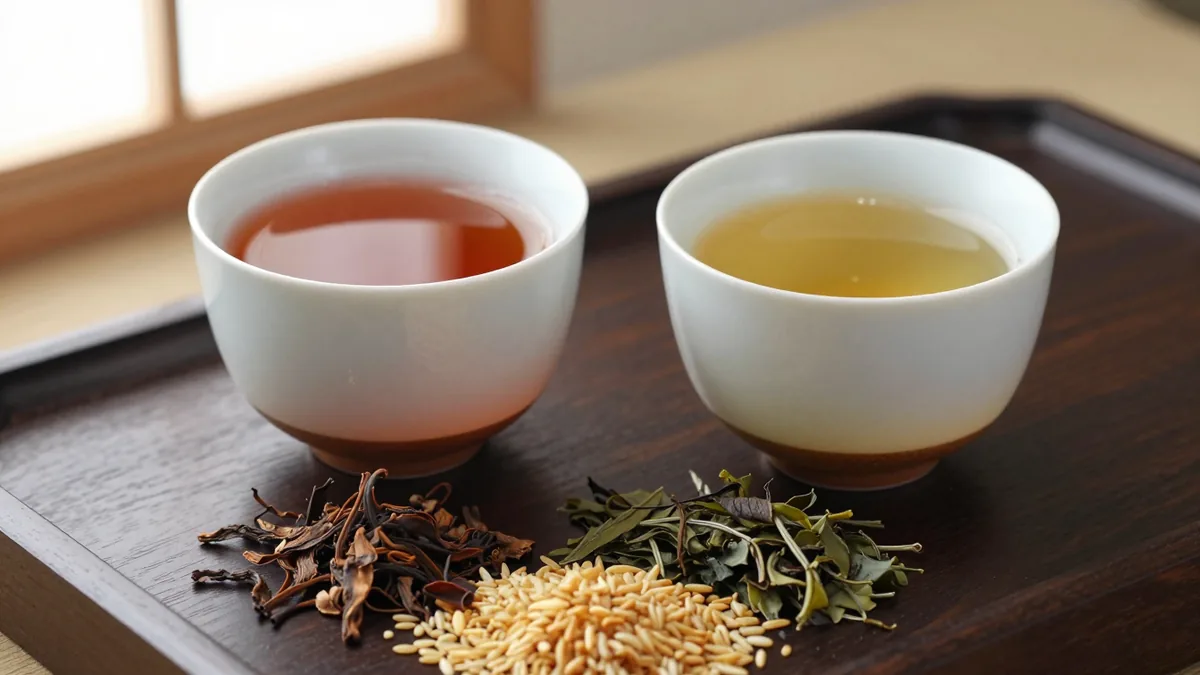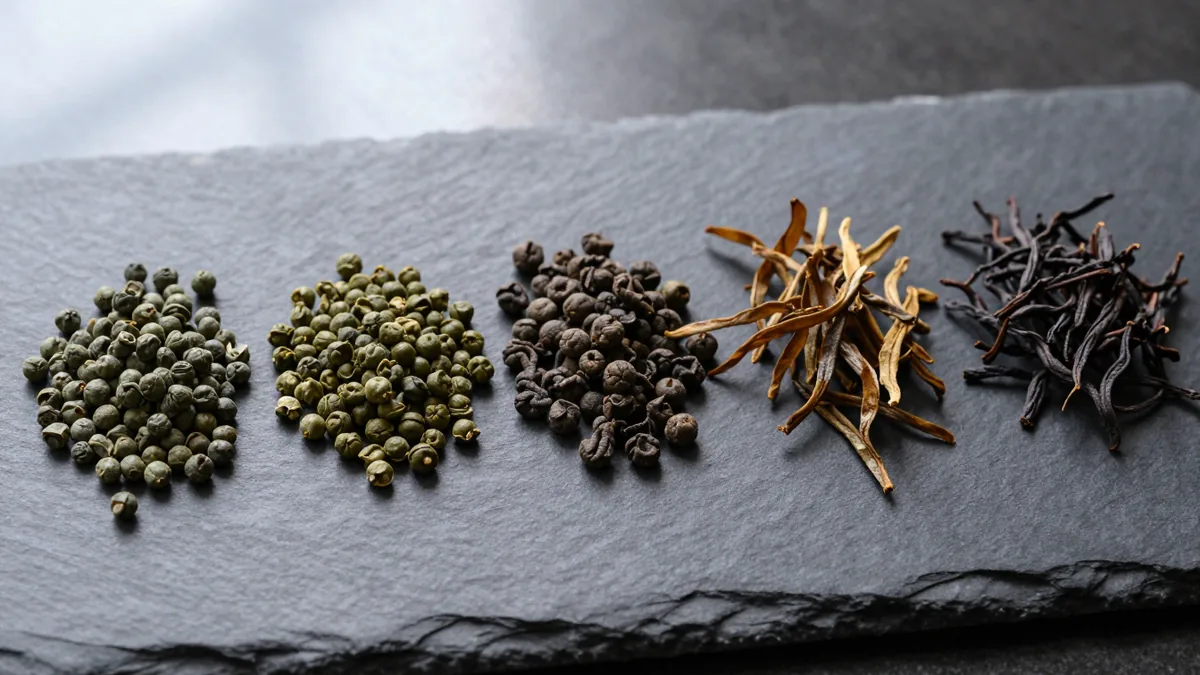
Oolong is tea stopped partway through oxidation, anywhere from about 8% to 85%. Wenshan Baozhong sits at the light end (8–15%), Taiwanese high-mountain oolong near 15–25%, Dong Ding around 25–30%, and Oriental Beauty at 50–70%. Roasting is a separate step after oxidation, which is why a lightly oxidized tea can still taste toasty.
Oxidation is the single number that sorts oolongs, and it is also the least precise number on the label. Producers estimate it by color, smell and experience. Tea From Taiwan notes that lab measurement is impractical for most producers because of cost and batch variation.
So read every percentage below as a range a vendor or reference gives, not a lab result. Where sources disagree, both figures are shown.
What oxidation means in oolong
Tea leaves store catechins and the enzymes that oxidize them in separate parts of the cell. Crushing or bruising the leaf mixes them, and oxidation starts. Heat stops it: steaming or roasting inactivates the enzymes, which is how green tea stays green (Tanaka, Matsuo and Kouno, International Journal of Molecular Sciences, 2009).
Green tea gets heat almost at once. Black tea is allowed to oxidize fully. Oolong is stopped in between, and Wikipedia's oolong entry gives the span as 8% to 85%.
"Fermentation" is the common word in tea shops, but it is the wrong one. Oxidation needs air; fermentation is an anaerobic process (Tea From Taiwan). Shou puer is fermented. Oolong is oxidized.
Get tasting and processing notes
Oxidation, rolling, roasting oolong, aging pu-erh, and how to taste tea side by side at home. Free, no spam.
No fixed schedule. Unsubscribe anytime.
The processing steps, in order
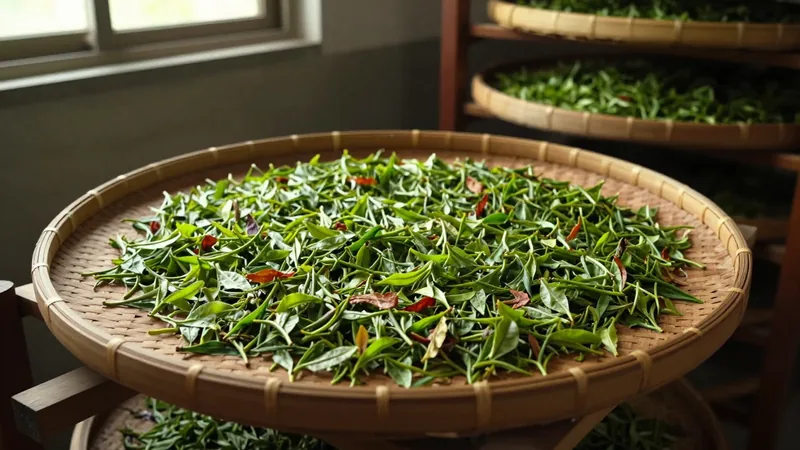
The order is broadly the same from Taiwan to Fujian. Wikipedia's Tieguanyin entry lists eight stages, and Chazhidao's Taiwan oolong description lists nine with the repeat cycles.
- Plucking. Fresh leaves are picked and carried to the processing room.
- Withering. Sun or indoor withering softens the leaf and drops its water content.
- Tossing (bruising). Leaves are shaken or tumbled in bamboo drums or trays. This damages the leaf edges and starts oxidation.
- Resting. Leaves sit between tossings while oxidation runs. Tossing and resting repeat; the number of rounds sets the oxidation level.
- Kill-green (fixation). High heat stops the enzymes. Chazhidao describes a rotary drum at about 300°C; a 2023 study in Foods used drum roasting for 5 minutes at 290°C.
- Rolling. Leaves are shaped into strips or balls. Ball oolong cannot be curled in one pass, so cloth-wrapped kneading and drying repeat many times, per Chazhidao.
- Drying. Moisture comes down so the tea is stable.
- Roasting (optional). A separate, slower heat treatment, sometimes repeated over weeks.
All of this takes time. Wikipedia's high-mountain tea entry puts one batch of Taiwanese gaoshan tea at 36 to 40 hours of processing.
Oxidation and roasting are different steps
Oxidation happens before kill-green and changes the leaf chemistry. Roasting happens after drying and adds heat-driven flavors. A tea can be light in one and heavy in the other.
The temperatures show how different they are. Eco-Cha roasts its Dong Ding "3 times over a few weeks, beginning at 90°C and ending at 123°C." Hence Tea describes Da Hong Pao charcoal roasting in two to four sessions at 110–140°C, with more than 30 hours of cumulative heat.
Kill-green, by contrast, is a few minutes near 300°C. Roasting is long and low; kill-green is short and hot.
What each one does to the cup:
- Oxidation moves flavor from green and floral toward fruit and honey, and the leaf color from green toward reddish-brown.
- Roasting "will further concentrate and deepen the flavors of the tea, and can shift some of the sweet notes into savory ones" (Floating Leaves). The Fragrant Leaf sorts roasts into light, medium and dark.
A dark brown, toasty Tieguanyin may have moderate oxidation and a heavy roast. A pale Baozhong has light oxidation and no roast. Leaf color alone does not tell you which step made it dark.
The spectrum, style by style
| Style | Region | Approx. elevation | Oxidation | Roast | Brew temp |
|---|---|---|---|---|---|
| Wenshan Baozhong | Pinglin, New Taipei, Taiwan | 600 m [ECO-BZ] | 8–12% [W-BZ]; 10–15% [ECO-BZ] | None [ECO-BZ] | 99°C [ML] |
| Ali Shan high mountain | Chiayi, Taiwan | 1,000–1,400 m [W-OOL]; 1,300 m [AMOT] | 15–25% [AMOT] | None [SIAM] | 99°C [ML] |
| Li Shan high mountain | Heping District, Taiwan | above 1,600 m [W-OOL]; 2,100 m [ECO-LS] | Not published | None [ECO-LS] | 99°C [ML] |
| Dong Ding | Lugu, Nantou, Taiwan | 700 m [ECO-DD] | 25–30% [FL]; "medium" [ECO-DD] | Medium, 90→123°C [ECO-DD] | 99°C [ML] |
| Oriental Beauty | Hsinchu County, Taiwan | Lower elevations [W-OOL] | 50–60% [FL]; 60–70% [ITW]; ~70% [W-DM] | Varies by maker [MOR] | 90–95°C [MOR] |
| Tieguanyin, modern | Anxi, Fujian | Not given | 10–20% [ITW] | Light or none [W-TGY] | 100°C [ITW] |
| Tieguanyin, traditional | Anxi, Fujian | Not given | Higher than modern [W-TGY] | Heavy [W-TGY] | 100°C [ITW] |
| Phoenix Dancong | Phoenix Mountain, Chaozhou, Guangdong | ~1,200 m garden [MM]; peak 1,497.8 m [W-PM] | "Light" to "beyond-medium" [CT; SIAM-MLX] | Often roasted [SIAM-MLX] | 95–100°C [HDC] |
| Da Hong Pao (Wuyi yancha) | Wuyi Mountains, Fujian | Not given | 30–60% [HDHP] | Charcoal, 2–4 rounds, 110–140°C [HDHP] | 100°C [HDHP] |
Sources: W-BZ, ECO-BZ, W-OOL, AMOT, SIAM, ECO-LS, ECO-DD, FL, ITW, W-DM, MOR, W-TGY, MM, W-PM), CT, SIAM-MLX, HDC, HDHP, ML.
Elevation conversions: 600 m is about 1,970 ft, 1,400 m about 4,590 ft, 2,100 m about 6,890 ft.
Taiwan: Baozhong to Oriental Beauty
Wenshan Baozhong is the lightest Taiwanese oolong. Wikipedia puts it at 8–12% oxidation; Eco-Cha sells a Pinglin Baozhong grown at 600 m at about 10–15%, unroasted. The leaves are left unrolled, light green to brown, per Wikipedia.
High-mountain (gaoshan) oolong means tea grown above 1,000 m in central Taiwan, mainly Nantou and Chiayi counties. Ali Shan gardens sit at 1,000–1,400 m and Li Shan above 1,600 m, per Wikipedia. Eco-Cha's Li Shan comes from 2,100 m. These are rolled into balls, lightly oxidized, and usually sold unroasted.
Dong Ding is named for a mountain in Nantou County. It is the classic medium style: The Fragrant Leaf gives 25–30% oxidation, and Eco-Cha's version from Lugu at 700 m gets three roasts.
Oriental Beauty (Dongfang Meiren, Bai Hao) is the heavy end of Taiwan oolong. It comes from Hsinchu County, is harvested in summer, and is made from leaves fed on by the tea green leafhopper, Jacobiasca formosana. A 2007 Kyoto University study (Cho et al., Bioscience, Biotechnology, and Biochemistry) found that the traditional process uses the leaf's own defense response to raise production of volatile aroma compounds, which gives the ripe-fruit and honey aroma.
Its oxidation is quoted as 50–60% by The Fragrant Leaf, 60–70% by iTeaWorld and Floating Leaves, and about 70% by Wikipedia. The leafhopper's name is not settled either: Wikipedia's species page links the tea to Empoasca onukii, while the 2007 paper uses Jacobiasca formosana.
Fujian and Guangdong: Tieguanyin, Wuyi, Dancong
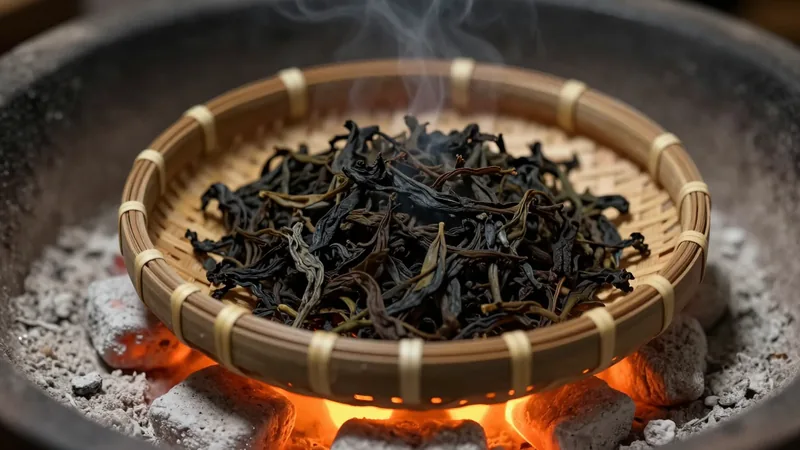
Tieguanyin comes from Anxi County in Fujian. Modern Tieguanyin is "close to a green tea, with only a little oxidation," per Wikipedia, and iTeaWorld gives 10–20%. The older style was more heavily roasted and brews darker. If a Tieguanyin is bright green and floral, it is the modern style; if it is brown and toasty, it is traditional.
Wuyi rock tea (yancha) grows in the Wuyi Mountains of northern Fujian, listed as a UNESCO World Heritage Site since 1999. Wikipedia describes Wuyi teas as "generally more heavily oxidated" and fired heavily. Hence Tea puts Da Hong Pao at roughly 30–60% oxidation, followed by the charcoal roasting described above.
Phoenix Dancong comes from Phoenix Mountain (Fenghuang Shan) in Chaozhou, Guangdong, whose peak is 1,497.8 m). Dancong means "single bush", and the strip-style teas are known for imitating specific flower and fruit aromas. Oxidation varies by maker: Curious Tea sells a "lightly oxidised" Dancong, and Siam Tea Shop processes its Mi Lan Xiang with "a beyond-medium degree of oxidation" and a strong roast. No reliable single percentage exists for the category.
How to brew across the spectrum
Oolong takes hotter water than green tea across the whole range. Mei Leaf's chart uses 99°C for both strip and ball oolong, with 4.5–5 g per 100 ml for strips and 6–6.5 g per 100 ml for balls.
Worked dose for a 120 ml gaiwan:
| Leaf shape | Examples | g per 100 ml | Dose in 120 ml |
|---|---|---|---|
| Ball (rolled) | Ali Shan, Li Shan, Dong Ding, modern Tieguanyin | 6–6.5 | 7.2–7.8 g |
| Strip (twisted) | Baozhong, Oriental Beauty, Dancong, Da Hong Pao | 4.5–5 | 5.4–6.0 g |
Source: Mei Leaf; dose = 120 ml × ratio ÷ 100.
Two exceptions in the vendor guides: Morima brews Oriental Beauty cooler, at 90–95°C, and Hence Tea brews Da Hong Pao at a full boil because lower temperatures "mute the roast." Full schedules for every tea type are in our gongfu brewing guide. Shop by style on our tea pages, and look up unfamiliar terms in the glossary.
Frequently Asked Questions
What oxidation percentage is oolong?
Anywhere from about 8% to 85%, per Wikipedia. Wenshan Baozhong sits at 8–15%, Ali Shan high-mountain oolong at 15–25%, Dong Ding around 25–30%, and Oriental Beauty at 50–70%. These are producer estimates, not lab measurements.
Is a dark oolong always more oxidized?
No. Roasting darkens the leaf and cup after oxidation has stopped. Eco-Cha's Dong Ding is medium-oxidized but roasted three times up to 123°C, and traditional Tieguanyin is darker than modern Tieguanyin mainly because of a heavier roast.
Which oolong is the most oxidized?
Among common styles, Oriental Beauty, at 50–60% (The Fragrant Leaf) to about 70% (Wikipedia). Hence Tea puts Da Hong Pao at 30–60%, and some Dancong makers process beyond medium oxidation.
What does high mountain oolong mean?
Taiwanese oolong grown above 1,000 m, mainly in Nantou and Chiayi counties. Ali Shan is grown at 1,000–1,400 m and Li Shan above 1,600 m; Eco-Cha's Li Shan comes from 2,100 m. The style is ball-rolled, lightly oxidized at around 15–25%, and usually unroasted.
What temperature should I brew oolong at?
Mei Leaf uses 99°C for all oolong, and Hence Tea brews Da Hong Pao at a full 100°C boil. Morima recommends a slightly cooler 90–95°C for Oriental Beauty. Use 4.5–5 g per 100 ml for strip oolong and 6–6.5 g for ball oolong.