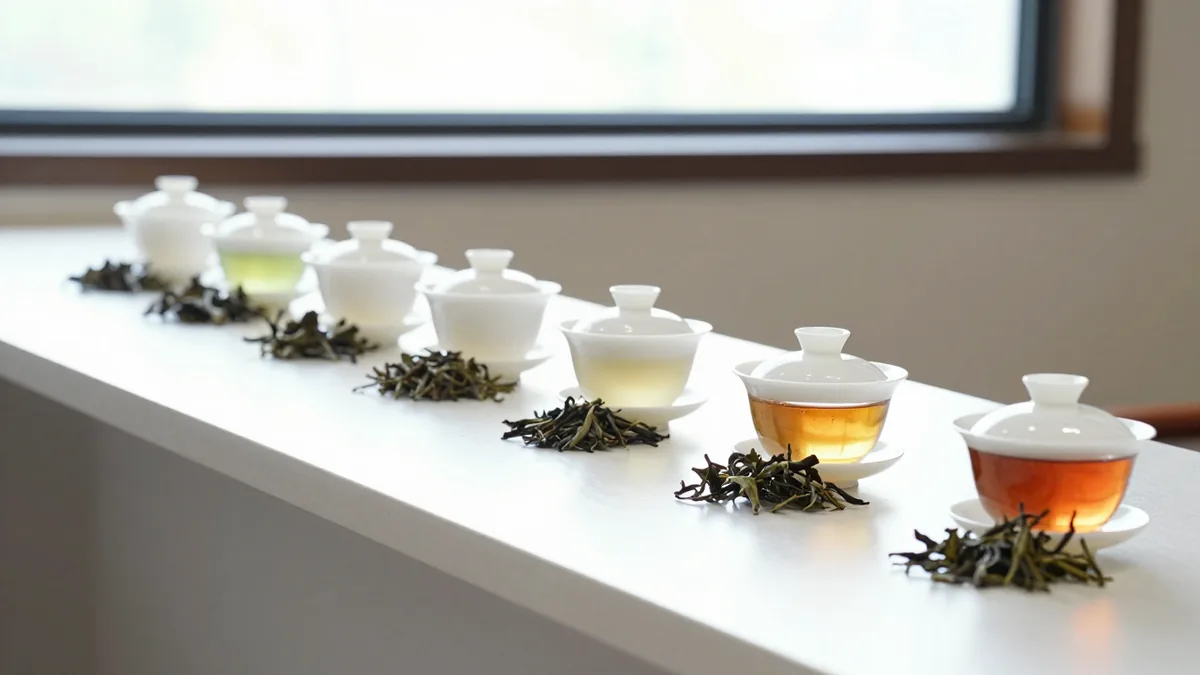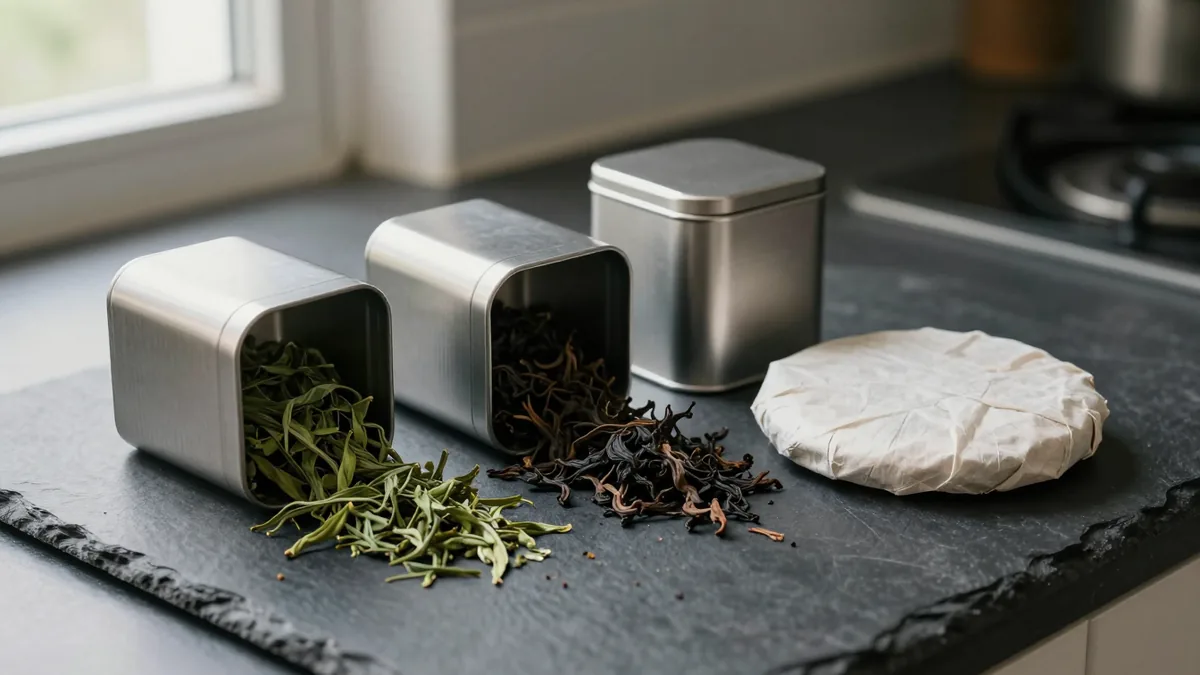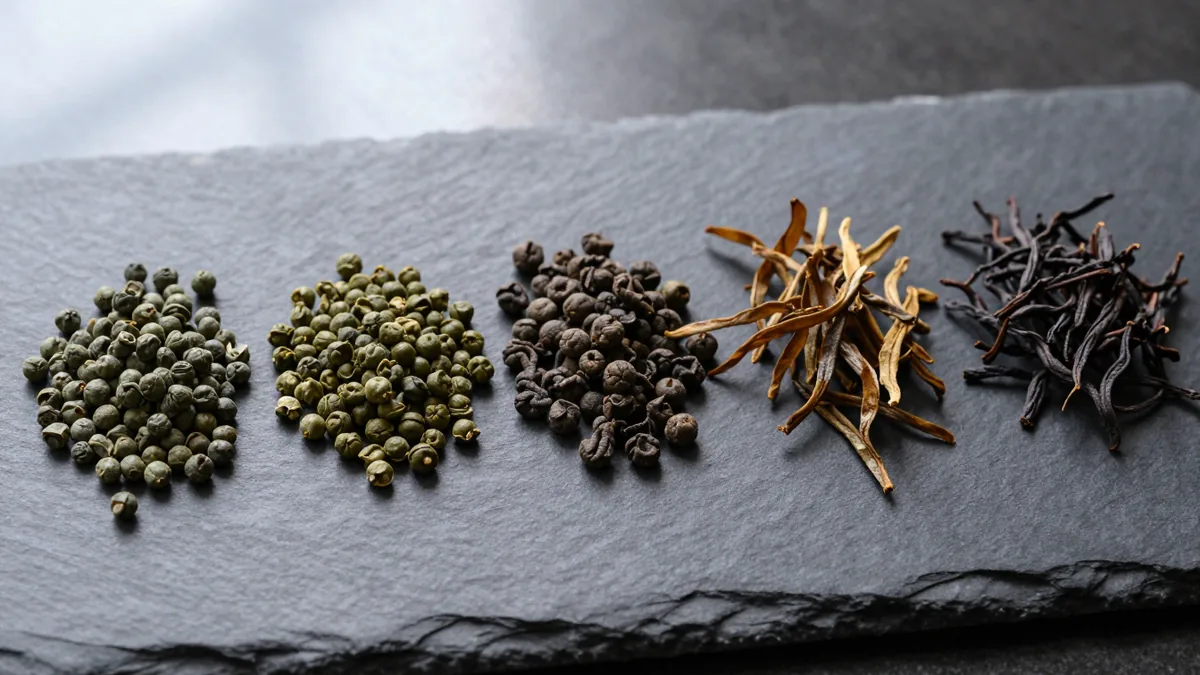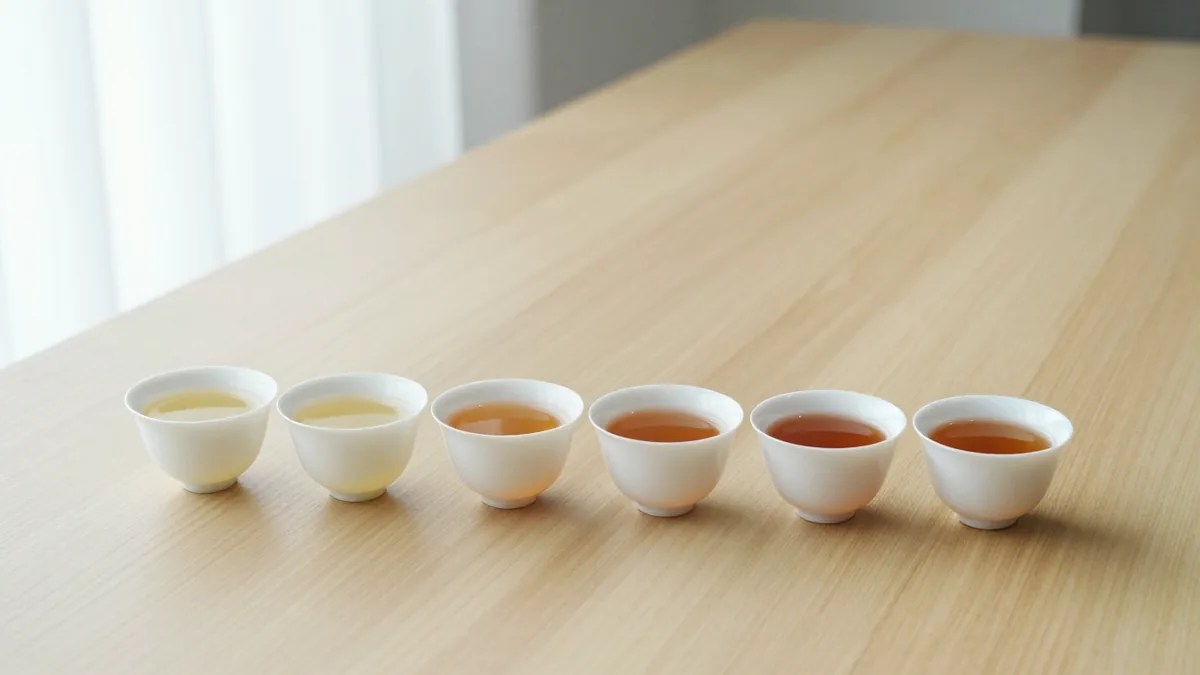
A tasting flight is 3–4 teas brewed side by side under identical conditions, with one variable changing. We built four from in-stock catalog listings: an oxidation ladder, black tea from four countries, an oolong roast ladder and a puer age ladder. At China's GB/T 23776 tasting dose of 3 g per cup, one session of each costs $1.01–$3.30 in leaf; buying every pack for all four costs $205.75, as of October 1, 2026.
How a flight works
A flight changes one thing and holds everything else still. Same weight, same water, same time, same cup. If the cups taste different, the change you chose is the likely cause.
We use the lab dose from China's GB/T 23776-2018 sensory method: 3.0 g of tea in 150 ml of boiling water in a covered cup for 5 minutes (Scientific Reports 2026). ISO 3103 is close: 2 g per 100 ml, which is 2.8 g in its small pot of about 140 ml (ISO 3103:2019). Either works. Pick one and keep it for every cup.
Boiling water and long steeps are hard on green tea, and working tasters often brew to the producer's recommendation instead (Wikipedia: Tea tasting). That is fine for drinking. For a flight it adds a second variable, so we keep the lab method and accept a harsher green cup.
For the full scoring method (dry leaf, aroma hot and cold, liquor, taste, infused leaf, a 0–15 sheet) see how to taste tea. Three rules from it matter most here:
- Taste in order, lightest to darkest, and rest between cups. GB/T panels drink water and wait 10 minutes (Scientific Reports 2026).
- Re-steep. Kansas State found the third and fourth brews of green tea milder than the first two (Lee et al. 2013). Score infusions 1, 2 and 4 from the same 3 g.
- Taste blind. Have someone code the cups. A panel found the prices of 138 green teas "did not differentiate the flavors" (Lee, Chambers & Chambers 2014).
How we picked the teas. Every tea is an in-stock listing of 20 g or more in the Tea Explorer catalog, 7,306 teas from 40 vendors, fetched 2026-10-01, with no flavoured, scented, decaf or blended teas. For each slot we take the cheapest pack, and we prefer one vendor that covers every slot, so you pay shipping once. Prices exclude shipping.
Get tasting and processing notes
Oxidation, rolling, roasting oolong, aging pu-erh, and how to taste tea side by side at home. Free, no spam.
No fixed schedule. Unsubscribe anytime.
Flight 1: the oxidation ladder
| Cup | Slot | Tea | Grams | Price | $/g | Cost at 3 g |
|---|---|---|---|---|---|---|
| A | Green | Yunnan Green Spring Bi Luo Chun Green Tea | 100 | $10.00 | $0.100 | $0.30 |
| B | White | 2024 Yunnan Sourcing "Meng Song Village" White Tea Cake | 25 | $7.75 | $0.310 | $0.93 |
| C | Oolong | Medium Roast "Fancy Grade" Ben Shan Varietal Oolong Tea | 100 | $8.00 | $0.080 | $0.24 |
| D | Black | Yunnan "Black Gold" Black Tea | 100 | $8.00 | $0.080 | $0.24 |
| Flight | 4 teas, 12 g | $33.75 | $1.71 |
Source: Tea Explorer catalog, 7,306 teas from 40 vendors, fetched 2026-10-01, Yunnan Sourcing Tea Shop, as of October 1, 2026. All four teas are from China.
Holding the country still leaves processing as the main change. 4 origin countries in the catalog sell all four types, and Yunnan Sourcing Tea Shop's China set is the cheapest single-vendor ladder. From four different shops, the cheapest China ladder would cost $25.50 before 3 shipping charges.
What changes along the ladder:
- A, green. Steaming or roasting at the start of green tea production "inactivates enzymes involved in the oxidation" (PMC review).
- B, white. White tea gets a gentle wither, then drying, with limited enzymatic oxidation during the wither (Foods, 2026).
- C, oolong. Oxidation ranges from 8% to 85% depending on the time between picking and final drying (Wikipedia: Oolong). The cheapest China oolong at Yunnan Sourcing Tea Shop is sold as a roasted tea, so cup C adds roast to oxidation; the roast ladder below separates the two.
- D, black. Black tea is "more oxidized than oolong, yellow, white, and green teas" (Wikipedia: Black tea).
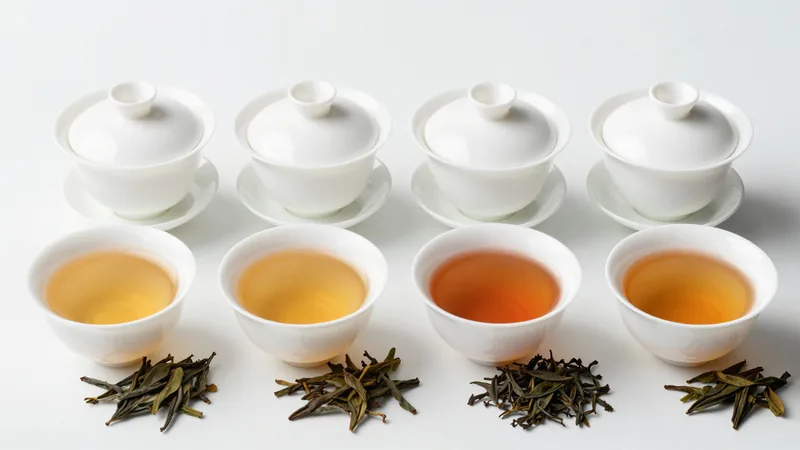
Compare liquor color against white porcelain first, then astringency and the "Green" versus "Brown" words from the Kansas State lexicon. For why the liquor darkens, see the chemistry of tea color; for the middle of the ladder, oolong oxidation explained.
Flight 2: one black tea, four countries
| Cup | Slot | Tea | Grams | Price | $/g | Cost at 3 g |
|---|---|---|---|---|---|---|
| A | India | CTC Assam | 113.4 | $8.00 | $0.070 | $0.21 |
| B | Sri Lanka | Kenilworth Ceylon | 113.4 | $11.00 | $0.097 | $0.29 |
| C | Kenya | Kenya Milima | 113.4 | $9.00 | $0.079 | $0.24 |
| D | China | Tippy Yunnan | 113.4 | $10.00 | $0.088 | $0.26 |
| Flight | 4 teas, 12 g | $38.00 | $1.01 |
Source: Tea Explorer catalog, 7,306 teas from 40 vendors, fetched 2026-10-01, Harney & Sons Fine Teas, as of October 1, 2026. 2 vendors in the catalog sell in-stock black tea from all four countries.
Type stays fixed; origin, cultivar and factory method change. Harney describes its CTC Assam as having "a striking amber color, rich flavor, and a full body" (Harney & Sons); CTC leaf "quickly gives a dark brew" (Wikipedia: CTC). Its Kenya Milima grows above 6,000 feet, is made by the orthodox method, and its brew "is light-bodied and tends toward citrus" (Harney & Sons). The Tea Board of India and PIB call Assam "full-bodied, strong and malty" (PIB).
Black tea is the one flight where milk helps. ISO 3103 says milk is not essential but "sometimes helps to accentuate differences in flavour and colour" (ISO 3103:2019). Taste each cup plain, then add milk to a second pour. The full country comparison is in Assam vs Ceylon vs Kenyan black tea.
Flight 3: the oolong roast ladder
| Cup | Slot | Tea | Grams | Price | $/g | Cost at 3 g |
|---|---|---|---|---|---|---|
| A | Light or no roast (vendor tag: light roast) | "Auspicious Dragon" Xiang Long Oolong Tea (Taiwan) | 100 | $36.00 | $0.360 | $1.08 |
| B | Medium roast (vendor tag: charcoal roasted, medium roast) | "Honey Orchid" Mi Lan Xiang Dan Cong Oolong Tea | 100 | $38.00 | $0.380 | $1.14 |
| C | Dark or heavy roast (vendor tag: charcoal roasted, dark roast) | 10-Year Aged Lao Cha Oolong Tea (Taiwan) | 100 | $36.00 | $0.360 | $1.08 |
| Flight | 3 teas, 9 g | $110.00 | $3.30 |
Source: Tea Explorer catalog, 7,306 teas from 40 vendors, fetched 2026-10-01, Path of Cha, as of October 1, 2026.
Roast is the oolong maker's second dial after oxidation. Levels are usually called light, medium or dark (The Fragrant Leaf), and a roast can be long: Eco-Cha roasts its Dong Ding "3 times over a few weeks, beginning at 90°C and ending at 123°C" (Eco-Cha).
The catalog has no roast field, so we matched roast words in each product name and vendor tags, and skipped any tea tagged with two levels. That leaves 8 light, 12 medium and 5 dark in-stock oolongs. Only 1 vendor covers all three, which keeps one shop's roast scale across the flight. The three come from Taiwan, China and Taiwan, so origin and cultivar change along with roast. Mixing shops costs less, $43.25 from Eco-Cha Teas and Yunnan Sourcing Tea Shop, but then each level is a different shop's call.
What to compare: the "Brown" family in the Kansas State lexicon, "ashy/sooty, brown spice, burnt/scorched, nutty, tobacco" (Lee & Chambers 2007). Score each one 0–15 per cup, along with floral and sweet, and repeat on the fourth infusion.
Flight 4: the puer age ladder
| Cup | Slot | Tea | Grams | Price | $/g | Cost at 3 g |
|---|---|---|---|---|---|---|
| A | Young sheng (2023) | 2023 Yunnan Sourcing "Ba Da Guardian" Raw Pu-erh Tea Cake | 25 | $7.50 | $0.300 | $0.90 |
| B | Middle sheng (2015) | 2015 Spring "Da Xue Shan" Wild Arbor Raw Pu-erh Tea Cake | 25 | $6.00 | $0.240 | $0.72 |
| C | Aged sheng (2010) | 2010 Mengku "Gu Hua Xiang" Raw Pu-erh Tea Brick | 25 | $6.00 | $0.240 | $0.72 |
| D | Shou (2023) | 2023 Xiaguan "Xiao Fa" Ripe Pu-erh Tea Tuo | 100 | $4.50 | $0.045 | $0.14 |
| Flight | 4 teas, 12 g | $24.00 | $2.47 |
Source: Tea Explorer catalog, 7,306 teas from 40 vendors, fetched 2026-10-01, Yunnan Sourcing Tea Shop, as of October 1, 2026.
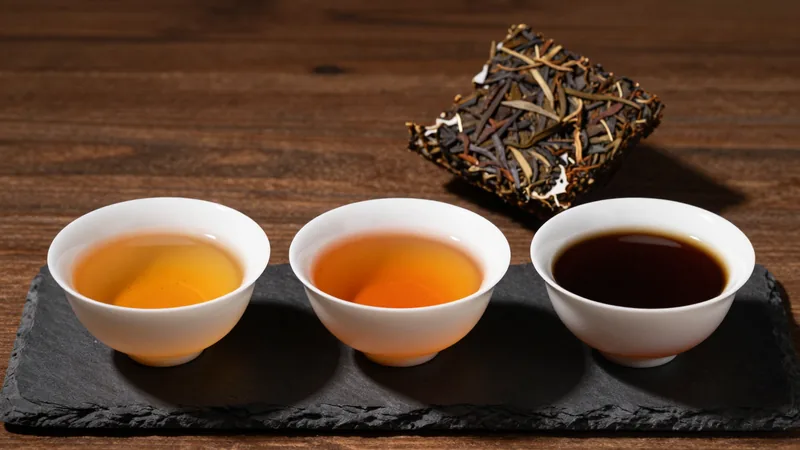
Slots: young sheng from 2021 or later, middle sheng from 2015–2020, aged sheng from 2014 or earlier, and one shou. The three sheng here are 3, 11 and 16 years old as of 2026; cup C, from 2010, is the oldest. white2tea writes that aged character starts at around seven to eight years and becomes "more dramatic and noticeable after 10-12 years or longer" (white2tea). Cup B falls inside that 10–12-year window and cup C is past it.
Cup D is the control. Raw puer is pressed straight into "dark green teacakes"; shou turns reddish-brown in pile fermentation (China Mission to the EU).
Score bitterness, astringency, liquor color and infused-leaf color from A to C, then bring in D and note which sheng sits closest to it. Depth on the two types: sheng vs shou puer.
What the four flights cost
| Flight | Vendor | Teas | Leaf per session | Cost per session | Buy-in | Sessions before a pack runs out |
|---|---|---|---|---|---|---|
| Oxidation ladder | Yunnan Sourcing Tea Shop | 4 | 12 g | $1.71 | $33.75 | 8 |
| Black tea, four countries | Harney & Sons Fine Teas | 4 | 12 g | $1.01 | $38.00 | 37 |
| Oolong roast ladder | Path of Cha | 3 | 9 g | $3.30 | $110.00 | 33 |
| Puer age ladder | Yunnan Sourcing Tea Shop | 4 | 12 g | $2.47 | $24.00 | 8 |
| All four | 15 | 45 g | $8.49 | $205.75 |
Source: Tea Explorer catalog, 7,306 teas from 40 vendors, fetched 2026-10-01, as of October 1, 2026; leaf cost at 3 g per cup; shipping excluded. "Sessions before a pack runs out" is the smallest pack in the flight divided by 3 g.
The leaf in one session of all four flights costs $8.49. The packs cost more because the smallest pack in these flights holds 25 g and the largest 113.4 g, far more than one 3 g cup. Split packs with a friend or run each flight several times. On a tight budget, start with the puer age ladder, the lowest buy-in at $24.00; the oolong roast ladder costs the most per session, $3.30. For a breadth-first basket instead of themed ladders, see tea sampler strategy; to price your own flight, use the tea cost calculator.
Frequently Asked Questions
How many teas should a tasting flight have?
Three or four. Each of our flights holds 3–4 teas that differ in one variable: oxidation, country, roast or age. At 3 g per cup that is 9–12 g of leaf per session.
How much tea do I need for a tasting flight?
3.0 g per cup in 150 ml of boiling water for 5 minutes under GB/T 23776, or 2.8 g in ISO 3103's 140 ml small pot. Re-steep the same leaf and score infusions 1, 2 and 4, so 3 g per tea covers a full session.
What does a tea tasting flight cost?
As of October 1, 2026, one session costs $1.01 to $3.30 in leaf for each of our four flights, $8.49 for all four. Buying every pack costs $205.75 before shipping, enough for at least 8 sessions of each flight.
Should every tea in a flight use the same water temperature?
Yes, if you want to compare teas rather than brews. The lab methods use boiling water for every cup. Green tea will taste harsher than at its usual temperature, but every cup gets the same treatment.