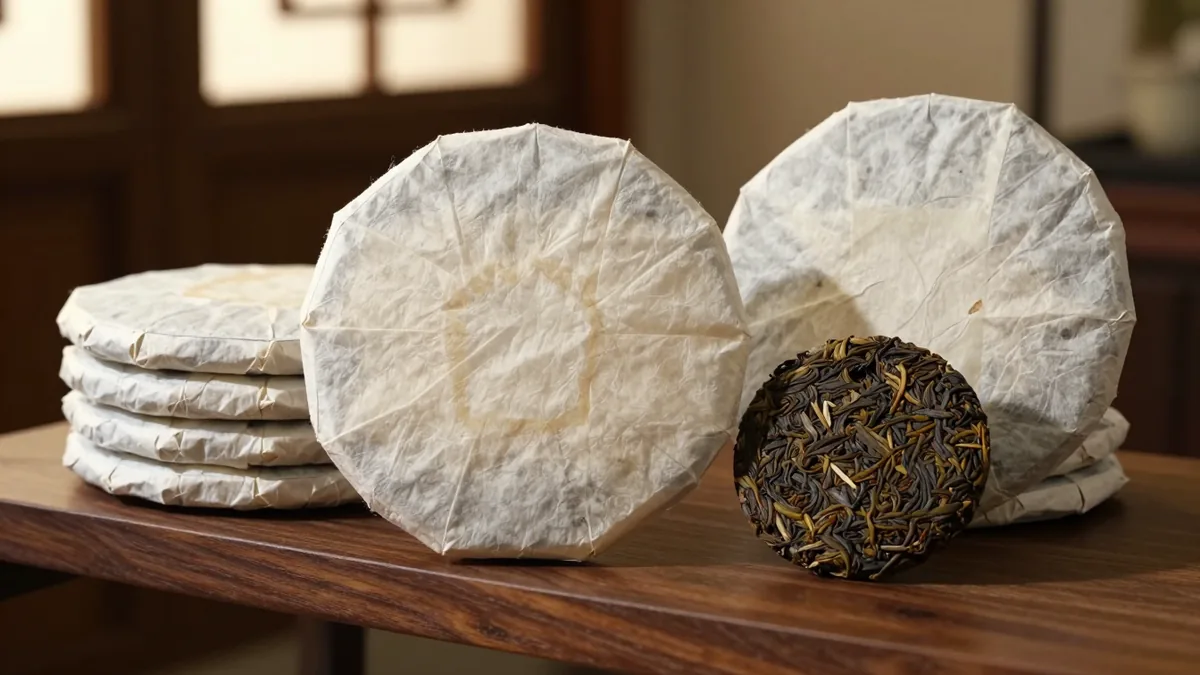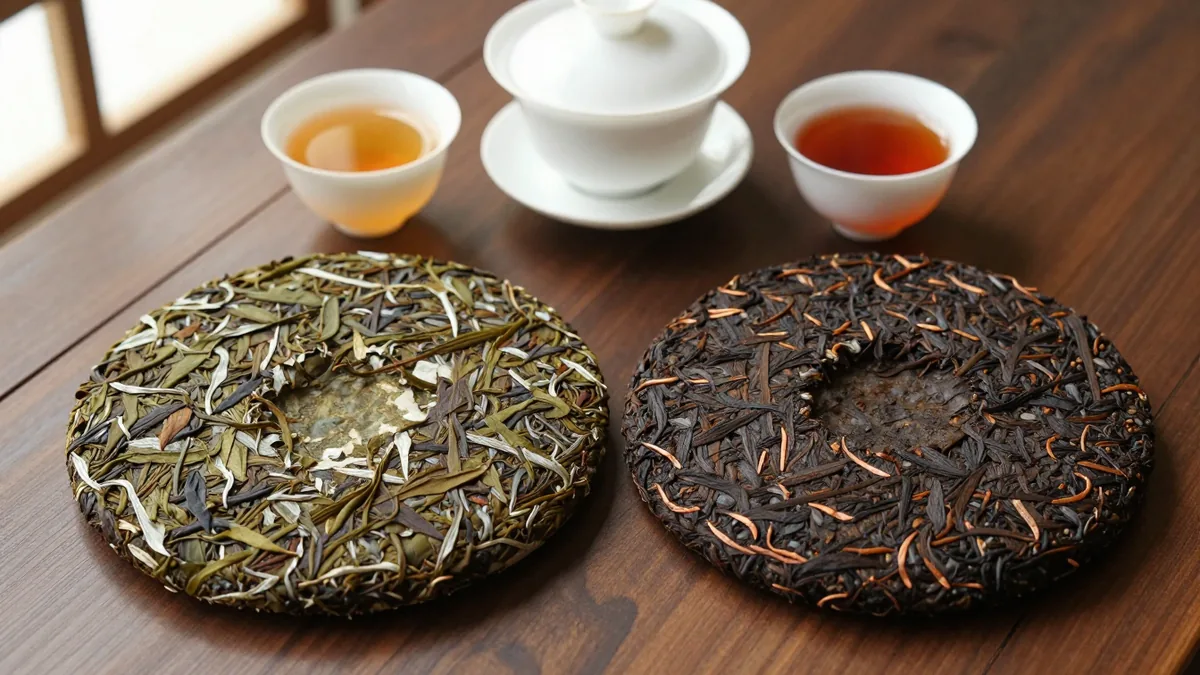
Sheng (raw) puer is sun-dried Yunnan large-leaf tea pressed into cakes and aged slowly for years. Shou (ripe) puer is the same raw material wet-piled for about 45 days so heat and microbes, mostly Aspergillus, turn it dark before pressing. On October 1, 2026 a 357 g Menghai 7572 shou cake cost $32 (about $0.09 per gram) and 200 g young sheng cakes cost $36–$50 ($0.18–$0.25 per gram). Start with 25 g samples at about $8 each.
What the Chinese standard counts as puer
Puer is a protected name in China. The national standard GB/T 22111-2008 defines it as a geographical indication product, and it covers 11 prefectures, 75 counties and 639 townships in Yunnan.
The raw material is fixed: sun-dried maocha (rough, unpressed leaf) from the Yunnan large-leaf variety, grown and processed inside that zone. China's mission to the EU lists the main producing areas as Pu’er, Xishuangbanna, Lincang and Baoshan.
The same source names the two legal types: raw (sheng) puer, "made by compressing loose primary tea directly into dark green teacakes," and ripe (shu or shou) puer, which turns reddish-brown after pile fermentation. Every other difference between them follows from that one step.
Get brewing and teaware notes
Steep times, water temperatures, leaf ratios, and teaware that is worth buying. Free, no spam.
No fixed schedule. Unsubscribe anytime.
How sheng is made
Sheng starts as maocha. The leaf is picked, withered, heated to stop enzyme activity (kill-green), rolled and sun-dried. That sequence, kill-green, rolling, sun-drying, is the base for both types.
For sheng, the maocha is steamed and pressed into a cake with nothing else done to it. Young sheng is green, bitter and astringent. It changes slowly in storage.
The change takes years, not months. White2tea's buyer guide says the distinctive aged character starts at around seven to eight years and becomes more obvious after 10–12 years or longer, depending on storage.
- Day one: green-gold cup, sharp bitterness, fast sweetness on the finish.
- 7–8 years: aged notes begin, per white2tea.
- 10–12+ years: darker cup, softer bitterness, the profile collectors pay for.
How shou is made: the wet pile
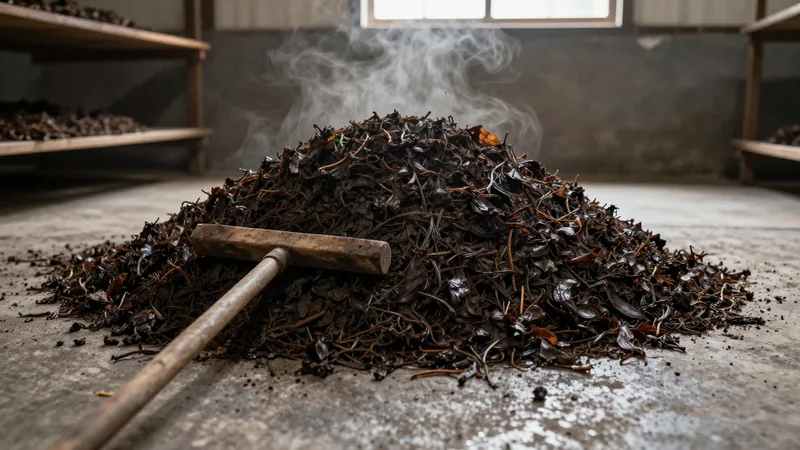
Shou is a 1970s shortcut to that aged color and softness. The wo dui (wet pile) process was developed in 1973 and is usually credited to the Kunming Tea Factory. Yunnan specialists studied piling in Guangdong that year, and within two years the method was refined enough for mass production.
The process, step by step:
- Sun-dried maocha is sprayed with water and piled into a large heap.
- Microbial activity heats the pile to around 50°C for the first 35 days. A 2024 study kept its piles at 40–60°C.
- Workers turn the pile on a schedule so it ferments evenly.
- Around day 35 the temperature falls, and the leaf is spread and dried to about 14% moisture. The whole run takes about 45 days.
- The finished leaf is sorted, steamed and pressed like sheng.
The main organisms are fungi. The same 2024 study in Molecules reports that Aspergillus species are the most common fungi during pu-erh post-fermentation. When the authors added Aspergillus niger to a pile, 95 metabolites went up and 105 went down compared with the control.
The result is a dark red-brown cup with little bitterness on day one. It is meant to be drunk when you buy it rather than aged for a decade.
Sheng vs shou side by side
| Sheng (raw) | Shou (ripe) | |
|---|---|---|
| Extra processing step | None: pressed after sun-drying | Wet pile, about 45 days |
| Time to "finished" taste | 7–12+ years of storage | Ready on purchase |
| Cake color | Dark green to brown | Reddish-brown to black |
| Young flavor | Bitter, astringent, sweet finish | Earthy, smooth, low bitterness |
| Price per gram (our check) | $0.18–$0.30 | $0.09–$0.32 |
| Brew temperature | 95–100°C | 95–100°C |
| Gongfu leaf | 6 g per 100 ml | 6 g per 100 ml |
| Rinses before drinking | 1 | 2 |
Sources: processing from this pile-fermentation account and white2tea; color from China–EU GI listing; prices from the vendor pages in the cost table below; brewing from Yunnan Sourcing.
Both types take boiling or near-boiling water. Yunnan Sourcing recommends 95–100°C and 6 g per 100 ml, with one quick rinse for sheng and two for shou. White2tea suggests dropping young sheng to 95°C or lower if it is too bitter. Our gongfu brewing guide covers the gaiwan routine.
Reading recipe numbers: 7542 and 7572
Menghai Tea Factory (brand name Dayi) sells its standard blends under four-digit recipe numbers. Per TeaDB:
- Digits 1–2: the year the recipe was created. "75" means 1975.
- Digit 3: average leaf grade on a 0–9 scale. It describes leaf size, not quality.
- Digit 4: the factory. 1 is Kunming, 2 is Menghai, 3 is Xiaguan.
So 7542 is a 1975 Menghai recipe built on grade-4 leaf, the benchmark sheng. 7572 is the 1975 Menghai shou recipe with grade-7 leaf; Yunnan Sourcing describes its 2023 batch as "an average blend of 7th grade material". A cake's production code, such as 2301, gives the year and batch.
TeaDB adds two warnings. The recipes have shifted over time to support higher volume, and other producers print famous numbers on cakes that are not from the factory. A "7542" from an unknown seller proves nothing.
What a first cake costs
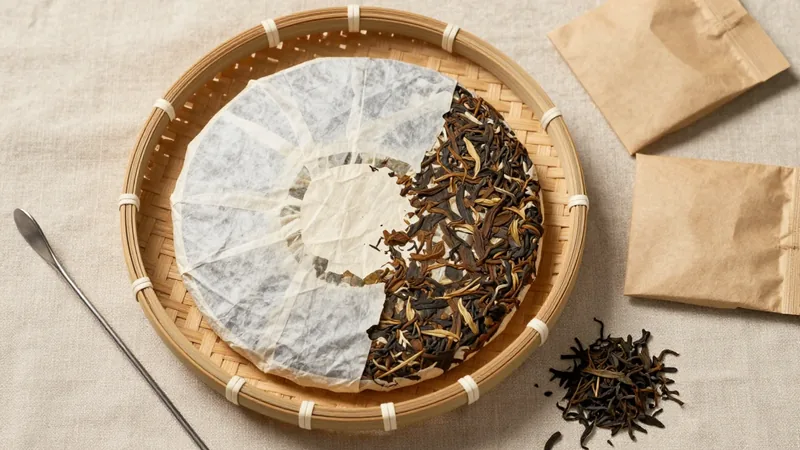
We checked these prices on the vendor pages on October 1, 2026. Prices are in US dollars before shipping.
| Vendor | Tea | Type | Size | Price | Per gram |
|---|---|---|---|---|---|
| Yunnan Sourcing | 2023 Menghai "7572" | Shou | 357 g | $32.00 | $0.090 |
| Yunnan Sourcing | 2025 "Bu Lang Snake" | Shou | 357 g | $48.00 | $0.134 |
| Yunnan Sourcing | 2025 "Bu Lang Snake" sample | Shou | 25 g | $8.00 | $0.320 |
| white2tea | 2025 Green Hype | Sheng | 200 g | $36.00 | $0.180 |
| Yunnan Sourcing | 2025 "Mo Lie Shan" | Sheng | 200 g | $37.00 | $0.185 |
| Yunnan Sourcing | 2025 "Mo Lie Shan" sample | Sheng | 25 g | $7.60 | $0.304 |
| Crimson Lotus Tea | 2025 "Muse" | Sheng | 200 g | $49.99 | $0.250 |
White2tea listed Green Hype as "more stock coming soon" on the day we checked.
The per-session math, using 6 g per gongfu session:
- 7572 shou cake: 6 g × $0.090 = $0.54 per session, about 59 sessions per 357 g cake.
- Mo Lie Shan sheng cake: 6 g × $0.185 = $1.11 per session, about 33 sessions per 200 g cake.
- Bu Lang Snake sample: 6 g × $0.32 = $1.92 per session, 4 sessions per 25 g.
Samples cost more per gram: 1.6 times the cake price for Mo Lie Shan and 2.4 times for Bu Lang Snake. They are still the right first purchase. White2tea's own guide tells new buyers to try a lot of different samples before committing to large quantities. Spend $30–$40 on four samples, then buy the cake you finish first.
A full tong is the classic bulk unit: seven cakes, or 2,499 g of 357 g cakes. White2tea bundles its 200 g cakes five per tong. Neither makes sense until you know what you like. To compare these prices with your other teas, use the tea cost calculator.
Storage, and what the 2007 crash teaches
Puer stored for aging needs steady, moderate humidity. Six Mountains Tea recommends 60–70% relative humidity and 20–30°C. Below that range aging slows; above it, mold becomes the risk. White2tea adds the hazards to avoid: strong odors, direct sunlight, and extremes of heat, dryness, wet or cold. Keep cakes out of the spice cabinet.
The same rules apply to shou and to any cake you plan to drink soon: keep it wrapped, away from smells and light.
Do not buy puer as an investment. In 2007 the market ran up and then broke. Seven Cups reported that prices rose three- to fourfold in the first four months of 2007, peaked in May at 20 times the previous year's level, and then "dropped suddenly" in early July. Fresh puer marketed the previous October had gone from 900 to 1,600 yuan per kilogram, an 80% rise.
TeaDB's advice on modern factory recipes is blunt: don't buy these teas now and expect them to appreciate the way decades-old cakes did. Buy what you want to drink. Check the glossary for maocha, huigan and other label terms.
Frequently Asked Questions
Is shou puer just aged sheng?
No. Shou is sun-dried maocha that went through a wet pile of about 45 days at around 50°C, then was pressed. Sheng is pressed without that step and darkens over 7–12+ years of storage. The pile process was developed in 1973 to imitate aged color and smoothness quickly.
What do the numbers 7542 and 7572 mean?
They are Menghai Tea Factory recipe codes. "75" is the year the recipe began (1975), the third digit is the average leaf grade (4 or 7), and the final "2" means Menghai. 7542 is the benchmark sheng and 7572 the benchmark shou.
How much should a first puer cake cost?
In our October 1, 2026 check, a 357 g Menghai 7572 shou cake cost $32 ($0.09 per gram) and 200 g young sheng cakes cost $36–$50 ($0.18–$0.25 per gram). At 6 g per session that is $0.54 to $1.50 a session. Buy 25 g samples ($7.60–$8.00) first.
How do I store a puer cake at home?
Aim for 60–70% relative humidity and 20–30°C, away from sunlight and strong smells. Keep cakes in their wrappers. Sheng meant for 10+ years of aging is the type that needs steady humidity most.
What water temperature should I use for puer?
Use 95–100°C for both types, with 6 g of leaf per 100 ml. Rinse sheng once and shou twice before the first cup. If young sheng tastes too bitter, drop the water to 95°C or lower.