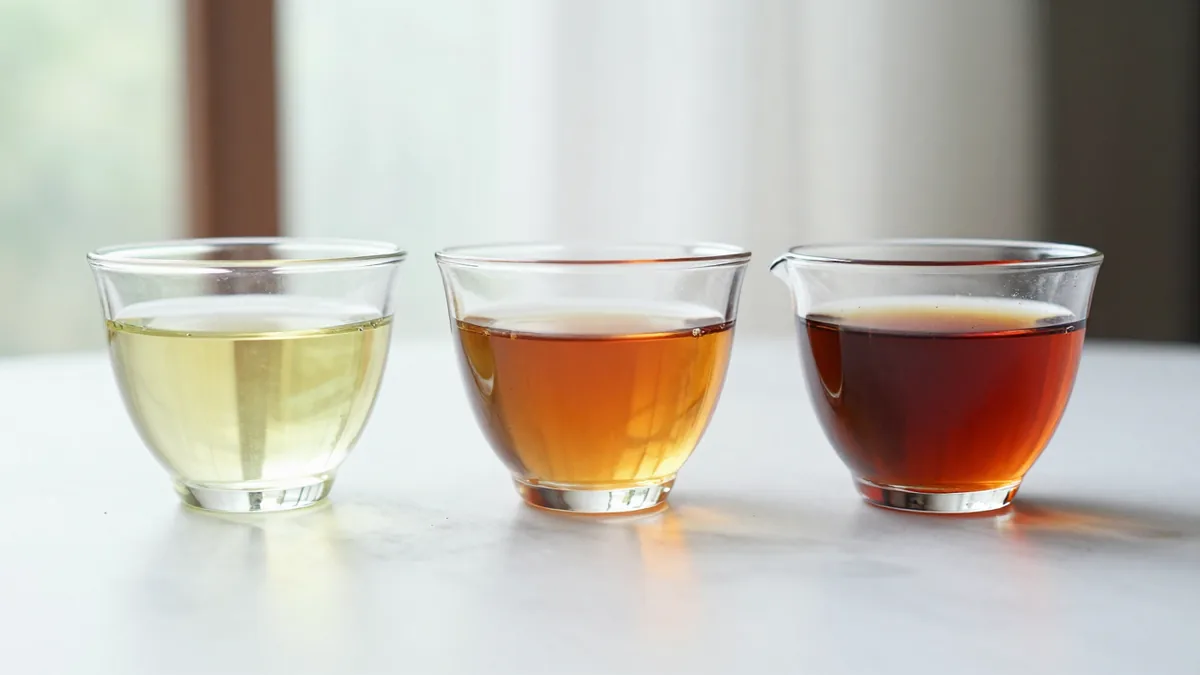
Black tea gets its color from three groups of pigments made when leaf enzymes oxidize catechins: orange-red theaflavins (about 0.3–2.3% of black tea), red-brown thearubigins (9–19% of dry weight) and brown theabrownins. Theaflavins make a cup bright and brisk; thearubigins make it dark and full. Processing reviews give a TF:TR ratio near 1:10 as the quality target; the two fractions have been measured by spectrophotometer since Roberts and Smith's 1961 method.
Where tea color comes from
Fresh tea leaf is green because of chlorophyll. The brew color of black and oolong tea comes from something else: catechins, the colorless polyphenols in the leaf, oxidized into colored compounds.
Two leaf enzymes do the work. A 2023 review of tea pigments in Food Science & Nutrition says the pigments are made by polyphenol oxidase (PPO) and peroxidase (POD), "triggered by turgor loss due to water decrease during wilting." It puts the share of leaf polyphenols that end up as reactive o-quinones at about 75%.
The enzymes and the catechins sit in different parts of the cell. Rolling or cutting the leaf breaks the cells and lets them meet. Green tea makers stop this at the start: steaming or roasting "inactivates enzymes involved in the oxidation". That one step separates green tea from black.
Oolong sits in between. Makers stop oxidation anywhere from 8% to 85%; our oolong oxidation guide covers how each style is made.
Get tasting and processing notes
Oxidation, rolling, roasting oolong, aging pu-erh, and how to taste tea side by side at home. Free, no spam.
No fixed schedule. Unsubscribe anytime.
The three pigments: theaflavins, thearubigins, theabrownins
Each pigment group has its own color and its own job in the cup.
| Pigment | Color | Formed by | Typical share of black tea | Source |
|---|---|---|---|---|
| Theaflavins (TF) | Reddish-orange, golden | Oxidation of catechin pairs by PPO and POD | 0.28–2.30% (regional ranges) | Food Sci Nutr review |
| Thearubigins (TR) | Red, brown-red | Further oxidation and polymerization; partly from TF | 9–19% of dry weight | Food Sci Nutr review |
| Theabrownins (TB) | Brown | TF and TR polymerizing with other compounds | 5.5–13.1% (regional values) | Food Sci Nutr review |
- Theaflavins were first described by Roberts and colleagues in 1957. The review counts four main ones: theaflavin, theaflavin-3-gallate, theaflavin-3'-gallate and theaflavin-3,3'-digallate. A high theaflavin content shows as a "golden circle" on the rim of the glass.
- Thearubigins are "the main contributor to the color of black tea water." Their exact structure is still not settled.
- Theabrownins are water-soluble brown polymers. They are the end of the chain: more of them means a duller, browner cup.
The same review collects regional averages from several studies. Here the TR:TF column is our division of thearubigin by the midpoint of the theaflavin range.
| Black tea origin | Theaflavins (%) | Thearubigins (%) | Theabrownins (%) | TF:TR |
|---|---|---|---|---|
| Darjeeling | 0.28–0.56 | 3.62 | 13.09 | about 1:9 |
| Assam | 0.96–1.91 | 7.26 | 12.25 | about 1:5 |
| Sri Lanka | 0.61–1.15 | 8.40 | 5.54 | about 1:10 |
| African | 1.66–2.3 | 9.80 | 5.63 | about 1:5 |
| Chinese | 0.44–0.89 | 8.21 | 7.34 | about 1:12 |
Source: Table 1 of the Food Science & Nutrition review, compiled from Engelhardt 2013, Owuor et al. 1986 and other studies. Methods differ between studies, so treat the columns as rough.
African teas carry the most theaflavin and Darjeeling the least. Darjeeling also shows the highest theabrownin share, which fits the FAO's description of a liquor that runs from "delicate lime green in the spring flush to bright copper purple in the second flush and pale brown in autumn." Our Assam, Ceylon and Kenya comparison covers how those origins differ in the cup.
Brightness versus depth: the TF:TR ratio
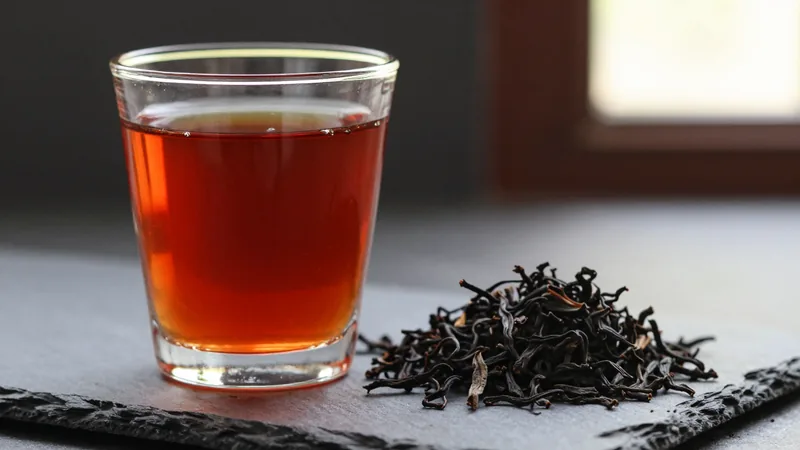
Theaflavin and thearubigin pull the cup in different directions. The 2023 Foods review of black tea processing puts it plainly: "An astringent, brisk taste and golden color come from TF, while a brown-red color and rich mouth feel are contributed by TRs."
So tasters read the balance, not one number:
- High TF, low TR: bright, brisk, golden, thinner.
- Low TF, high TR: dark, heavy, dull.
- Target: the same review says "maintain the (TF:TR) 1:10 ratio to achieve the overall best result," and calls a TR/TF ratio of 8–10 "ordinary for well-fermented tea."
The standard way to measure both comes from E. A. H. Roberts and R. F. Smith in The Analyst in 1961: a spectrophotometric method that reads theaflavins and thearubigins in black tea liquor "in assessments of quality." Later labs added the Flavognost method, which measures theaflavins by complexing them with a reagent (Spiro & Price, 1986; critiqued by Robertson & Hall, 198990033-2)). The 2026 brewing study below still reports results as the same two fractions, TF and TR.
Oxidation time sets the balance
The longer the leaf oxidizes, the more theaflavin turns into thearubigin and theabrownin. The Foods review prints one trial that sampled leaf every 15 minutes:
| Oxidation time (min) | Theaflavins (%) | Thearubigins (%) | TF:TR |
|---|---|---|---|
| 15 | 1.61 | 10.5 | 1:6.5 |
| 30 | 2.29 | 12.5 | 1:5.5 |
| 45 | 2.59 | 12.7 | 1:4.9 |
| 60 | 2.43 | 13.1 | 1:5.4 |
| 90 | 2.29 | 14.2 | 1:6.2 |
| 120 | 2.20 | 12.9 | 1:5.9 |
| 180 | 1.96 | 13.3 | 1:6.8 |
Source: Foods 2023 review, Table 3.
Theaflavin peaked at 45 minutes at 2.59%, then fell 24% by 180 minutes. Thearubigin kept climbing to 14.2% at 90 minutes, then held near 13%. The ratio moved from 1:6.5 to 1:4.9 at the theaflavin peak, then to 1:6.8.
Factory practice follows the same logic. The review reports that CTC tea oxidizes for "about 55–110 min" and orthodox tea for "2–4 h," and that 25 °C for 60 minutes "is considered the optimum." The leaf matters as well: "coarse plucking produces high TRs and low TF," because mature shoots carry more polyphenol oxidase. The same review notes that "in milky and plain tea, fine plucking produces a bright red color."
What brewing does to color
The pigments are fixed when the leaf is dried. Brewing decides how much of them reaches the cup.
A 2026 study in Scientific Reports brewed 2,688 cups of Turkish black tea under different conditions. Water temperature was the strongest factor:
| Water temperature | Theaflavins (%) | Thearubigins (%) |
|---|---|---|
| 75 °C | 0.10 | 12.8 |
| 90 °C | 0.13 | 16.8 |
| 95 °C | 0.16 | 19.6 |
Source: Sci Rep 2026, Table 2, mean of 96 brews per temperature.
Going from 75 to 95 °C raised extracted theaflavin 60% and thearubigin 53%. Panelists scored color highest at 95 °C. Brewing for 20 minutes instead of 15 did not change color scores significantly, and neither did leaving the teapot spout open or closed. Use near-boiling water for black tea if you want the full red. Our steeping chart lists temperatures by type.
Water minerals change color too. In a 2019 study in Nutrients, tea brewed in tap water came out "more cloudy and darker in color" than tea brewed in bottled or deionized water. Hard water also forms the surface film on black tea: the strongest film formed at 200 mg CaCO3 per L, and none formed in pure water. Our water guide has the mineral numbers for common bottled waters.
Green tea browning and aged black tea
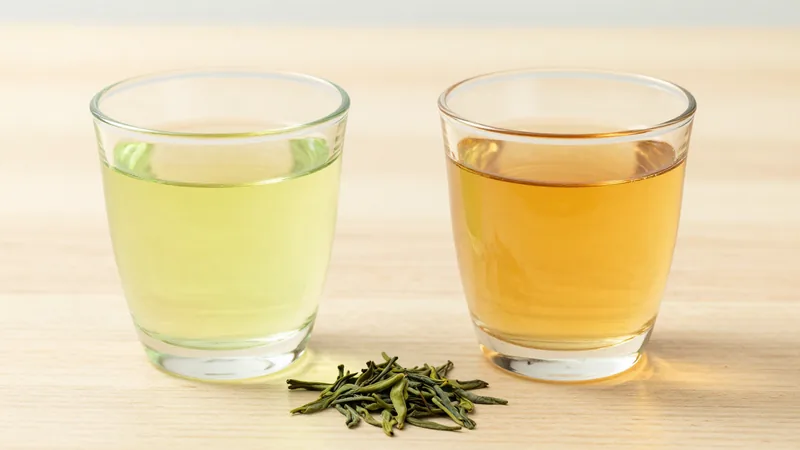
Green tea is never meant to oxidize, so its color problem is browning after brewing. A 2024 study in Foods says green tea color "is influenced by various factors, including the content of chlorophyll, flavonoids, and other pigments, as well as by oxidation and degradation processes." It brewed green tea at 95 °C and then either chilled it to 18 °C or let it cool to 30 °C over 4–5 hours. The fast-chilled tea was "lighter, greener, and yellower"; the slow-cooled tea was "darker, redder."
Practical rules from that and related work:
- Drink green tea fresh or chill it fast. Warm green tea left standing turns toward amber.
- Watch the water. Green tea browning needs both a pH above 6.3 and hardness above 42 ppm CaCO3; our bitter green tea guide explains the chemistry.
- Keep bottled green tea out of light. A 2026 study of unsweetened green tea drinks found about 90% of riboflavin degraded within 5 days under retail-shelf lighting, and chlorophyll dropped about 37.5% after 8 hours of simulated sun. Riboflavin was the main driver of the fading.
Stored black tea keeps changing as well. A 2026 study of Lapsang Souchong stored for up to 10 years found "higher theabrownin levels and lower TR/TB ratios in long-stored samples," so aged leaf brews browner.
Frequently Asked Questions
Why is black tea red instead of black?
The cup color comes from thearubigins (red, brown-red, 9–19% of black tea's dry weight) and theaflavins (reddish-orange, up to about 2.3%). Chinese calls black tea hong cha, "red tea", after the color of the oxidized leaf.
What does the TF:TR ratio tell you?
It measures the balance between bright, brisk theaflavins and dark, full thearubigins. A 2023 Foods review recommends about 1:10 and calls 1:8 to 1:10 normal for well-oxidized tea. In one trial the ratio went from about 1:4.9 at the 45-minute theaflavin peak to 1:6.8 after 3 hours.
Does hotter water make tea darker?
Yes for black tea. In a 2026 study of 2,688 brews, water at 95 °C extracted 60% more theaflavin and 53% more thearubigin than 75 °C, and panelists scored the color higher. Brewing 20 minutes instead of 15 made no significant difference to color.
Why does my green tea turn brown?
Oxidation continues in the cup. In a 2024 study, green tea cooled slowly over 4–5 hours turned darker and redder than the same tea chilled fast to 18 °C. Hard, alkaline water speeds browning, which starts above pH 6.3 and 42 ppm hardness.
Do Darjeeling and Kenyan teas differ in pigment content?
Yes. Compiled studies put Darjeeling theaflavins at 0.28–0.56% and African teas at 1.66–2.30%, with thearubigins at about 3.6% and 9.8%. The studies used different methods, so compare them as ranges, not exact values.