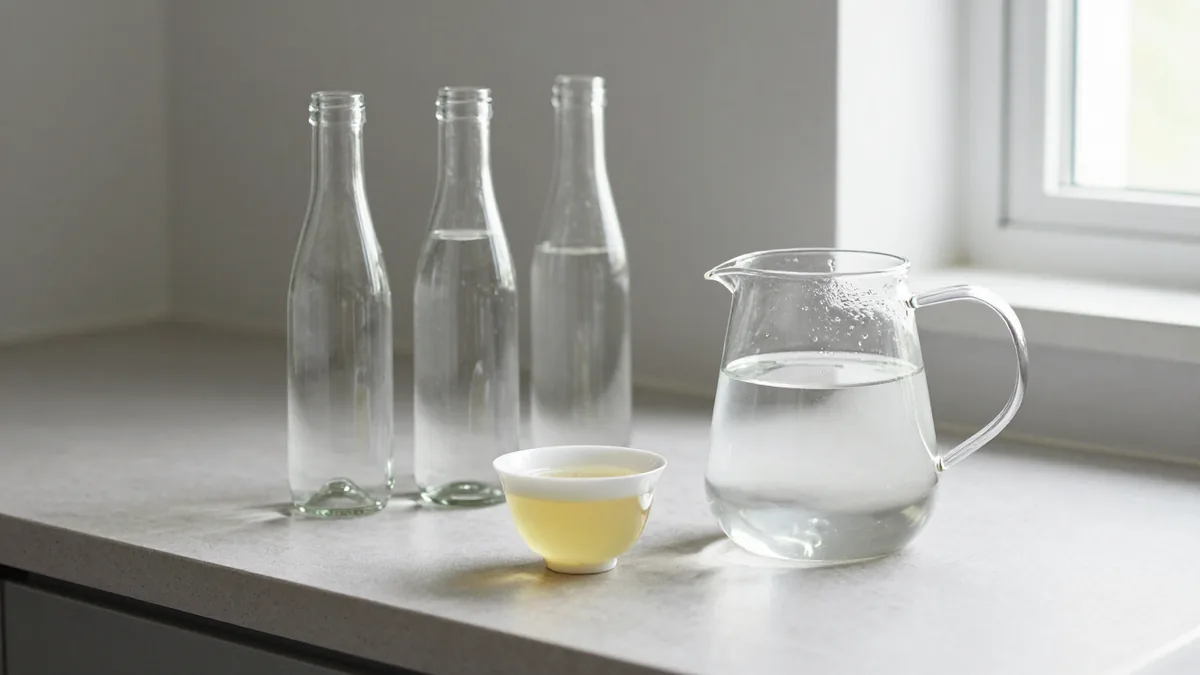
Use soft water with a little mineral in it. Japan's agriculture ministry recommends water under 100 mg/L hardness, ideally 30–80 mg/L, for Japanese tea. Of nine bottled waters we checked, Volvic (about 70 mg/L) and Crystal Geyser's Mount Shasta source (38 mg/L) land in that band. Evian (about 307 mg/L) and S.Pellegrino (about 618 mg/L) are far too hard, and near-pure waters such as Aquafina pull out more bitter catechins.
A cup of tea is mostly water, and the minerals in that water change extraction, color, aroma and the film on top. This guide covers hardness, total dissolved solids (TDS) and pH, what the studies found, and the published mineral numbers for nine bottled waters. Brewing temperatures by tea type are in our Japanese green tea guide and the brewing guides.
What Hardness, TDS and pH Mean
Hardness is the calcium and magnesium in water, reported as mg/L of calcium carbonate (CaCO3). The USGS says hardness is caused by compounds of calcium and magnesium, and by a variety of other metals. Its classes:
| USGS class | Hardness (mg/L as CaCO3) |
|---|---|
| Soft | 0–60 |
| Moderately hard | 61–120 |
| Hard | 121–180 |
| Very hard | over 180 |
Source: USGS Water Science School.
Labels usually list calcium and magnesium in mg/L, not hardness. Convert with the Standard Methods 2340 B formula: hardness = 2.497 × Ca + 4.118 × Mg. Evian lists 80 mg/L calcium and 26 mg/L magnesium, which works out to 2.497 × 80 + 4.118 × 26 = 307 mg/L. Evian's own 2022 California lab report measured 310 mg CaCO3/L, so the formula holds.
TDS is everything dissolved: calcium and magnesium plus sodium, bicarbonate, sulfate, silica and more. A water can be soft and still have high TDS. Fiji has 85 mg/L of silica and 220 mg/L TDS, and about 98 mg/L of hardness.
Every bottled water below that reports pH falls between 6.2 and 8.1. For reference, the EPA's non-enforceable secondary standards are 500 mg/L for TDS and pH 6.5–8.5.
Get tasting and processing notes
Oxidation, rolling, roasting oolong, aging pu-erh, and how to taste tea side by side at home. Free, no spam.
No fixed schedule. Unsubscribe anytime.
What Minerals Do to a Cup of Tea
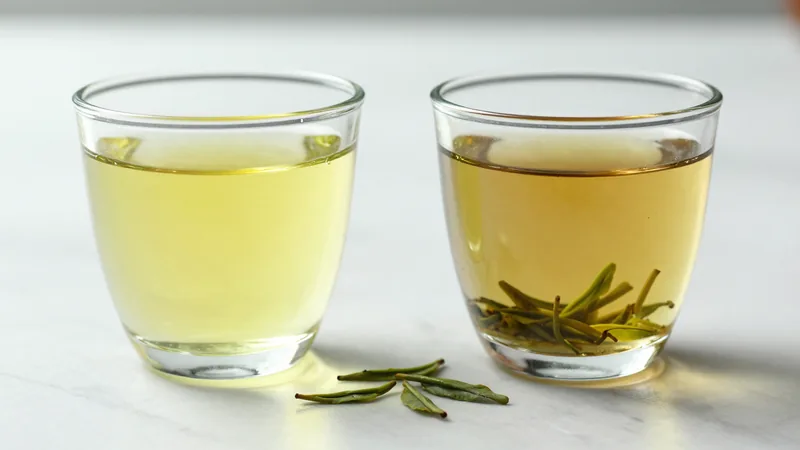
Minerals hold back extraction. A Cornell study brewed the same Zhejiang green tea in Ithaca tap water, Poland Spring and deionized water: 2.5 g of leaf, 125 mL of water at 80 °C, 3 minutes (Franks et al., Nutrients 2019). The tap water had 53.6 mg/L calcium and 9.46 mg/L magnesium; Poland Spring had 8.0 and 1.37. That is about 173 mg/L hardness for the tap (hard, by USGS) against 26 mg/L for the bottled water.
The results:
- EGCG: green tea brewed in the bottled or deionized water had around double the EGCG of the tap-water brew.
- Taste: the panel rated the tap-water green tea far less bitter than both purer waters.
- Liking: overall liking for the green tea was clearly higher for tap than bottled water.
- Black tea: the effect was mild. Black tea is lower in EGCG to begin with.
In short, purer water pulled out more catechins and the mineral-rich water gave a smoother cup. Their tap water also made darker, cloudier infusions for both teas. Neither extreme is ideal, which is why the Japanese guidance below asks for some minerals, not none.
Bicarbonate, the alkaline part of most mineral waters, has its own effect. A 2026 study from the Sichuan Academy of Agricultural Sciences found that low bicarbonate (21.97 mg/L or less) improved aroma and cut bitterness, while 40.27 mg/L or more dimmed the infusion, dulled the aroma and reduced the refreshing taste. It also found high bicarbonate unfavorable to green tea's substance stability but somewhat beneficial to that of black tea. Volvic lists 80 mg/L bicarbonates; Evian lists 360 mg/L.
Hard, alkaline water also browns green tea and destroys catechins. The numbers for that are in why green tea tastes bitter.
Scum: Why Hard Water Leaves a Film
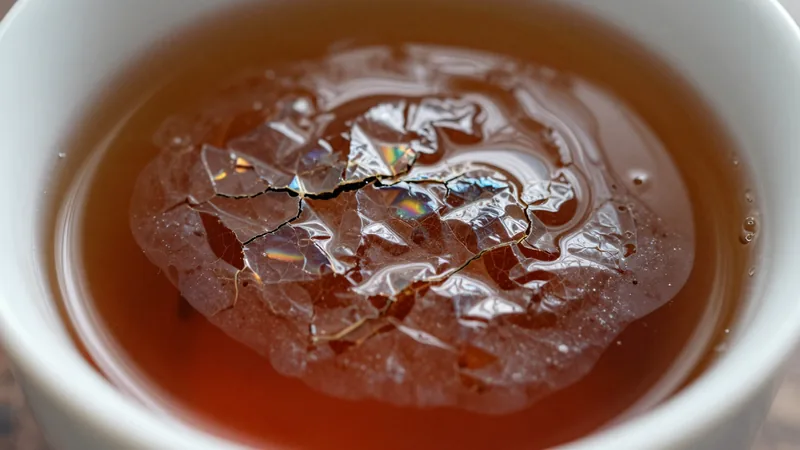
The film on top of a mug of tea is a mineral problem. Spiro and Jaganyi first reported it in Nature in 1993. Later work summarized their finding: the film is high molecular weight organic material with islands of calcium carbonate or bicarbonates of magnesium or manganese.
A 2023 study in Soft Matter measured how strong the film gets in artificial tap water at three hardness levels: 50, 100 and 200 mg CaCO3 per L.
- Pure water: no tea film formed.
- Hard water (200 mg/L): the strongest tea film.
- Citric acid: added to black tea in hard and moderate water, it reduced the film strength to below 10−2 Pa·m. Lemon juice supplies citric acid, which is why a squeeze clears the surface.
- Milk protein: beta-casein made the film more resilient to deformation.
- Green tea: in hard water it formed brittle films that cracked at much lower strain.
If your mug grows a skin, the water is hard. Mountain Valley Spring Water, at 190–200 mg/L hardness, sits at the level that made the strongest film.
Bottled Waters Compared
Numbers come from each brand's published water-quality report or label, checked October 1, 2026. Hardness marked † is our calculation from calcium and magnesium; unmarked hardness is the brand's own reported figure.
| Water | TDS (mg/L) | Ca (mg/L) | Mg (mg/L) | Hardness (mg/L CaCO3) | pH | For tea |
|---|---|---|---|---|---|---|
| Aquafina (2025) | not detected (<10) | not listed | not listed | about 0 | not listed | Too pure for most green tea |
| Smartwater (2025) | under 500 | not listed | added as MgSO4 | not listed | not listed | Distilled base; numbers not published |
| Poland Spring (2025) | 27–84 | 4.2–11 | 0.92–2.3 | 14–38 | 6.2–7.5 | Soft, below the 30–80 band; can push green tea bitter |
| Crystal Geyser, Mt. Shasta | not listed | 6.4 | 5.4 | 38 | not listed | Inside the 30–80 band |
| Volvic | not listed | 13 | 9 | 70† | not listed | Inside the 30–80 band |
| Fiji (2023) | 220 | 18 | 13 | 98† | 7.61 | At the 100 mg/L ceiling |
| Mountain Valley (2025) | 210 | 65–70 | 6.1–7.2 | 190–200 | 7.3–8.1 | Very hard; scum risk |
| Evian | 345 | 80 | 26 | 307† | 7.2 | Very hard; avoid for green and white tea |
| S.Pellegrino (2018 analysis) | 853 | 166 | 49.5 | 618† | not listed | Sparkling and very hard; do not use |
Crystal Geyser values are from the Mount Shasta source as labeled for Japan by its distributor Otsuka Foods; U.S. bottles come from several springs and vary. S.Pellegrino values are its label analysis (University of Pavia, June 20, 2018) as published by Beverfood. Smartwater says it is re-mineralized by the addition of small amounts of magnesium sulfate and potassium chloride but does not publish the amounts.
Calcium does most of the work. In Evian, calcium supplies 2.497 × 80 = 200 mg/L of its 307 mg/L hardness. In Volvic, magnesium supplies more than calcium: 4.118 × 9 = 37 mg/L against 2.497 × 13 = 32 mg/L.
Japanese Guidance and How to Hit 30–80 mg/L
Japan's MAFF brewing manual gives the clearest target: soft water with less than 100mg/L hardness (about 30-80mg/L) is suitable. With hard water, it says, the tea turns pale, loses its fresh aroma and tastes strange. It also says to boil the water properly before brewing.
You can mix your way into that band. Blending two waters averages their hardness by volume:
- 1 part Evian + 3 parts distilled water: 307 ÷ 4 = about 77 mg/L.
- 1 part Mountain Valley + 2 parts distilled: about 195 ÷ 3 = 65 mg/L.
- 1 part S.Pellegrino (flat) + 7 parts distilled: 618 ÷ 8 = about 77 mg/L, though it brings 853 ÷ 8 = about 107 mg/L TDS, much of it sulfate.
Blending also divides bicarbonate. Evian's 360 mg/L becomes 90 mg/L at 1:3, still above the 40 mg/L level where the Sichuan study saw duller green tea.
Pitcher filters help with one part of hardness. Brita says its ion exchange resin reduces both carbonate hardness (limescale) and metals such as copper and lead. Carbonate hardness is the calcium and magnesium paired with bicarbonate, the part that scales kettles. Brita does not say how far it lowers total hardness, so test the result with a strip if you need a number.
Tap water is worth checking before you buy anything. U.S. community water systems must send customers an annual water quality report, the Consumer Confidence Report, each year by July 1. Not every report lists hardness. If yours does, compare it with the USGS table above.
Frequently Asked Questions
What is the best water hardness for tea?
Japan's agriculture ministry recommends under 100 mg/L, ideally 30–80 mg/L, for Japanese tea. That sits in the USGS soft to moderately hard range. Volvic (about 70 mg/L) and Crystal Geyser's Mount Shasta source (38 mg/L) fall inside it.
Is distilled water good for tea?
Not on its own for green tea. In a Cornell study, green tea brewed in deionized water had about double the EGCG of a tap-water brew and tasted far more bitter to the panel. Mix it with a mineral water to reach 30–80 mg/L, for example 1 part Evian to 3 parts distilled for about 77 mg/L.
Why does my tea have a film on top?
Calcium and bicarbonate in hard water bind with tea polyphenols and form a surface film. A 2023 study found no film with pure water and the strongest film at 200 mg/L hardness. Softer water or a squeeze of lemon reduces it.
Is Evian good for tea?
No for green or white tea. Evian has 80 mg/L calcium and 26 mg/L magnesium, about 307 mg/L hardness, which the USGS classes as very hard, plus 360 mg/L bicarbonate. Diluted 1:3 with distilled water it drops to about 77 mg/L.
Does a Brita filter make water better for tea?
It reduces carbonate hardness, the part of hardness that scales kettles and forms tea film, according to Brita. It does not publish how much total hardness remains, so a test strip is the only way to know your number.