Caffeine leaves broken tea leaf fast: one kinetics study measured a rate constant of 0.99 per minute at 80 °C, which works out to about 95% of the extractable caffeine in 3 minutes. Whole leaf is slower. A study of commercial teas found a 3-minute steep gave two-thirds of what 90 minutes gave, and about 20 minutes was needed for full extraction. A second infusion of green tea still carried a median 83% of the first cup's caffeine.
How caffeine leaves the leaf
Caffeine extraction follows first-order kinetics: the rate is proportional to how much caffeine is still in the leaf. Early minutes extract the most, and each later minute adds less.
A South African kinetics study measured black tea leaf sieved to 1.40–2.00 mm. At 80 °C the rate constant was 0.99 per minute, and the activation energy was 40.3 kJ/mol00101-0). The same paper found caffeine diffusion through the leaf was hindered by factors of 86 to 54 compared with caffeine in plain water. The leaf structure, not the water, sets the pace.
Two more results shape the curve:
- Two speeds. An Iranian green tea study found extraction runs as two diffusion processes, fast and slow, with diffusion inside the particle as the rate-governing step. Its best caffeine conditions were 20–40 minutes at 80 °C, far past any drinking steep.
- Green leaf released caffeine faster than black. A Japanese sencha study found the caffeine infusion rate and activation energy were significantly larger than for black teas90086-8), which the authors linked to manufacturing differences.
If you only want the headline per-cup numbers by tea type, they are in our tea vs coffee caffeine comparison. This article is about the curve: how much of the caffeine is out at each minute.
Get caffeine and decaf notes
How much caffeine each tea type carries, how decaf tea is made, and caffeine-free alternatives. Free, no spam.
No fixed schedule. Unsubscribe anytime.
Modeled extraction by minute and water temperature
We plugged the published rate constant into the first-order equation (share extracted = 1 − e−kt) and used the 40.3 kJ/mol activation energy to scale k to other temperatures. The result: k of 0.66 per minute at 70 °C, 1.44 at 90 °C and 2.07 at 100 °C. Boiling water extracts caffeine about 2.1 times as fast as 80 °C water. 70 °C runs at about 0.67 times the 80 °C rate.
| Steep time | 70 °C | 80 °C | 90 °C | 100 °C |
|---|---|---|---|---|
| 30 s | 28% | 39% | 51% | 64% |
| 1 min | 49% | 63% | 76% | 87% |
| 2 min | 73% | 86% | 94% | 98% |
| 3 min | 86% | 95% | 99% | >99% |
| 5 min | 96% | 99% | >99% | >99% |
| 10 min | >99% | >99% | >99% | >99% |
Source for k and activation energy: Jaganyi & Price, Food Chemistry 199900101-0). Percentages are our calculation, share of extractable caffeine.
Read this table as the fast case. It describes small, loose, stirred particles of black tea at a fixed temperature. A real mug cools, the leaf is often whole, and nobody stirs. The model also ignores the first seconds when dry leaf is still wetting. Whole leaf lags well behind these numbers, as the next section shows.
Whole leaf vs broken leaf
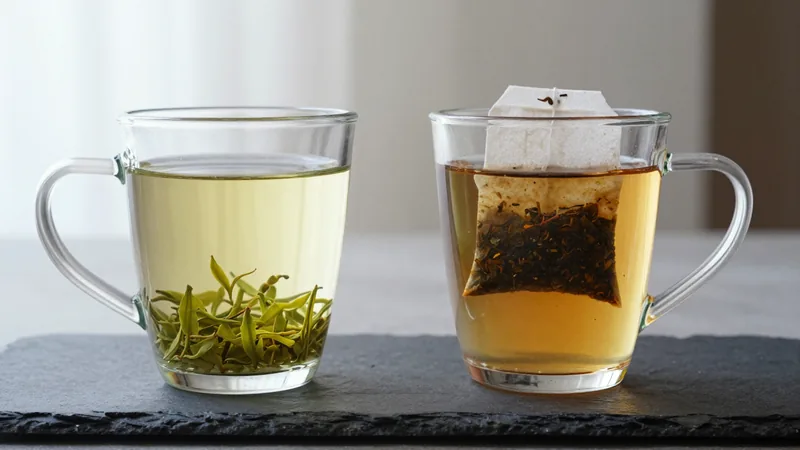
Particle size is the biggest variable after time. Four measurements line up:
- Crushed (CTC) black tea: 5 g in 500 mL of just-boiled water, stirred. Caffeine was extracted within a very short period, with rapid extraction in the first two minutes. At 20 minutes the brew held 42.1 mg of caffeine per gram of leaf, essentially the study's fitted extraction capacity of 42.2 mg/g.
- Whole-leaf green tea: 1 g in 100 mL of 80 °C water. About 20 min was required for total extraction, and 90 minutes gave 1.5 times the caffeine of 3 minutes. So a 3-minute steep delivered about two-thirds of the long-steep amount.
- Ground vs unground Thai tea: for unground leaf, caffeine kept rising with time until about 15 minutes, then levelled off. For ground leaf, infusion time made no difference. Ground Camellia sinensis var. sinensis gave 26.8 mg per 100 mL against 22.3 mg for the unground leaf.
- Tea bags: a bag slows extraction when it is cramped. The rate constant rose with bag size until the leaf-to-bag size ratio reached 1:1000186-8). Bag shape had no effect. The paper itself is not the barrier. A separate test found the resistance of the teabag membrane itself was negligible00251-4) at 25 and 80 °C.
The practical split: bagged and broken leaf is close to done at 3 minutes. Whole leaf at 3 minutes still has roughly a third of its caffeine left in it.
Worked numbers: milligrams in your cup
The Hungarian study above measured 37 commercial teas with the same 3-minute, 80 °C, 1 g per 100 mL method. Its mean caffeine values let you estimate a cup (Boros et al. 2016).
| Tea type | Caffeine extracted in 3 min (mg/g) | 3 g leaf, 3 min (mg) | 3 g leaf, full extraction (mg) |
|---|---|---|---|
| White | 16.79 | 50 | 76 |
| Green | 16.28 | 49 | 73 |
| Oolong | 19.31 | 58 | 87 |
| Black | 17.73 | 53 | 80 |
The last column multiplies by 1.5, the 3-minute to 90-minute ratio the study measured on one green tea (a Yunnan FOP). Treat it as an upper estimate for the other types. The type means sit within 3.1 mg/g of each other. The authors concluded caffeine content gave no information on the effect of processing.
Example: 3 g of green tea in 300 mL at 80 °C (the same 1 g per 100 mL ratio):
- 3 minutes: 3 g × 16.28 mg/g = 49 mg.
- Steep it until it stops changing: 49 mg × 1.5 = 73 mg.
- Forgetting the leaf in the mug for 20 minutes adds about 24 mg. Choosing a different tea type at the same steep changes the cup by less than 10 mg.
To pick a leaf weight first, use the tea ratio calculator.
Second and third infusions
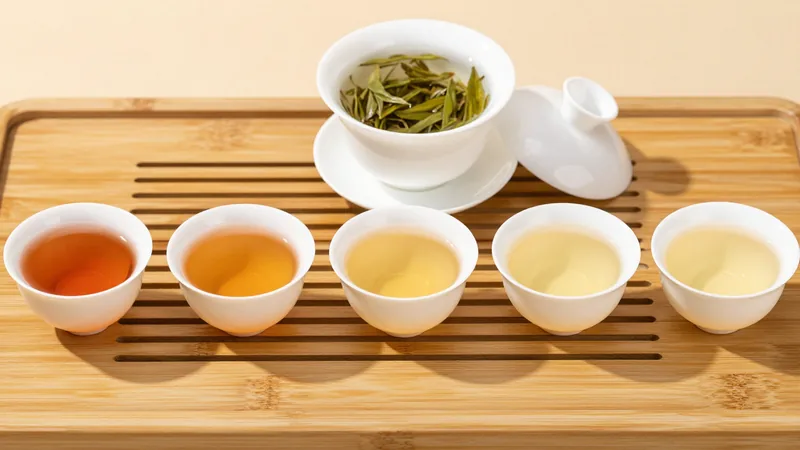
Re-steeping does not reset to zero caffeine, and the second cup is sometimes the stronger one.
- 17 loose green teas, label instructions (60–90 °C, 1–2 min, 11–13 g/L): the second infusion held a median of 83% of the first infusion's caffeine. The lowest was 62%, and only three samples were above 95%. Theanine dropped harder, to a median of 58%.
- Bag tea steeped eight times for 30 s each (3 g, 150 mL): at 70 °C the second infusion contained the most caffeine. At 85 and 100 °C the first did, with gradual declines after.
- Green tea, 4 g in 100 mL at 85 °C, 2 minutes per infusion: caffeine was significantly higher in the second infusion than in the first, and lowest in the third. The same paper notes earlier work that found sequential 50% drops with 3-minute infusions at 80–100 °C.
Why the second cup holds up: wet leaf extracts more efficiently. The German study found the second infusion's extraction efficiency (share of what was left in the leaf) was often higher than the first, probably because the leaf structure is already soaked with water and more permeable.
Worked example with the USDA green tea value of 12 mg per 100 g, or 28 mg per 237 g cup: a second cup at 83% adds 24 mg, so two cups from one dose of leaf give about 52 mg, not 28 mg.
Gongfu session math
Gongfu uses more leaf and short infusions, so the session total depends on how fast caffeine falls off from cup to cup. Studies measured either two infusions or very different leaf, so we modeled two decay rates over six infusions: 83% per step (the green tea median above) and 50% per step (the older halving result).
| Infusion | Share of 6-infusion total at 83% per step | Share at 50% per step |
|---|---|---|
| 1 | 25% | 51% |
| 2 | 21% | 25% |
| 3 | 17% | 13% |
| 4 | 14% | 6% |
| 5 | 12% | 3% |
| 6 | 10% | 2% |
Derived from Zimmermann & Drees 2025 and the halving result cited in Journal of Food Science 2026.
- At 50% per step, the first three cups carry 89% of the session caffeine.
- At 83% per step, they carry 64%, and cups four to six still matter.
- Ceiling for a 5 g green tea session: 5 g × 16.28 mg/g × 1.5 = 122 mg if every infusion together reached full extraction. For oolong at 19.31 mg/g it is 145 mg.
Leaf weights and timings for each tea type are in our gongfu brewing guide.
How to cut or raise caffeine with time and temperature
To get less caffeine per cup:
- Use whole leaf, not bags or dust. Whole leaf at 3 minutes leaves about a third of its caffeine behind.
- Steep shorter. On the model, 1 minute at 80 °C pulls 63% of extractable caffeine from broken leaf; 3 minutes pulls 95%.
- Drop the temperature. 70 °C cuts the extraction rate to about 0.67 of the 80 °C rate.
- Stop after one or two infusions if the later cups are the problem. On the 50% decay model, cups four to six carry 11% of the session; on the 83% model they carry 36%.
To get more: use boiling water, bagged or broken leaf, a longer steep, or a second infusion. If you want caffeine close to zero, steeping tricks do not get you there. Use a decaffeinated tea (how decaf tea is made).
Starting times and temperatures for each tea type are in the steeping chart.
Frequently Asked Questions
Does steeping tea longer increase caffeine?
Yes, until the leaf runs out. Broken black leaf at 80 °C reaches about 95% of its extractable caffeine in 3 minutes on the published rate constant. Whole-leaf green tea kept releasing caffeine for about 20 minutes, and 90 minutes gave 1.5 times the 3-minute amount.
Does hotter water extract more caffeine?
It extracts it faster. Using the measured activation energy of 40.3 kJ/mol, caffeine leaves black tea about 2.1 times as fast at 100 °C as at 80 °C. At 70 °C the rate is about 0.67 of the 80 °C rate.
How much caffeine is in a second infusion?
In 17 green teas brewed to label instructions, the second infusion had a median of 83% of the first infusion's caffeine, with a low of 62%. In two other studies the second infusion was the strongest: one used 70 °C water, the other 2-minute infusions at 85 °C.
Do tea bags release caffeine faster than loose leaf?
Broken leaf releases caffeine faster than whole leaf, and bags usually hold broken leaf. Crushed CTC tea released its caffeine rapidly in the first two minutes. For ground Thai tea, steep time made no difference. A cramped bag slows extraction until the leaf-to-bag size ratio reaches 1:10.
How much caffeine is in a gongfu session?
It depends on leaf weight and how many infusions you drink. For 5 g of green tea, the extractable ceiling is about 122 mg, using 16.28 mg/g extracted at 3 minutes and the 1.5 times multiplier for full extraction. The first three infusions carry 64%–89% of a six-infusion session, depending on how fast caffeine falls between cups.