Hojicha is Japanese green tea roasted at about 160–180 °C, which turns it brown and builds nutty pyrazines. Roasting cuts catechins far more than caffeine: in one study a hojicha serving had 26 mg caffeine against 28 mg for green tea, but 37.4 mg catechins against 94.4 mg. Genmaicha is green tea mixed with roasted rice, usually about half and half, so a cup has roughly half the caffeine of plain sencha. As of October 1, 2026, our catalog's median plain genmaicha costs $0.14 per gram, hojicha powder $0.35, and loose hojicha $0.19 (or $0.60 from specialist Kettl).
Hojicha and genmaicha are the two everyday Japanese teas built on cheaper leaf. Our Japanese green tea types guide covers the official definitions and how they fit next to sencha and gyokuro. This piece goes into what roasting and rice actually change in the cup, what the caffeine numbers say, and how the styles inside each tea differ in price.
What Roasting Does to the Leaf
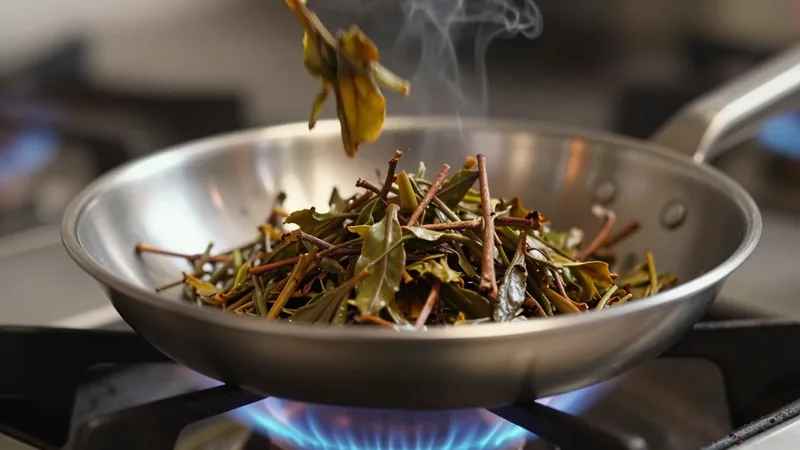
Hojicha is made by roasting already-dried green tea. Japan's National Institute of Vegetable and Tea Science tested roast conditions and found the target flavor at 160 °C for 30 minutes or 180 °C for 15 minutes. An Ito En-funded study describes commercial hojicha the same way: sencha or bancha roasted at 160–180 °C.
Three things change in that window:
- Aroma. The same study identified 2-ethyl-3,5-dimethylpyrazine and 2-ethyl-3,6-dimethylpyrazine as potent odorants.
- Catechins. The bitter, astringent catechins break down. Roasting at 160 °C degraded fewer catechins than 180 °C.
- Acrylamide. Roasting forms it. Infusions measured 2.0 µg/L after the 160 °C roast and 4.0 µg/L after 180 °C, so the cooler, longer roast halved it.
Roast depth is a style choice. What-Cha sells Obubu's Kyoto hojicha in a light and a dark roast from the same farm, and both brew at about 85 °C for 60–90 seconds.
Get caffeine and decaf notes
How much caffeine each tea type carries, how decaf tea is made, and caffeine-free alternatives. Free, no spam.
No fixed schedule. Unsubscribe anytime.
Does Roasting Remove Caffeine?
Much less than its reputation suggests. Caffeine sublimes at 178 °C, inside the roasting range, which is where the "roasting burns off caffeine" claim comes from. The measured numbers are smaller.
| Per serving (Ito En study) | Green tea | Hojicha | Hojicha as % of green |
|---|---|---|---|
| Caffeine | 28 mg | 26 mg | 93% |
| Catechins | 94.4 mg | 37.4 mg | 40% |
| Theanine | 6 mg | not detected | 0% |
Source: Kurosaka et al., Scientific Reports 2024. The two drinks were commercial products, not the same leaf before and after roasting, and the study was funded by Ito En.
Japan's official food composition table shows the same pattern. Brewed at its standard ratio, hojicha has 0.02 g caffeine per 100 g of infusion, identical to sencha's 0.02 g. Tannins differ: 0.04 g for hojicha against 0.07 g for sencha.
At that ratio, a 240 mL cup of either tea carries about 48 mg caffeine. Popular guides quote lower: BBC Bitesize puts a cup of hojicha at 7–20 mg. A lighter cup is real when hojicha is made from late-season bancha or stems, brewed for 30 seconds, or made with fewer grams. The roast itself removes little caffeine. For a wider comparison, see caffeine in tea vs coffee.
Hojicha Styles: Leaf, Stems, Tencha and Powder
The usual origin story is attributed, not documented. Bon Appetit says hojicha is thought to have originated in Kyoto in the 1920s, and BBC Bitesize repeats that a Kyoto merchant roasted leftover green tea leaves to avoid wasting them.
Today the base leaf sets the style:
- Bancha hojicha. Made from later-harvest leaf. The Ito En study defines hojicha as roasted sencha or bancha.
- Kyobancha / iribancha. A Kyoto style made from the year's last leaves, steamed for 30 minutes, then dried and roasted. Kettl sells Ryuouen's Iribancha at $0.12/g in a 300 g bag.
- Kuki hojicha (stem hojicha, boucha). Roasted stems. The Global Japanese Tea Association notes roasted kukicha runs woody and sweet vanilla. Ippodo's Stems Hojicha is $0.16/g.
- Tencha hojicha. Roasted stems left over from matcha-grade tencha. Kettl's House Roasted Asahi Tencha Houjicha is the top of the catalog at $1.20/g.
- Hojicha powder. Roasted leaf milled fine for lattes and baking. Rishi's Houjicha Powder uses 5.5 g per latte, or $4.26 of powder per drink at its listed price.
| Hojicha style (in stock) | Listings | Median $/g | Range $/g |
|---|---|---|---|
| Loose leaf, Kettl | 8 | $0.60 | $0.12–$1.20 |
| Loose leaf, 8 other vendors | 10 | $0.19 | $0.13–$0.56 |
| Stem hojicha (kuki, boucha) | 3 | $0.17 | $0.16–$0.60 |
| Tencha hojicha | 2 | $0.90 | $0.60–$1.20 |
| Powder | 5 | $0.35 | $0.21–$0.78 |
Source: Tea Explorer catalog, 7,306 teas from 40 vendors, fetched 2026-10-01 (see the tea price index). Flavored powders, latte mixes and a smoked hojicha are excluded. Stem and tencha rows overlap the loose-leaf rows.
Kettl alone accounts for 8 of the 18 loose listings, and its house-roasted and tencha hojicha pull the price up: its median is 3.1x the other vendors'. Powder costs 1.8x non-Kettl loose leaf at the median.
Genmaicha: Rice, Popped Grains and Matcha
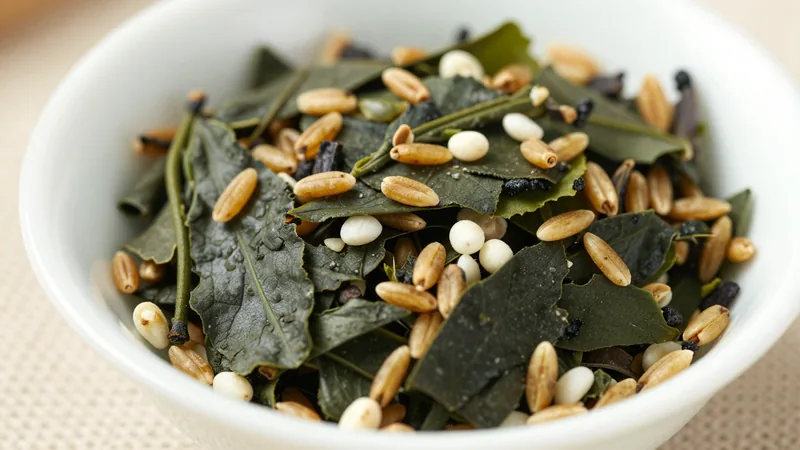
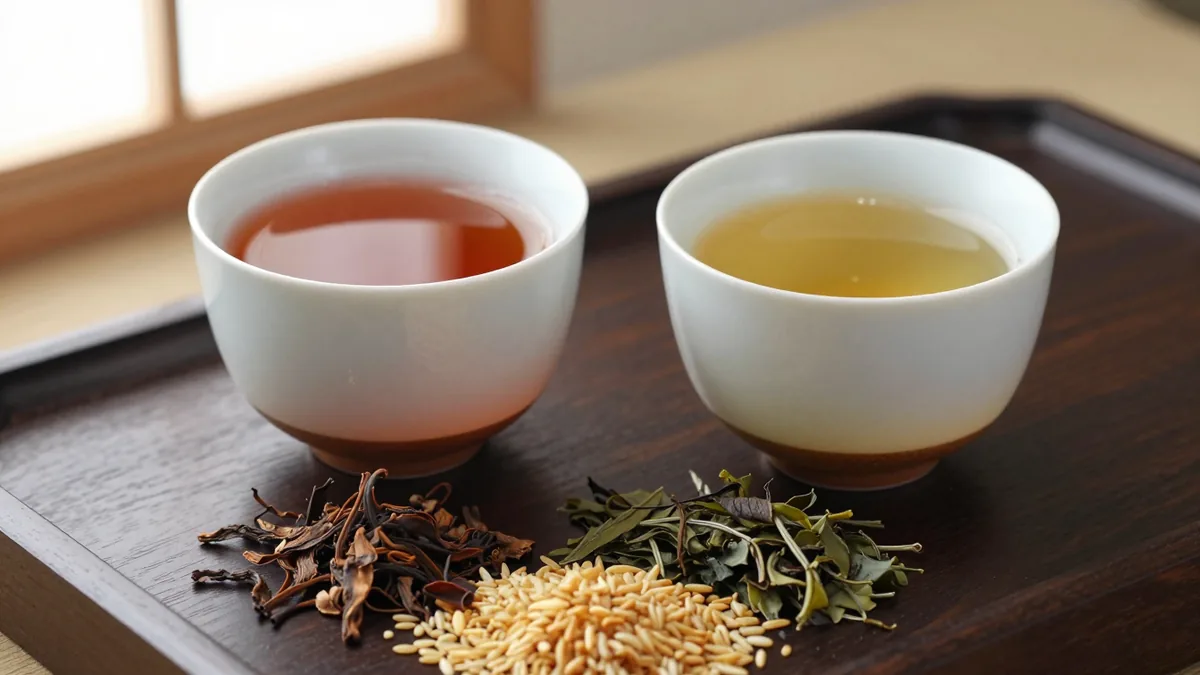
Genmaicha is green tea plus roasted rice. The Global Japanese Tea Association gives the proportions as usually half rice and half tea, with bancha as the usual base and sometimes high-grade sencha.
The rice varies:
- Grain. Usually roasted white rice, or sometimes glutinous (mochi) rice. Rishi lists organic roasted sticky rice in its blend.
- Popped kernels. Some grains burst during roasting and look like popcorn. Nio sells a version built around them, Genmaicha Popcorn.
- Matcha-iri genmaicha. Some producers add matcha to the blend. Seven catalog listings are this style.
The origin is folklore. The same association lists three competing tales: a servant dropping rice into a samurai's cup, a Kyoto merchant mixing leftover New Year's mochi into tea, and a sweet maker salvaging dropped mochi.
Because half the weight is rice, the caffeine drops. Japan's food table lists brewed genmaicha at 0.01 g caffeine per 100 g, half of sencha, which is about 24 mg in a 240 mL cup.
| Genmaicha style (in stock) | Listings | Median $/g | Range $/g |
|---|---|---|---|
| Plain genmaicha | 11 | $0.14 | $0.11–$0.29 |
| Matcha-iri genmaicha | 7 | $0.19 | $0.10–$0.37 |
Source: Tea Explorer catalog, fetched 2026-10-01. Flavored blends (yuzu, rose) and a gift-caddy listing are excluded.
Matcha-iri costs 1.34x plain genmaicha at the median, a small premium for the added powder. Ippodo's Genmaicha sits near the plain median at $0.14/g.
Hojicha vs Genmaicha Side by Side
| Hojicha | Genmaicha | |
|---|---|---|
| What it is | Green tea roasted after drying | Green tea plus roasted rice |
| Usual base | Bancha, stems, sometimes sencha | Bancha, sometimes sencha |
| Heat step | Leaf roasted at 160–180 °C | Rice roasted, leaf not |
| Key aroma | Pyrazines from roasting | Toasted grain |
| Caffeine, MEXT standard brew | 0.02 g/100 g | 0.01 g/100 g |
| Tannin, MEXT standard brew | 0.04 g/100 g | 0.01 g/100 g |
| Catalog median, as of Oct 1, 2026 | $0.19/g loose, non-Kettl (n=10) | $0.14/g plain (n=11) |
Sources: Mizukami et al.; Kurosaka et al.; MEXT food composition entries for hojicha and genmaicha; GJTA; Tea Explorer catalog.
Both follow MEXT's same test brew: 15 g of leaf in 650 mL of 90 °C water for 30 seconds, or 2.3 g per 100 mL.
How to Brew Both
Vendor instructions run from 80 °C to boiling and from 30 seconds to 3 minutes.
| Source | Tea | Leaf | Water | Temp | Time | g per 100 mL |
|---|---|---|---|---|---|---|
| Ippodo | Hojicha, genmaicha | 10 g | 240 mL | 100 °C | 30 s | 4.2 |
| Kettl | Iribancha | 5 g | 180 mL | 190 °F (88 °C) | 1 min | 2.8 |
| Nio | Genmaicha | 5 g | 150 mL | 80 °C | 1 min | 3.3 |
| Rishi | Genmaicha | 1 tbsp | 8 oz | 180 °F (82 °C) | 2–3 min | n/a |
Ippodo's reason for boiling water is aroma: it says to use water that is boiling vigorously to get the full aroma. Ten grams is 4 tablespoons of fluffy hojicha but only 2 of denser genmaicha, so weigh rather than scoop.
Cost per 10 g pot at catalog medians:
- Loose hojicha, non-Kettl: $1.90
- Loose hojicha, Kettl: $6.00
- Hojicha powder: $3.50
- Plain genmaicha: $1.40
- Matcha-iri genmaicha: $1.90
Nio re-steeps its genmaicha 2–3 more times at 20 seconds each; Rishi re-steeps once. If a cup tastes harsh, check the troubleshooting steps in our bitter tea guide, and the steeping chart for other teas.
Frequently Asked Questions
Does hojicha have less caffeine than green tea?
Only slightly at the same leaf ratio. In an Ito En study the hojicha serving had 26 mg caffeine against 28 mg for green tea, and Japan's food table lists both hojicha and sencha at 0.02 g per 100 g of brewed tea. Lower-caffeine cups come from stem or bancha bases, fewer grams and 30-second steeps.
What temperature is hojicha roasted at?
A Japanese government tea institute found the target flavor at 160 °C for 30 minutes or 180 °C for 15 minutes. The 160 °C roast kept more catechins and produced half the acrylamide (2.0 vs 4.0 µg/L in the infusion).
How much rice is in genmaicha?
Usually about half rice and half tea by the Global Japanese Tea Association's description. That is why brewed genmaicha lists 0.01 g caffeine per 100 g in Japan's food table, half of sencha's 0.02 g.
Is hojicha powder worth the price?
At the median it costs $0.35 per gram against $0.19 for loose leaf outside Kettl's premium line, or 1.8x. Buy it for lattes and baking, where you drink the whole leaf; for brewed cups, loose leaf is cheaper per pot.
What water temperature should I use for genmaicha?
Ippodo uses boiling water for 30 seconds, while Nio uses 80 °C for 1 minute and Rishi 180 °F for 2–3 minutes. The Global Japanese Tea Association suggests 90 °C or hotter to bring out the buttery rice aroma.