Per 100 mL, yerba mate and green tea are close: a Brazilian caffeine table lists chimarrão at 26 mg and infused green tea at 20 mg. The serving makes the difference. A 350 mL chimarrão gourd delivers about 91 mg, against 40 mg for a 200 mL cup of green tea, because a gourd holds around 50 g of leaf. The safety issue is heat: IARC classifies drinks above 65 °C as probably carcinogenic, and traditional mate is drunk at about 70 °C.
What yerba mate is
Yerba mate is not tea. It is the dried leaf and twig of Ilex paraguariensis, a holly. Tea comes from Camellia sinensis. Both contain caffeine, which is why they get compared.
The plant is native to southern Brazil, northeastern Argentina and Paraguay, and it is drunk mainly in those countries and Uruguay. The first harvest comes 3–5 years after planting.
Commercial mate comes in two basic cuts. Elaborada con palo contains up to 30% twigs and sticks; despalada contains up to 10%. The bag on a shelf in South America is mostly chopped leaf, stem and dust, not whole leaves.
Get caffeine and decaf notes
How much caffeine each tea type carries, how decaf tea is made, and caffeine-free alternatives. Free, no spam.
No fixed schedule. Unsubscribe anytime.
Who grows and drinks it
Argentina's national yerba mate institute (INYM) publishes monthly mill data. For January–December 2025 it reported (INYM statistics 2025):
| Measure, Argentina, 2025 | Volume |
|---|---|
| Green leaf delivered to dryers | 889.3 million kg |
| Processed mate shipped from mills to the domestic market | 266.8 million kg |
| Mate exported | 58.0 million kg |
| Mate exported in 2024 | 43.8 million kg |
Exports grew 32% in a year but were still only 18% of mill shipments. Argentina drinks most of what it makes.
Uruguay drinks the most per person: an average of 25 g of dried product per inhabitant per day. That is half a gourd of leaf every day for every person in the country.
Caffeine per gram and per serving
The leaf itself is not stronger than tea. A 2025 review puts mate's caffeine at 0.3% to 1.8% of dry weight, or 3–18 mg/g. Tea leaf extracts about 16–19 mg/g in a 3-minute steep (Boros et al. 2016). Per serving, mate wins because of the leaf dose.
The Brazilian Caffeine Content Table (BraCaffT) compiled published values for local drinks (Brazilian Caffeine Content Table, Nutrients 2022):
| Drink | Mean caffeine (mg/100 mL) | Range (mg/100 mL) | Serving | Caffeine per serving (mg) |
|---|---|---|---|---|
| Chimarrão (hot, in a gourd) | 26 | 14–52 | 1 gourd, 350 mL | 91 |
| Tereré (cold, in a gourd) | 24 | 17–36 | 1 gourd, 350 mL | 84 |
| Green tea, infused | 20 | 17–21 | 1 cup, 200 mL | 40 |
| Mate tea, infused (roasted, bagged) | 5 | – | 1 cup, 200 mL | 10 |
Source: BraCaffT, Table 1.
Worked numbers:
- One gourd vs cups of green tea: 91 mg / 40 mg = 2.3 cups of green tea per gourd.
- A day of traditional drinking: the 2025 review estimates 1–2 L per day at about 100–300 mg of caffeine.
- Uruguay's average: 25 g of leaf a day at 0.3–1.8% caffeine holds 75–450 mg of caffeine in the leaf. Not all of it reaches the cup.
- Refills keep giving: in a lab test with 5 g per 100 mL and 10-minute brews, the first brew extracted 17.79 mg/g and the second 14.28 mg/g. The second brew carried 80% of the first.
Mate also carries theobromine, the main stimulant in cocoa. In a 2024 Polish study, theobromine was higher than caffeine in a significant number of products, in some up to twice as much. The authors note this differs from earlier literature, which found more caffeine than theobromine.
For tea-only caffeine numbers and the steep-time curve, see tea vs coffee caffeine.
How each is prepared
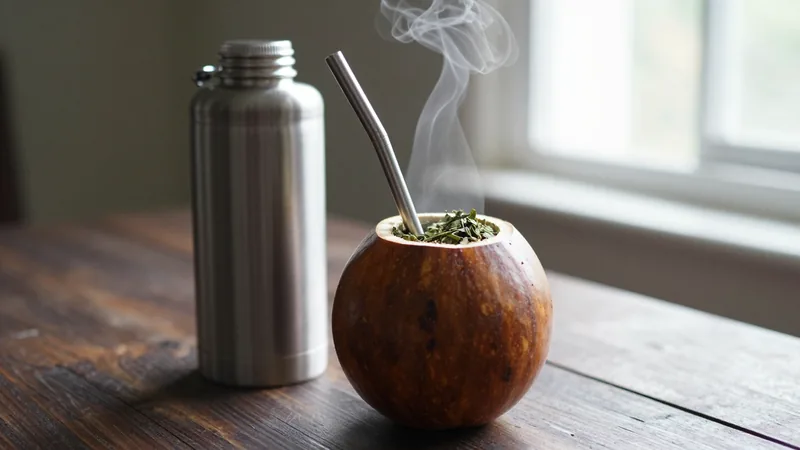
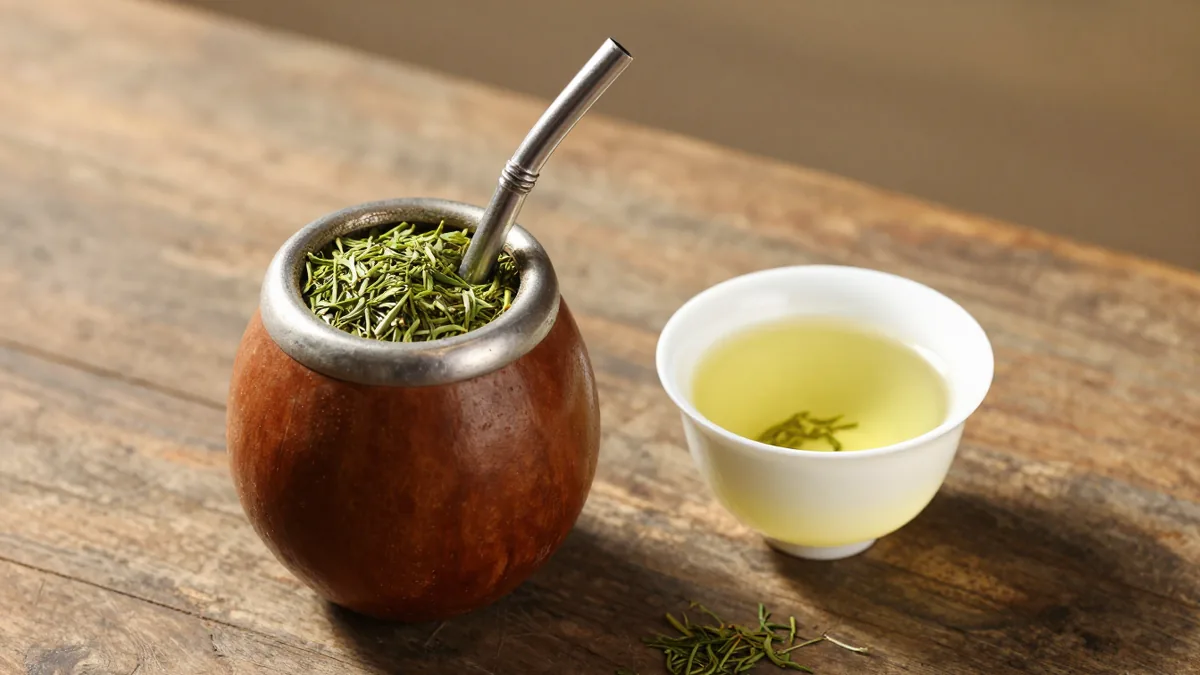
Mate is brewed by refilling. In Uruguay, about 50 g of dried mate goes into a calabash gourd, 30–40 mL of 80 °C water is poured over it, and the infusion is sipped through a stainless-steel straw. The pour is repeated, and up to 1 L is drunk. The straw is called a bombilla.
Traditional practice fills 75% of the vessel with dried material, and the optimum brewing temperature is 65–80 °C.
Green tea is brewed by steeping a small dose once or a few times. Labels on 17 loose green teas in a German study called for 60–90 °C, 1–2 minutes, and 11–13 g of leaf per litre.
| Yerba mate (chimarrão) | Green tea (loose leaf) | |
|---|---|---|
| Plant | Ilex paraguariensis | Camellia sinensis |
| Leaf per session | about 50 g | 11–13 g per litre |
| Water temperature | 65–80 °C | 60–90 °C |
| Method | Repeated small pours, 30–40 mL | Steep 1–2 min, strain |
| Volume per session | up to 1 L | 1 cup or more |
| Caffeine per serving | 91 mg per 350 mL gourd | 40 mg per 200 mL cup |
| Other notable compound | theobromine | L-theanine |
Sources: Uruguay PAH study, yerba brewing study, Zimmermann & Drees 2025, BraCaffT.
Green tea gets bitter if you treat it like mate with hot water and long contact. Our bitter green tea guide covers the fixes.
Chimarrão vs tereré
Chimarrão is the hot version; tereré is made with cold water. A Brazilian study simulated both as they are drunk. It described chimarrão as a partial infusion with hot water and tereré as a total infusion with cold water. Tereré delivered xanthines (caffeine plus theobromine) at 2.5 times the level of the strongest chimarrão, made with coarse-ground mate. It also extracted almost all of the phenolics.
Per 100 mL the BraCaffT means are close, 24 mg for tereré and 26 mg for chimarrão. The difference shows up over a full session.
A short cold steep is weaker. With 10 minutes at 3 °C against 10 minutes at 80 °C (1 g per 25 mL), total alkaloids were 29–76 µg/mL hot and 5.9–40 µg/mL cold. Tereré makes up for it with time and leaf. For cold-brewing green tea instead, see our cold brew tea ratios.
Heat and smoke: the two safety questions
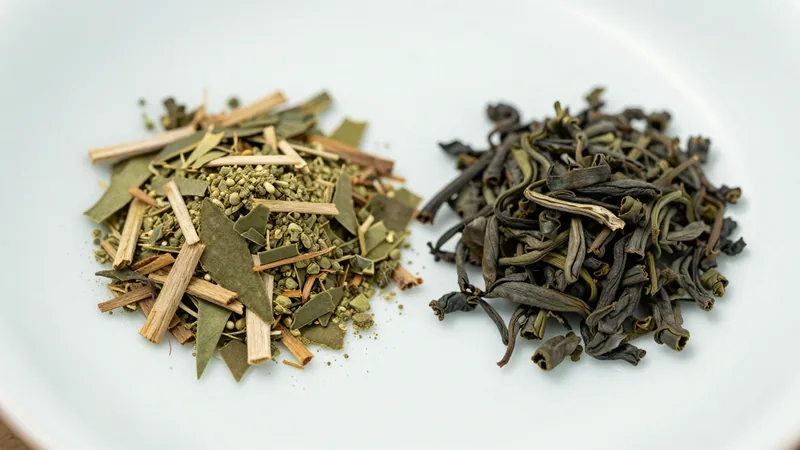
Temperature. In 2016 the WHO cancer agency classified drinking very hot beverages as probably carcinogenic to humans (Group 2A). "Very hot" means above 65 °C. The evidence came partly from South America, where mate is traditionally drunk at about 70 °C. Mate drunk at temperatures that are not very hot was not classifiable (Group 3), and cold mate showed no carcinogenic effects in animal or human studies. The same rule applies to green tea or any drink above 65 °C.
Smoke. Mate leaves are often dried via smoking, which leaves polycyclic aromatic hydrocarbons (PAHs) in the leaf.
- A US National Cancer Institute study of 8 commercial brands found [total PAHs of 536 to 2,906 ng/g of dry leaf and benzo[a]pyrene of 8.03 to 53.3 ng/g](https://pubmed.ncbi.nlm.nih.gov/18483349/). Over 12 infusions, 37% of total PAHs and 50% of the benzo[a]pyrene moved into the drink.
- A follow-up found large swings by brand and batch. The [2010 sample processed without touching smoke had the lowest benzo[a]pyrene content](https://pmc.ncbi.nlm.nih.gov/articles/PMC3525749/).
- A 2019 review of 10 studies found most measured benzo[a]pyrene over 25 ng/g, some up to 600 ng/g. Transfer into the infusion ranged from 1 to 50%.
- A Uruguayan risk model found infusions prepared as habitually consumed carried about 40% of total PAH content. It concluded heavy drinkers of high-PAH mate are the ones at risk.
Practical rules: let the water fall below 65 °C before you drink, and look for mate labeled as dried without smoke. Smoked tea has the same issue; see lapsang souchong.
Price per gram
As of October 1, 2026, the Tea Explorer catalog (7,306 teas from 40 vendors, fetched 2026-10-01) has 4 plain loose yerba mate listings of 20 g or more in stock. We excluded flavored blends (mint, licorice, lemon, chai) and listings without a weight.
| Product | Vendor | Size | Price | $/g |
|---|---|---|---|---|
| Yerba Mate | Rishi Tea & Botanicals | 453.6 g | $24.50 | $0.054 |
| Yerba Mate | Harney & Sons Fine Teas | 113.4 g | $11.00 | $0.097 |
| Organically Grown Yerba Maté | The Steeping Room | 113.4 g | $12.10 | $0.107 |
| No. 23, Green Yerba Mate | BELLOCQ | 114 g | $19.00 | $0.167 |
Median plain yerba mate: $0.102/g. Median green tea across 380 in-stock listings of 20 g or more from 31 vendors: $0.301/g (Tea Explorer price index). With only 4 mate listings, treat the mate median as indicative.
Per session the order reverses:
- One 50 g gourd at $0.102/g = $5.09, refilled to as much as 1 L.
- One 3 g cup of green tea at $0.301/g = $0.90, before re-steeps.
Frequently Asked Questions
Does yerba mate have more caffeine than green tea?
Per serving, usually yes. BraCaffT lists 91 mg for a 350 mL chimarrão gourd and 40 mg for a 200 mL cup of infused green tea. Per 100 mL the gap is small, 26 mg vs 20 mg. The leaf itself is not stronger: mate runs 0.3–1.8% caffeine by dry weight.
What temperature water should I use for yerba mate?
Studies of traditional preparation give 65–80 °C, and Uruguayan practice uses about 80 °C water poured 30–40 mL at a time. Let the drink fall below 65 °C before sipping. IARC classifies drinks above that temperature as probably carcinogenic (Group 2A).
Is cold yerba mate (tereré) weaker?
Not per session. A Brazilian simulation found tereré delivered 2.5 times the xanthines of coarse-ground chimarrão, and BraCaffT lists 24 mg per 100 mL against 26 mg for chimarrão. A short 10-minute cold steep at 3 °C extracts less than hot water.
Is yerba mate safe to drink?
Cold or warm mate is not classified as a carcinogen (IARC Group 3). The concerns are drinking it above 65 °C and PAHs from smoke drying: one study measured 8.03–53.3 ng/g of benzo[a]pyrene in dry leaf. Mate processed without smoke had the lowest levels.
Is yerba mate cheaper than green tea?
Per gram, yes in our catalog: median $0.102/g for plain loose yerba mate vs $0.301/g for green tea, as of October 1, 2026. Per session it is not: a 50 g gourd costs about $5.09 against $0.90 for a 3 g cup of green tea.