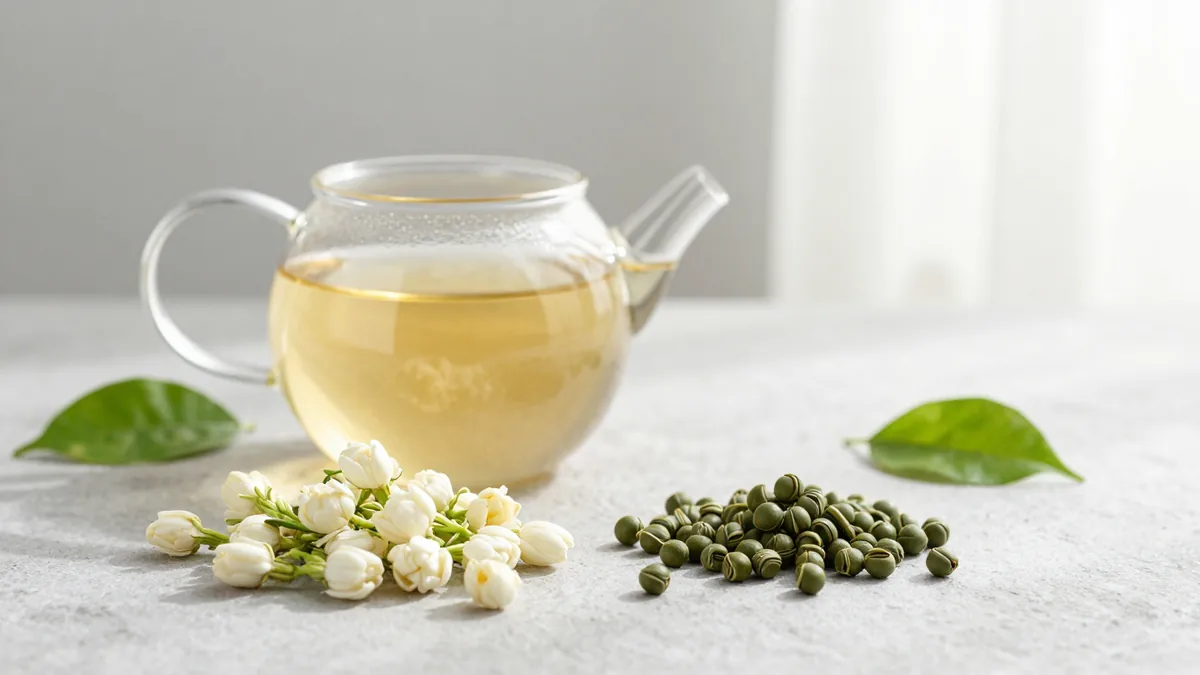
Real jasmine tea is made by piling fresh jasmine buds onto dry tea overnight, sifting the spent flowers out, drying the tea and repeating. Vendors in our catalog state 5 to 10 rounds, and in one Fuzhou study aroma peaked by round 4 or 5. Guangxi's Hengxian County grows over 80% of China's jasmine. As of October 1, 2026, the median jasmine pearl in our catalog costs $0.29 per gram against $0.21 for loose green jasmine.
Jasmine tea is a reprocessed tea: a finished tea, usually green, that takes on the smell of Jasminum sambac flowers. A Fuzhou research team lists the main producing provinces as Fujian, Guangxi and Sichuan. For where jasmine sits among China's famous teas, see China's ten famous teas.
How Scenting Works, Step by Step
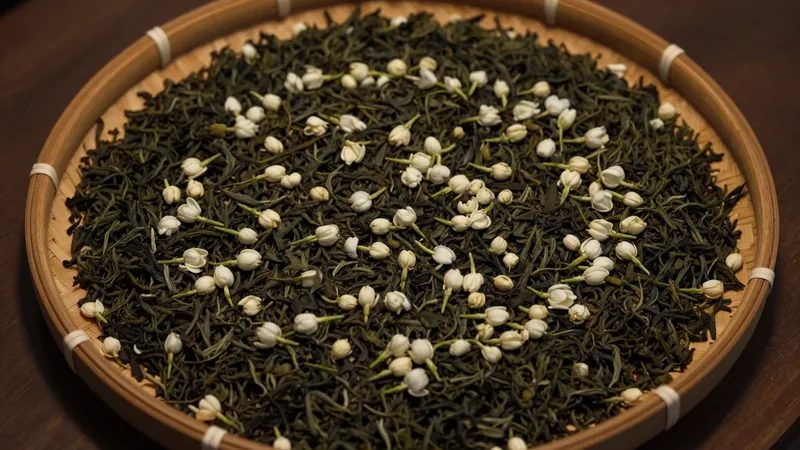
The tea and the flowers are harvested months apart. Base tea is picked in spring; jasmine blooms in summer. The Steeping Room describes its organic jasmine as green tea from the spring piled with summer blossoming jasmine flowers, and Yunnan Sourcing pairs spring Fuding tea with May-harvested flowers from Guangxi.
A 2025 study at a Fuzhou tea factory, following China's national processing standard GB/T 34779-2017, describes one round in detail (Gu et al.):
- Pick jasmine buds on a sunny afternoon, before they open.
- Hold the flowers until about 60% have opened, then sift them.
- When the flowers reach 80–90% open, mix them into the dry base tea.
- Spread the pile periodically to release heat. The pile is held at 40–45 °C.
- Separate the spent flowers from the tea.
- Dry the tea to fix the absorbed aroma.
Producers describe the timing the same way. Song Tea scatters flowers over warm tea, lets the pile rest overnight while the dry tea absorbs the residual moisture and aromatic oils, and fans the flowers off the next morning. The flowers open in the evening; DAVIDsTEA calls its flower night-blooming jasmine, and vendors count rounds in nights.
Scenting changes the tea, not just the smell. In a 2026 Sichuan study, amino acids and soluble sugars rose while tea polyphenols and catechins fell after scenting, and the liquor shifted from green to pale yellow.
Get the tea newsletter
New tea rooms, brewing notes, and tea worth trying. Free, no spam.
No fixed schedule. Unsubscribe anytime.
How Many Rounds: 4, 5, 7 or 10
Each round uses fresh flowers, and more rounds means more flowers and more labor. Vendors that state a number:
| Tea | Base | Rounds stated | Price, Oct 1, 2026 |
|---|---|---|---|
| Rishi Moonlight Jasmine | Yunnan green buds, unrolled | "fewer" than rolled styles | $0.45/g |
| Yunnan Sourcing Imperial Pearls | Fuding green, rolled | 5 | $0.19/g |
| Yunnan Sourcing Jasmine Silver Needles | Simao white, buds | 5 | $0.15/g |
| Path of Cha Dragon Pearls | Fuding green, hand-rolled | 5 | $0.39/g |
| Song Tea Snow Jasmine | Mengding Gan Lu green | 5 | $0.83/g |
| DAVIDsTEA Silk Dragon | Spring green | 5 nights | $0.07/g (1 kg bag) |
| Golden Moon Jasmine Tea | Fujian Yin Hao green | 7 nights | $0.13/g |
| Red Blossom Dragon Pearl Supreme | Fuding Da Bai buds, hand-rolled | 10 evenings | $0.53/g |
Source: vendor product pages, prices from the Tea Explorer catalog, 7,306 teas from 40 vendors, fetched 2026-10-01.
Round count does not track price cleanly. Golden Moon's seven-night tea is one of the cheapest in the table, while Song Tea's five-round tea is the most expensive. Base leaf grade drives price at least as much.
More rounds also stop paying off. In the Fuzhou study, aroma compounds in tea scented with the newer 'Round leaf' jasmine reached saturation in the fourth round; the standard double-petal jasmine tea scored best after the fifth.
Where the Flowers Come From
Most of China's jasmine comes from one county. A 2026 Scientific Reports paper states that Hengxian, in Guangxi, is the world's largest jasmine planting area, accounting for over 80% of China's total jasmine production. Path of Cha lists its pearls as Fuding tea scented with Hengxian jasmine, picked in April and August.
Fuzhou in Fujian has formal heritage status. The Food and Agriculture Organization lists the Jasmine and Tea Culture System of Fuzhou City among its Globally Important Agricultural Heritage Systems. Jing Tea Shop sells a Fuzhou Jasmine Mao Feng from the Min River plain at $0.54/g.
Sichuan is the third region. Song Tea's Snow Jasmine is scented in Sichuan on Mengding Shan green tea, picked in April and scented in October.
What You Smell: The Aroma Chemistry
A 2002 study found 66 compounds in jasmine green tea and narrowed the jasmine character to six potent odorants. Two mattered most:
- Linalool (floral). Tea held mostly the (R)-form: 81.6% enantiomeric excess, against 100% in the flower.
- Methyl anthranilate (grape-like). Removing it from a model mixture changed the smell sharply.
The 2025 Fuzhou study names a wider set of key compounds: methyl anthranilate, benzyl acetate, linalool, indole, methyl benzoate and methyl salicylate.
The flower's output shifts with the time of day. Benzyl acetate decreased from morning to afternoon and then increased in evening collections, which fits the practice of scenting overnight.
The smell has a measured effect. In 24 volunteers, jasmine tea odor at barely detectable strength caused significant decreases in heart rate, and (R)-linalool alone reproduced it.
Pearls, Yin Hao and Silver Needle: Styles and Prices
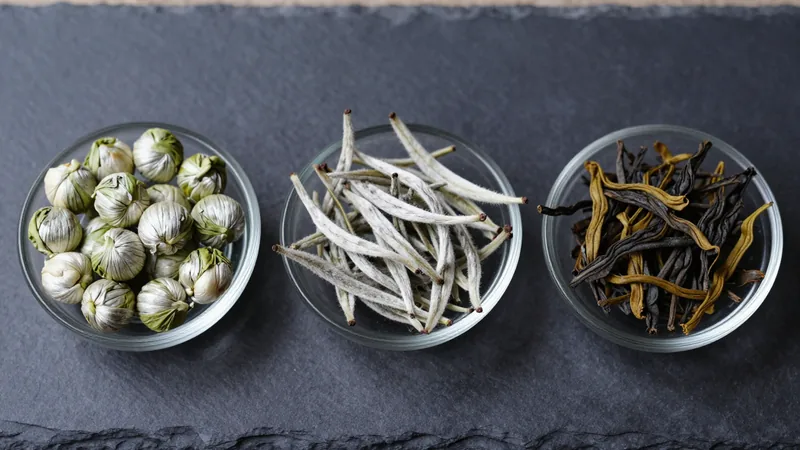
Style is set by the base leaf and its shape:
- Pearls (Mo Li Long Zhu, dragon pearls). Young buds and leaves rolled into balls, then scented. Red Blossom's are individually rolled by hand.
- Yin Hao and Mao Feng. Downy leaf left loose or twisted. Golden Moon and Jing Tea Shop both sell Fujian versions.
- Jasmine silver needle. Pure white-tea buds scented the same way.
- Jasmine black tea. Yunnan and Fujian black teas scented with jasmine.
| Style (in stock) | Listings | Vendors | Median $/g | Range $/g |
|---|---|---|---|---|
| Pearls, green base | 12 | 11 | $0.29 | $0.10–$0.53 |
| Loose green (Yin Hao, Mao Feng, buds) | 23 | 12 | $0.21 | $0.10–$1.20 |
| Black base | 5 | 4 | $0.19 | $0.10–$0.63 |
| White base (silver needle) | 2 | 2 | $0.15 and $0.32 | n/a |
Source: Tea Explorer catalog, fetched 2026-10-01; see the tea price index. Excludes flavored blends (vanilla, fruit), oolongs, compressed and instant jasmine, gift caddies and bulk packs over 500 g.
Pearls cost 1.4x loose green jasmine at the median. The loose group has the wider spread: three loose teas from Song Tea and Tea Habitat run $0.83–$1.20/g, above every pearl in the catalog.
At Song Tea's 3 g per 150 mL, a pearl session costs $0.87 and a loose-green session $0.63 at the medians. Use the tea cost calculator for your own numbers.
Natural vs Flavored: Reading the Label
Scenting takes several nights of fresh flowers. Flavoring adds an extract instead, and both can be sold as jasmine tea.
Under US rules, "natural flavor" covers an essential oil, essence or extractive derived from a bud, leaf or similar plant material, and the label may simply say natural flavor. So "natural jasmine flavor" means an added extract, not scenting.
How three labels read:
- Scented only: The Steeping Room lists organic green tea, organic jasmine flowers. Smith Teamaker lists green tea scented with jasmine blossoms.
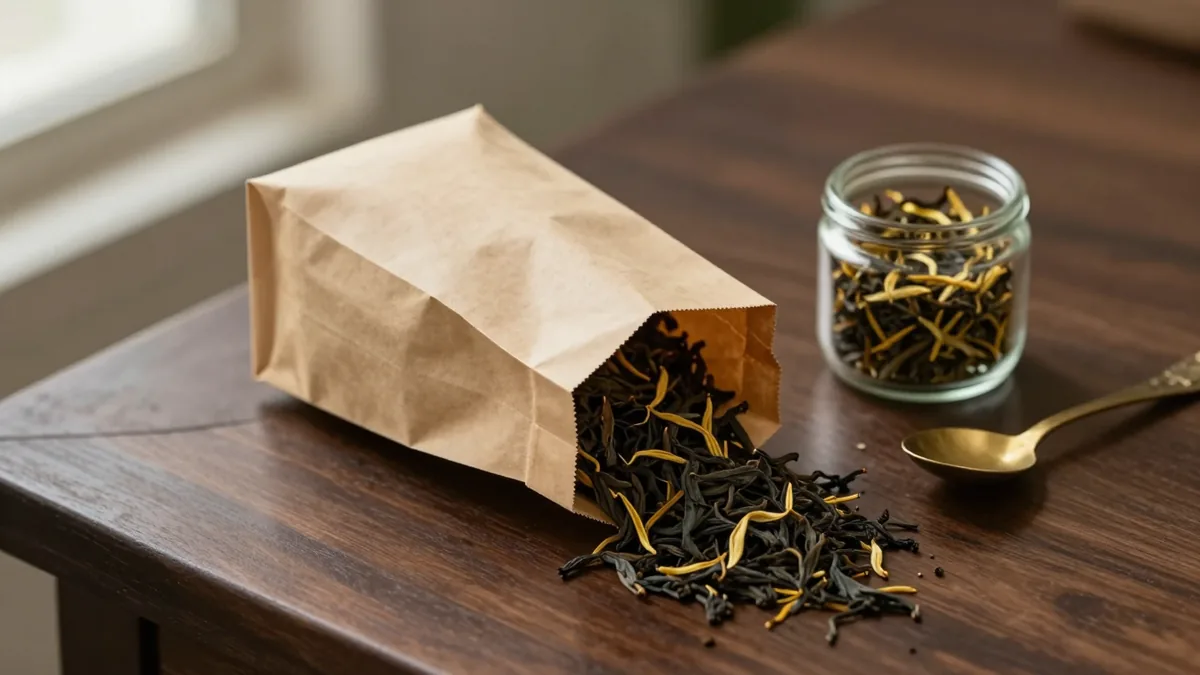
- Flavored plus flowers: Teabox lists green tea, natural jasmine flavor and jasmine. Dried petals in the bag do not prove scenting.
- Explicit: Golden Moon states its jasmine has no "natural" or artificial flavors.
If the ingredient list says "flavor" in any form, the aroma is at least partly added. Our tea label guide covers other label terms.
Brewing is gentle across vendors: Red Blossom uses 1 g per oz at 170 °F for 3 minutes, about 3.4 g per 100 mL; Path of Cha uses 1 g per 70–100 mL at 80 °C for 3–5 minutes, or 1 g per 25 mL for gongfu. For short-steep sessions, see our gongfu brewing guide.
Frequently Asked Questions
How many times is jasmine tea scented?
Vendors in our catalog state 5 rounds (Yunnan Sourcing, Path of Cha, Song Tea), 7 nights (Golden Moon) and 10 evenings (Red Blossom). In a Fuzhou factory study, aroma saturated by round 4 for one jasmine cultivar and peaked at round 5 for the standard double-petal flower.
Are there flowers left in good jasmine tea?
Usually not. Spent flowers are sifted or fanned off after each round, as Song Tea and the Fuzhou study describe. Petals in the bag are decorative and appear in flavored blends too, such as one that lists natural jasmine flavor alongside jasmine.
Are jasmine pearls better than loose jasmine?
They cost more: a median $0.29 per gram against $0.21 for loose green jasmine, about 1.4x. Rolling is labor, but the most expensive jasmine teas in our catalog are three loose teas at $0.83–$1.20 per gram.
Where does most jasmine come from?
Hengxian County in Guangxi grows over 80% of China's jasmine, per a 2026 Scientific Reports paper. Fuzhou in Fujian holds an FAO agricultural heritage listing for its jasmine and tea system, and Sichuan is a third producing region.
What chemicals make jasmine tea smell like jasmine?
Linalool and methyl anthranilate are the two key odorants identified in a 2002 study of 66 compounds. Later work adds benzyl acetate, indole, methyl benzoate and methyl salicylate.