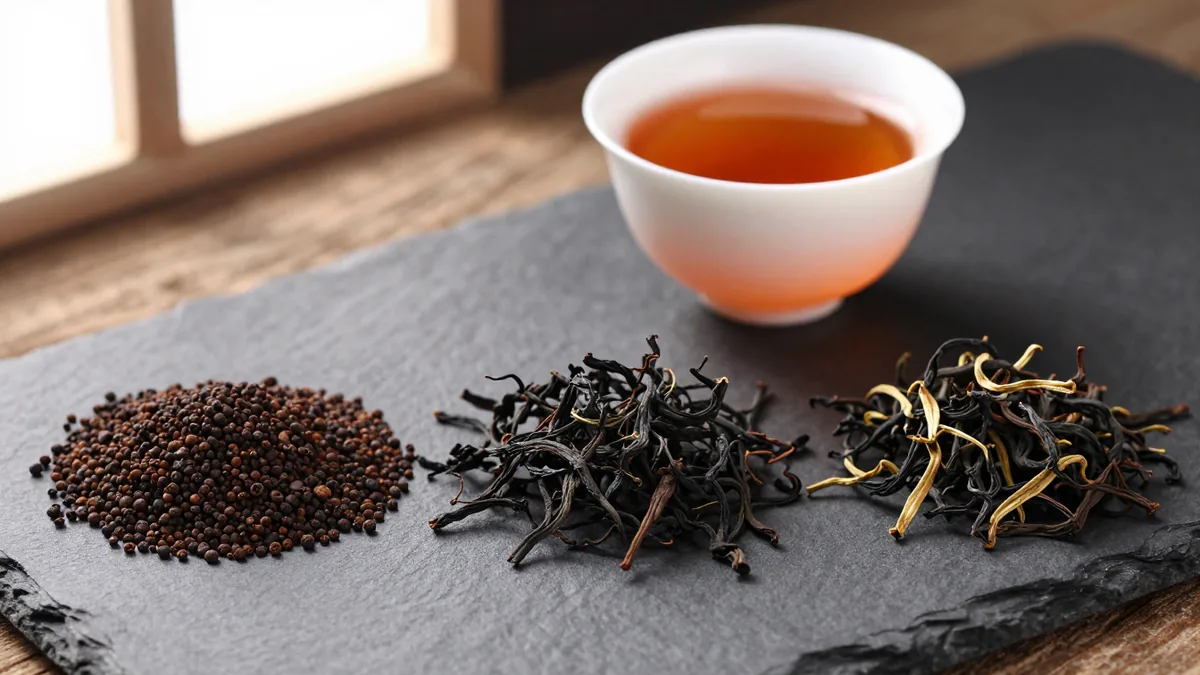
Lapsang souchong (zheng shan xiao zhong) is a black tea from Tongmu village in the Wuyi Mountains of Fujian, smoked over burning pinewood during withering and drying. In the Tea Explorer catalog, 7,306 teas from 40 vendors, fetched 2026-10-01, 46 lapsang listings have a median of $0.34 per gram, 30% above the $0.26 median for all 825 black teas; smoked and unsmoked versions price about the same. Smoked tea leaves carry more of some PAHs, but a 2014 study did not detect benzo(a)pyrene in any brewed smoked tea.
Where lapsang souchong comes from
Lapsang souchong is made in Tongmu village, Xingcun town, inside the Wuyi Mountain National Nature Reserve in Fujian (Tian et al., Food Chemistry: X, 2025). Its Chinese name, zheng shan xiao zhong, translates as "proper mountain small varietal" (Wikipedia). "Lapsang" comes from Fuzhou dialect for pine wood, and "souchong" means small sort (Wikipedia).
Fujian researchers call it "the ancestor of black tea" (Tian et al.) and "the world's first black tea" (Pang et al., Foods, 2024). Treat that as the producing region's account. The two origin stories in circulation are legends: one dates it to 1646, when villagers dried leaves over fires while fleeing Qing soldiers; another ties it to the Taiping Rebellion of 1850–1864 (Wikipedia). Wikipedia reports both as unverified accounts.
Its processing method was added to Fujian's provincial intangible cultural heritage list in 2017 (Tian et al.). Fujian also has a provincial standard for it, DB35/T 1838-2022 (Pang et al.).
Get origin and garden notes
Where tea is grown, how each region makes it, and the next origin explainer. Free, no spam.
No fixed schedule. Unsubscribe anytime.
How pine smoking works
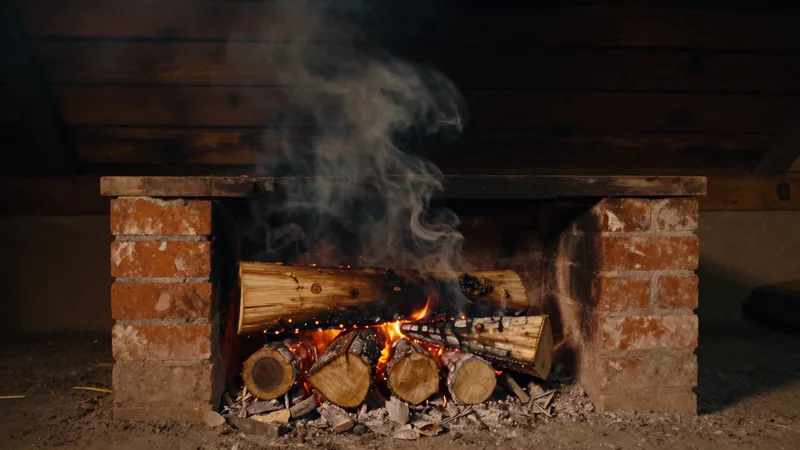
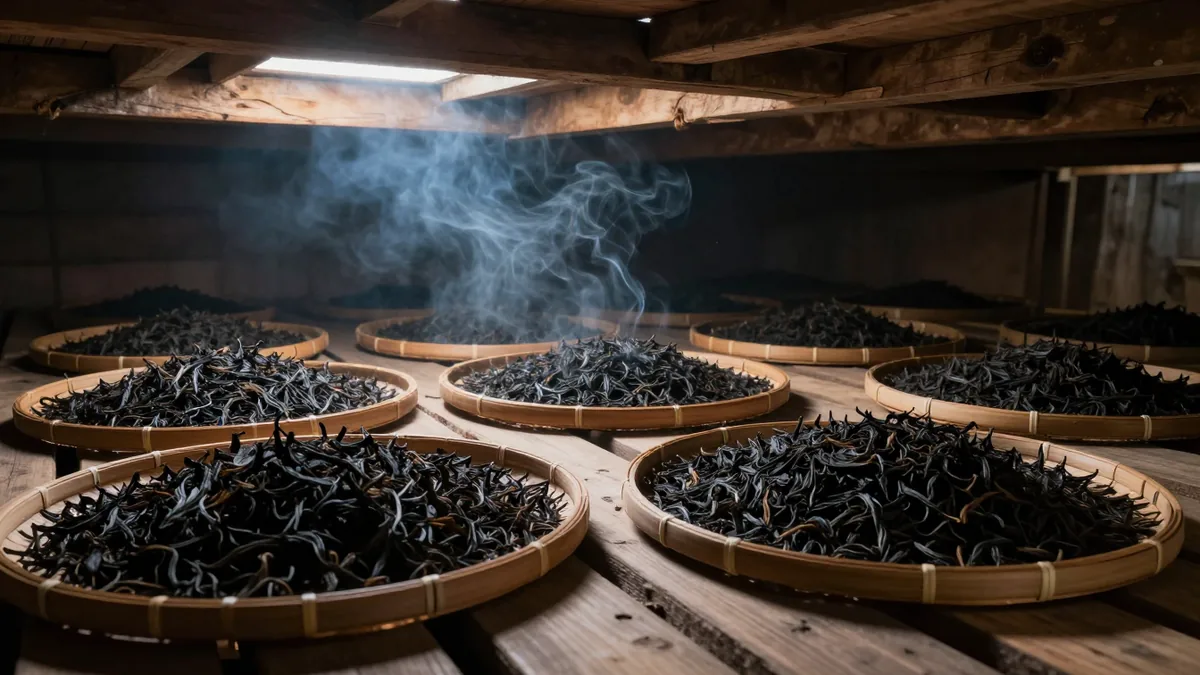
Traditional production happens inside a smokehouse. Pine fires burn below, and the leaves sit on upper floors or lofts of wooden slats, so different floors get different amounts of smoke (Wikipedia). Leaves oxidize in cloth bags for 5 to 6 hours before a quick pan-firing stops oxidation (Wikipedia).
Smoke goes in at two steps. A Fuzhou University study that followed the whole process found pinewood smoke compounds enter during withering and again during drying (Su et al., Food Chemistry, 2025). The wood is local pine: tea smoked with Huangshan pine and Masson pine from the reserve has a richer smoky aroma (Tian et al.).
Pine is getting scarce. Suitable pinewood is limited, and researchers have tested purpose-made fuel rods as a substitute (Tian et al.). In that study, smoking only at the drying stage gave a milder smoke than the traditional process, with lower levels of guaiacol and other smoky compounds (Tian et al.).
What the smoke adds to the cup
A 2005 Zhejiang University analysis identified 49 aroma compounds in lapsang and smoked lapsang. Longifolene and alpha-terpineol were the most abundant, and guaiacol, 4-methylguaiacol and 4-ethylguaiacol showed up only in this kind of black tea (Yao et al., J. Agric. Food Chem., 2005). Tea-origin aromas fell during smoking while pine terpenes and wood-pyrolysis products rose (Yao et al.).
- Guaiacols give the smoky, phenolic note. In the 2025 Fuzhou study their odor activity value was 77.05, meaning they sat about 77 times above their smell threshold (Su et al. 2025).
- Alpha-terpineol and longifolene come from the pine itself and are unique to the pinewood (Su et al. 2025).
- Less bitterness. Smoke-withering cut 10 catechins, 14 glycosylated flavonols and 6 galloylated phenolic acids. Guaiacol and alpha-terpineol also reduced activation of the bitter-taste receptor TAS2R14 by 37% and 21% in cell tests (Su et al., Food Chemistry, 2026).
Smoked vs unsmoked lapsang
An unsmoked style was developed in Tongmu in the early 21st century (Wikipedia). Catalog listings label it "unsmoked", "non-smoked" or "non-smoky". Many other listings, including "floral" and "wild" lapsangs, say nothing about smoke in the name, so read the description.
| Smoked (traditional) | Unsmoked | |
|---|---|---|
| Smoke | Pine smoke during withering and drying | None |
| Key aroma compounds | Guaiacols, alpha-terpineol, longifolene | Tea-origin floral and fruity volatiles |
| Listings in our catalog | 13 labeled smoked | 6 labeled unsmoked |
| Median $/g | $0.38 | $0.39 |
| Range $/g | $0.18–$1.00 | $0.20–$1.60 |
Sources: Su et al. 2025; Yao et al. 2005; Tea Explorer catalog, 7,306 teas from 40 vendors, fetched 2026-10-01, as of October 1, 2026.
The labels barely move the median: $0.38/g smoked against $0.39/g unsmoked. The unsmoked top end is BELLOCQ's wild-harvested lapsang at $1.60/g; the cheapest labeled unsmoked tea we found in stock is Wuyi Origin's daily unsmoked at $0.22/g.
What lapsang costs in our catalog
We counted black teas whose names include lapsang, souchong or xiao zhong, with a price per gram and at least 20 g, and dropped flavored blends and smoked sugar.
| Group | Listings | In stock | Vendors | Median $/g | Per 3 g mug |
|---|---|---|---|---|---|
| All lapsang / xiao zhong | 46 | 37 | 13 | $0.34 | $1.01 |
| Labeled smoked | 13 | 12 | 8 | $0.38 | $1.14 |
| Labeled unsmoked | 6 | 4 | 5 | $0.39 | $1.18 |
| No smoke label | 27 | 21 | 11 | $0.33 | $0.99 |
| Other smoked black teas | 3 | 2 | 2 | $0.26 | $0.78 |
| All black tea | 825 | 552 | 32 | $0.26 | $0.77 |
Source: Tea Explorer catalog, 7,306 teas from 40 vendors, fetched 2026-10-01, as of October 1, 2026.
- Cheapest Western house lapsangs: Harney & Sons at $0.16/g, Golden Moon at $0.18/g and Red Blossom at $0.19/g.
- Traditional smoked from China: Yunnan Sourcing's traditional smoked xiao zhong at $0.21/g, up to BELLOCQ's old-tree smoked lapsang at $1.00/g.
- Not from Wuyi: What-Cha sells a Taiwanese "tarry" lapsang at $0.18/g; The Steeping Room sells Japanese black teas smoked over whisky-barrel wood and sakura wood at $0.26/g.
At the all-lapsang median, a 3 g mug costs $1.01 versus $0.77 for a median black tea. Run your own numbers in the tea cost calculator.
Smoke and PAHs: what the studies found
Burning wood makes polycyclic aromatic hydrocarbons (PAHs), and four of them, led by benzo(a)pyrene, have legal limits in EU-derived food law (legislation.gov.uk). Two 2014 studies measured them in tea.
| Study | Samples | Leaf result | Brewed tea result |
|---|---|---|---|
| Pincemaille et al., Food Chemistry | Smoked and non-smoked black teas | Smoked leaf: 1.2–125.0 µg/kg per PAH4 compound; non-smoked: 0.6–10.8 µg/kg | Benzo(a)pyrene never detected; others 0.6–1.2 µg/L |
| Schulz et al., Food Additives & Contaminants | 91 teas and herbal infusions | Benzo(a)pyrene median 4.7 µg/kg, max 460; total PAH median 39 µg/kg, max 2,700 | None above detection limit after 10 min; 0.25–0.52% transfer after 30 min |
What this means in practice:
- Smoked leaf has more of some PAHs. Benz(a)anthracene and chrysene were higher in smoked tea than non-smoked; benzo(b)fluoranthene and benzo(a)pyrene were not (Pincemaille et al.).
- The two studies disagree on transfer. Pincemaille measured 82–123% migration from leaf to water (Pincemaille et al.). Schulz found 0.25–0.52% after 30 minutes of brewing (Schulz et al.). Use the worse number for a ceiling.
- Worst-case math. Take the highest smoked-leaf value, 125 µg/kg of benz(a)anthracene, and 3 g of leaf: that is 0.375 µg in the leaves for one mug, even if every bit moved into the water.
- No tea limit in the rule we checked. The EU contaminants regulation 1881/2006, as kept in UK law, sets PAH limits of 10 µg/kg benzo(a)pyrene and 50 µg/kg for the four-PAH sum on dried herbs and dried spices, with no entry for dried Camellia sinensis tea (legislation.gov.uk).
Russian Caravan and lapsang in the kitchen
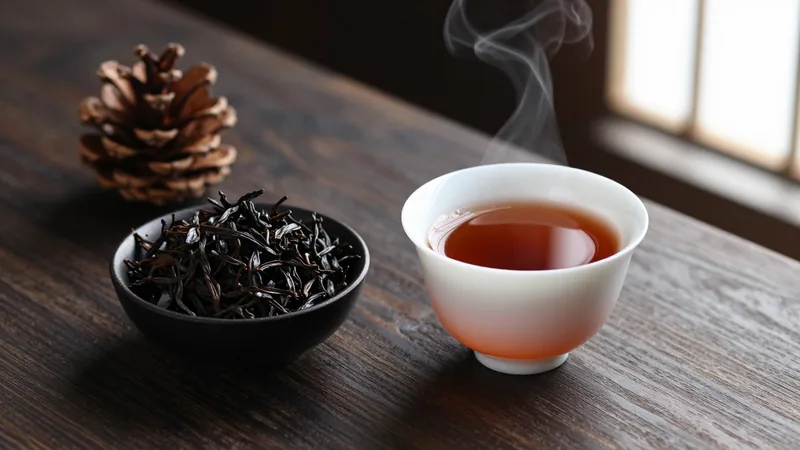
Russian Caravan is a blend, not a single tea. Wikipedia gives one common recipe as about 60% Keemun, 20% lapsang souchong and the rest roasted oolong (Wikipedia: Lapsang souchong); some versions leave out the lapsang or add Assam (Wikipedia: Russian Caravan). The name refers to the camel caravans that carried tea to Russia, a 6,000-mile trip that took at least half a year (Wikipedia: Russian Caravan).
Blend 100 g at home using our catalog medians: 60 g Keemun at $0.30/g, 20 g lapsang at $0.34/g and 20 g oolong at $0.42/g comes to $33.10, or $0.33/g. Keemun is covered in China's ten famous teas.
In cooking, lapsang goes into stock for soups, stews and sauces, or works as a dry seasoning (Wikipedia).
Frequently Asked Questions
Is lapsang souchong the first black tea?
Fujian researchers describe it as the ancestor of black tea and the world's first black tea. The origin stories, dated to 1646 or to the 1850–1864 Taiping Rebellion, are unverified accounts.
Is smoked tea safe to drink?
Smoked tea leaves can carry more benz(a)anthracene and chrysene than unsmoked tea. A 2014 Luxembourg study did not detect benzo(a)pyrene in any brewed smoked tea, and a 2014 Eurofins study found no PAHs above the detection limit in normally brewed tea.
Does unsmoked lapsang cost more?
Only slightly. In our catalog, 6 labeled unsmoked listings have a median of $0.39/g against $0.38/g for 13 labeled smoked listings. Both sit well above the $0.26/g median for all black tea.
What gives lapsang its smoky smell?
Phenols from burning pine, mainly guaiacol and its relatives, plus pine terpenes such as alpha-terpineol and longifolene. A 2025 study measured guaiacols at an odor activity value of 77.05.