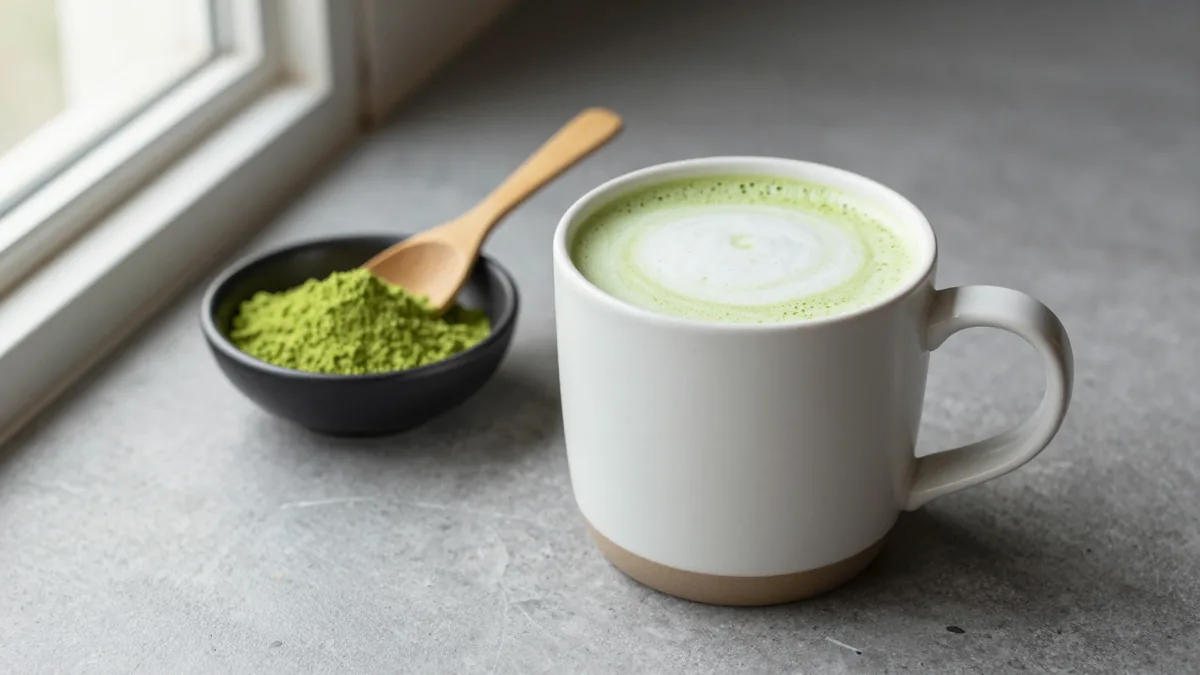
Ippodo's matcha latte uses 3 g of matcha whisked into 100 ml of 80 °C water, then 100 ml of warm or foamed milk: 1.5 g of matcha per 100 ml of drink. Latte-labelled matcha in our catalog has a median price of $0.39 per gram, so that latte costs about $1.28 with whole milk, against $3.76 with ceremonial-labelled powder.
A good matcha latte comes down to three numbers: grams of powder, water temperature, and the ratio of matcha to milk. Get the paste right first, then pick a milk for how it foams, not only for taste.
This guide covers ratios from two vendors, what the studies say about milk foam and about milk binding catechins, and a cost per cup computed from the Tea Explorer catalog, 7,306 teas from 40 vendors, fetched 2026-10-01.
The ratio: 3 g matcha, 100 ml water, 100 ml milk
Ippodo sifts 3 g of matcha, adds 100 ml of water at 80 °C, whisks for 15 seconds and pours in 100 ml of warm or foamed milk. Its iced version keeps the same 3 g and 100 ml of water, then pours the matcha over 100 ml of cold milk and ice.
Jade Leaf goes much lighter: 1/2 to 1 teaspoon of matcha, 1/4 cup of water and 1 full cup of milk, plus 2–3 teaspoons of sugar or honey "to match Starbucks sweetness." Ippodo's own conversion says 3 g is 1.5 level teaspoons, so one level teaspoon is about 2 g.
| Recipe | Matcha | Water | Milk | Matcha per 100 ml of drink |
|---|---|---|---|---|
| Ippodo hot latte | 3 g | 100 ml at 80 °C | 100 ml | 1.5 g |
| Ippodo iced latte | 3 g | 100 ml at 80 °C | 100 ml cold, plus ice | 1.5 g before the ice melts |
| Jade Leaf latte | 1–2 g (1/2–1 tsp) | 59 ml (1/4 cup) | 237 ml (1 cup) | 0.34–0.68 g |
| Usucha, no milk | 2 g | 60 ml at 80 °C | none | 3.3 g |
Ippodo's latte is about 2.2 times as concentrated as Jade Leaf's 1-teaspoon version. If your latte tastes like warm milk, the fix is more powder or less milk, not a better brand. Start at 3 g per 200 ml and adjust by 0.5 g.
Caffeine scales with the powder. Matcha tested at 18.9–44.4 mg of caffeine per gram (Nutrients review), so a 3 g latte carries about 57–133 mg and Jade Leaf's 1–2 g version about 19–89 mg. Our caffeine comparison puts those numbers next to coffee.
Get brewing and teaware notes
Steep times, water temperatures, leaf ratios, and teaware that is worth buying. Free, no spam.
No fixed schedule. Unsubscribe anytime.
Make the paste first: sift, 80 °C, whisk
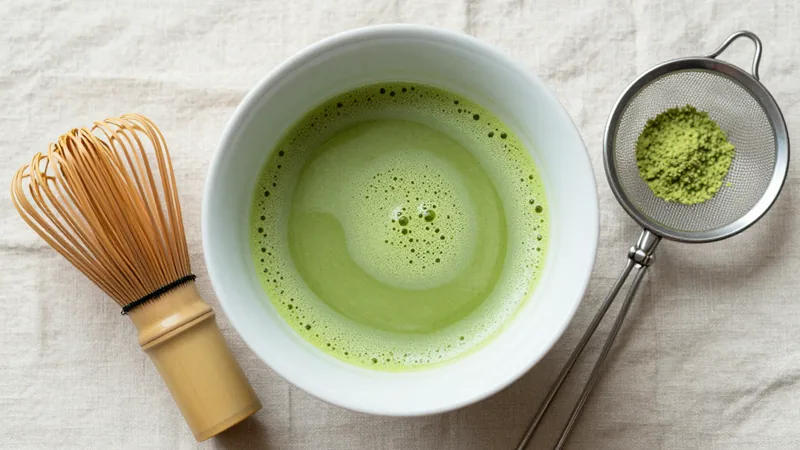
Matcha is ground leaf, and clumps that reach the milk stay as clumps. Both recipes make a concentrated paste or "shot" in a little water first, then add milk.
- Sift. Push 3 g through a small tea strainer into the bowl. Sifting is step one in Ippodo's recipe (Ippodo).
- Water at 80 °C. Ippodo pours boiling water into a teacup first to bring it down to 80 °C, then into the bowl (Ippodo). Use 100 ml for Ippodo's ratio.
- Whisk 15 seconds vigorously in an "M" shape with a bamboo chasen (Ippodo).
- Add milk. Pour warm or foamed milk into the mug. Jade Leaf heats milk to just under a boil and froths it before pouring in the matcha shot (Jade Leaf).
No chasen? Jade Leaf's iced recipe makes the shot "by whisking or shaking" the powder with 2 oz of warm water until it is completely blended (Jade Leaf). A lidded jar does the shaking; an electric frother, the tool used in the foam study below, handles the milk.
The powder you pick changes the cup. Ippodo recommends its light and medium matchas for lattes, because the lighter ones have "more astringency, which balances well with the milk's sweetness" (Ippodo). Our matcha grades guide explains why "ceremonial" and "culinary" are marketing words, not a Japanese standard.
Which milk foams best
Protein and added thickeners decide foam. USDA FoodData Central lists these values per 100 g:
| Milk | Protein (g/100 g) | Fat (g/100 g) | Foam result in Hassan et al. 2024 | Source |
|---|---|---|---|---|
| Whole milk (3.25%) | 3.27 | 3.20 | More hot foam than oat, pea and soy; less cold foam than oat, soy, almond | FDC 746782 |
| Skim milk | 3.43 | 0.08 | Not tested separately in the study below | FDC 746776 |
| Soy milk, unsweetened | 3.55 | 2.12 | Beat cow milk on cold foam volume and lifetime | FDC 1999630 |
| Oat milk, unsweetened | 0.80 | 2.75 | Longest-lasting foam of the eight milks tested | FDC 2257046 |
| Almond milk, unsweetened | 0.66 | 1.56 | Beat cow milk on cold foam volume and lifetime | FDC 2257045 |
Foam results: Hassan et al., Soft Matter 2024.
The Hassan et al. study frothed cow and goat milk and six plant milks with an electric frother at 10 °C and 65 °C. Three results matter for a latte:
- Hot milk: cow and goat milk made more foam than oat, pea or soy.
- Cold milk: oat, soy and almond beat cow milk on foam volume and lifetime. That is the iced latte case.
- Lifetime: oat made the longest-lasting foam of all eight; rice made the least.
Oat milk has about 24% of the protein of whole cow milk and still foams well. The authors note that most plant milks have higher viscosity from added polysaccharide thickeners, and in some, lecithin and saponin act as emulsifiers alongside the proteins. Unsweetened soy has 4.4 times the protein of unsweetened oat. Ippodo says it often makes its lattes with soy milk for its "pleasant round taste" (Ippodo).
Does milk cancel matcha's catechins?
The evidence is split, and the conditions matter. Four studies, on tea with cow milk or isolated milk and soy proteins:
| Study | Design | Result |
|---|---|---|
| van het Hof 1998 | 12 adults, black tea with 100 ml semi-skimmed milk in 600 ml | No significant change in blood catechins (AUC 0.53 vs 0.60 h·µmol/l) |
| Lorenz 2007 | 16 women, 500 ml black tea, 10% skimmed milk | Milk "completely blunted" tea's improvement in artery dilation; caseins blamed |
| van der Burg-Koorevaar 2011 | Simulated digestion, 5.6–40% milk | Catechin bioaccessibility comparable with and without milk |
| Egert 2013 | 24 women, 1.75 g green tea extract | EGCG availability 68% of control with skimmed milk, 63% with caseinate, 76% with soy protein |
The Egert result is the closest to matcha, because it used green tea and measured EGCG, the main catechin in green tea. Total catechin availability fell only to 87% with skimmed milk, and non-galloylated EGC actually rose to 134%. Soy protein cut EGCG too, and the authors found no significant difference between milk, caseinate and soy.
What this means for a latte: protein-rich milks, dairy or soy, cut short-term EGCG uptake by 24–32% in that study. Nobody has measured oat or almond milk in a matcha latte. If catechins are your reason for drinking matcha, drink some of it as plain usucha.
Which matcha to buy for lattes
Our catalog lists 143 in-stock matcha products of 20 g or more from 23 vendors, as of October 1, 2026. The median price is $1.12 per gram.
| Label on the tin | Products | Vendors | Median $/g | Cost of 3 g |
|---|---|---|---|---|
| Latte, culinary or barista | 14 | 9 | $0.39 | $1.17 |
| All matcha | 143 | 23 | $1.12 | $3.38 |
| Ceremonial | 20 | 9 | $1.22 | $3.65 |
Source: Tea Explorer catalog, 7,306 teas from 40 vendors, fetched 2026-10-01. Same product in several bag sizes counted once at its lowest price per gram.
Ceremonial-labelled powder costs 3.1 times as much per gram as latte-labelled powder at the median. The cheapest latte-labelled option was Nio Teas Latte Matcha Basic Grade at $0.10 per gram. Browse the full list on /teas.
Cost per latte
Milk is the small part. Whole milk averaged $4.229 a gallon in August 2026 (BLS), which is $0.11 per 100 ml.
- Ippodo size, latte-grade median: 3 g x $0.39 + $0.11 milk = $1.28
- Ippodo size, all-matcha median: $3.49
- Ippodo size, ceremonial median: $3.76
- Ippodo size, cheapest latte-labelled powder: $0.41
- Jade Leaf size (2 g, 1 cup milk, latte-grade median): $1.04, plus about $0.03 for 3 teaspoons (12.6 g) of sugar
At one latte a day, choosing the ceremonial median over the latte-grade median costs about $907 more a year. Run your own tin through the tea cost calculator.
Iced matcha latte
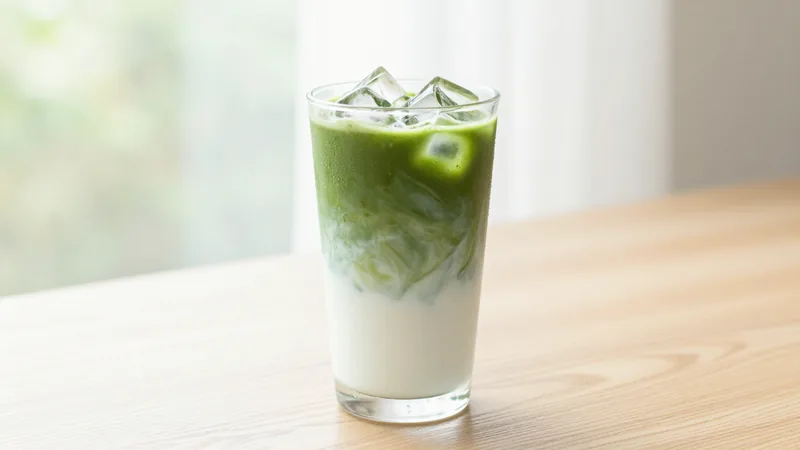
Ippodo's iced latte uses one part hot matcha to one part cold milk, then ice (Ippodo). Whisk the 3 g into 100 ml of 80 °C water as usual. Put 100 ml of cold milk and ice in a glass and pour the matcha on top.
Cold is where plant milks win on foam: oat, soy and almond all beat cow milk at 10 °C in the Hassan study. Froth the cold milk before it goes over the ice if you want a foam layer.
Sweeten the hot paste rather than the cold milk, so the sugar meets 80 °C water. Jade Leaf's 2–3 teaspoons is 8.4–12.6 g of sugar at 4.2 g per spoon (Keenan et al.).
Frequently Asked Questions
How much matcha goes in a matcha latte?
Ippodo uses 3 g (1.5 level teaspoons) for 100 ml of water and 100 ml of milk, which is 1.5 g per 100 ml of drink. Jade Leaf uses 1/2 to 1 teaspoon (about 1–2 g) with 1 cup of milk, a much milder cup. Start at 3 g and adjust by 0.5 g.
What water temperature should I use for a matcha latte?
80 °C (176 °F) for the paste, per Ippodo. Pour boiling water into a cup first to cool it, then whisk 15 seconds in 100 ml. The milk can be warm or cold.
Which milk is best for a matcha latte?
For hot foam, cow milk made more foam than oat, pea or soy in a 2024 frother study; for cold foam, oat, soy and almond beat cow milk. Oat made the longest-lasting foam of eight milks tested. Soy has the most protein of the plant milks at 3.55 g per 100 g.
Does milk reduce the antioxidants in matcha?
Probably somewhat. In a 24-person green tea study, skimmed milk cut EGCG availability to 68% of control and soy protein to 76%, while total catechins fell only to 87%. A black tea study found no significant change in blood catechins with milk.
How much does a homemade matcha latte cost?
With latte-labelled matcha at the catalog median of $0.39 per gram and whole milk at $0.11 per 100 ml, a 3 g Ippodo-style latte costs about $1.28. With ceremonial-labelled powder at $1.22 per gram it is about $3.76.