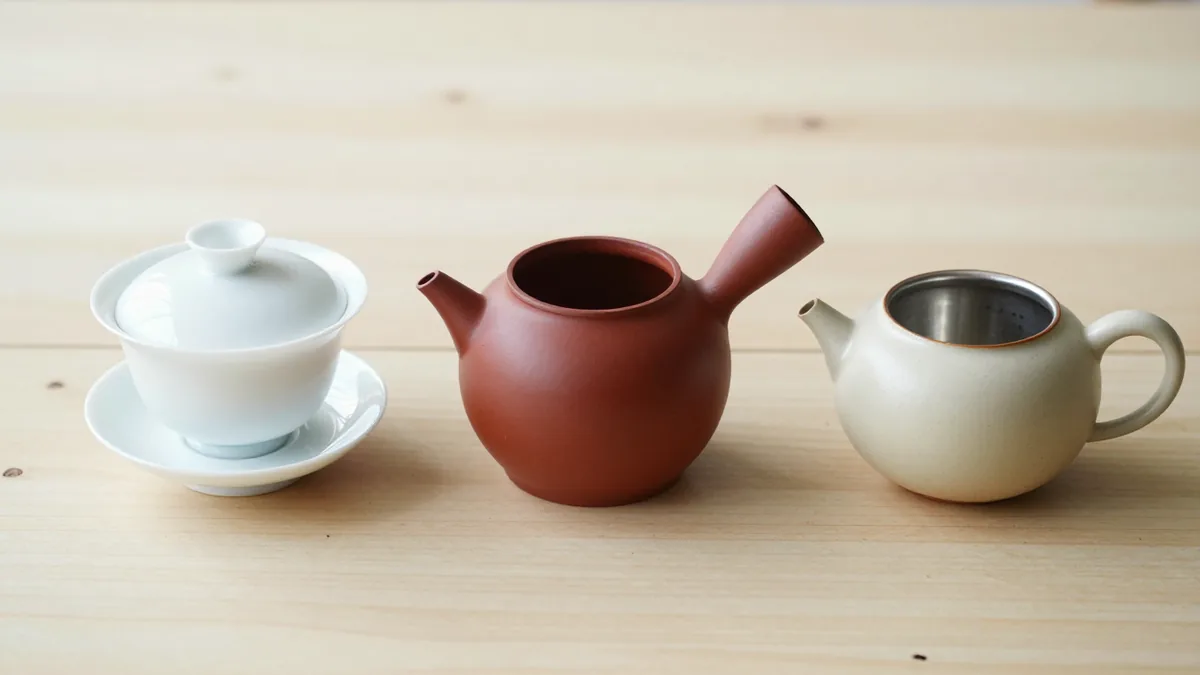
Buy a gaiwan first if you drink oolong, puer or Chinese green tea: it is a 100–150 ml lidded bowl, and the 6 we priced cost $6.75–$29.00. Buy a kyusu if you drink Japanese sencha: it is a side-handled pot with a built-in filter, and ours ran $36.00–$260.00. Buy an infuser teapot if you brew black tea or blends for two or more people: $29.00–$79.95 for 18–45 oz (532–1,331 ml). Prices checked October 1, 2026.
The three vessels do the same job, pouring tea off wet leaf, at three very different scales. Pick by the tea you drink most, then by how many people you pour for.
What each one is
Gaiwan. A Chinese lidded bowl with no handle, in three parts: bowl, lid and saucer. It dates from the Ming dynasty and is usually porcelain, sometimes glass, Yixing clay or jade (Wikipedia: Gaiwan). Typical volume is 100–150 ml, some as small as 80 ml (Wikipedia).
Kyusu. Kyusu just means "teapot" in Japanese, but in practice it means a pot with a side handle (yokode) (Wikipedia: Kyusu). The Japanese entry gives a traditional size of 1–2 go and notes that pots over about 400 ml usually switch to a top handle, because a side handle is poor at holding heavy weight (ja.wikipedia: 急須). One go is 180 ml (4 go is a 720 ml bottle) (Wikipedia: Japanese units), so 1–2 go is 180–360 ml.
Two towns are the classic sources:
- Tokoname (Aichi): designated a Japanese traditional craft on June 2, 1976. Iron in the clay turns it red; vermilion-clay tea utensils are a "relatively new" product line there (Traditional Crafts Aoyama Square: Tokoname).
- Yokkaichi Banko (Mie): designated on January 12, 1979. Its signature piece is the purple-clay teapot, often fired without glaze (Aoyama Square: Banko).
Western teapot. A larger pot, usually back-handled, with a removable steel infuser basket or a strainer built into the lid or spout. European pots were built to brew and hold tea, so they run bigger than green-tea pots (ja.wikipedia: 急須).
Get brewing and teaware notes
Steep times, water temperatures, leaf ratios, and teaware that is worth buying. Free, no spam.
No fixed schedule. Unsubscribe anytime.
Capacity: how much each one pours
| Vessel | Typical volume | Cup it pairs with | Source |
|---|---|---|---|
| Gaiwan | 100–150 ml | Small tasting cups | Wikipedia: Gaiwan |
| Pot for gyokuro | 90 ml | 40 ml | MAFF Japan |
| Pot for high-grade sencha | 250 ml | 100 ml | MAFF Japan |
| Pot for everyday sencha | 600 ml | 150 ml | MAFF Japan |
| Pot for bancha or hojicha | 800 ml | 200 ml | MAFF Japan |
| Western infuser pot | 18–45 oz (532–1331 ml) | Mugs | ForLife pots at Harney |
Ounces converted at 29.57353 ml per US fl oz (NIST SP 811). MAFF is Japan's Ministry of Agriculture, Forestry and Fisheries.
Worked numbers for the leaf:
- Sencha, 250 ml kyusu: Japan's agriculture ministry uses 2–3 g per 100 ml (MAFF), so 5.0–7.5 g.
- Fukamushi, 190 ml kyusu: MAFF uses about 2 g per 60 ml (MAFF), so about 6.3 g.
- Black tea, 24 oz pot (710 ml): the ISO 3103 test ratio of 2 g per 100 ml (ISO 3103:2019) gives 14.2 g.
Gaiwan ratios are much higher; our gongfu guide has them by tea type, and the grams per cup table covers every other vessel.
Prices we checked on October 1, 2026
The Tea Explorer catalog tracks tea, not teaware: of its 7,306 teas from 40 vendors, 0 are teaware. So we read prices straight from 7 vendors' product pages.
| Type | Product | Vendor | Capacity | Material and filter | Price | $ per 100 ml |
|---|---|---|---|---|---|---|
| Gaiwan | Classic White Porcelain Small Gaiwan | Yunnan Sourcing | 60 ml | Porcelain | $6.75 | $11.25 |
| Gaiwan | White Porcelain Gaiwan for Gong Fu Cha Brewing | Yunnan Sourcing | 100 ml | Porcelain | $9.25 | $9.25 |
| Gaiwan | Gaiwan (Assorted Styles), white porcelain | Harney & Sons | 4 oz (118 ml) | Glazed ceramic or glass | $12.50 | $10.59 |
| Gaiwan | Spring Gaiwan | Red Blossom Tea | 180 ml | Dehua porcelain | $18.00 | $10.00 |
| Gaiwan | Chao Zhou Zhu Ni Gaiwan | Jing Tea Shop | 100 ml | Zhuni clay, porcelain-lined | $21.00 | $21.00 |
| Gaiwan | Gaiwan Teapot | Rishi | not listed | Porcelain | $29.00 | n/a |
| Kyusu | Hario ChaCha "Zen" Kyusu Teapot | Rishi | not listed | Glass, open mesh basket | $36.00 | n/a |
| Kyusu | Takasuke Tokoname Kyusu Teapot | Rishi | not listed | Tokoname clay, fine clay mesh | $74.50 | n/a |
| Kyusu | Cera-Mesh Kyusu Teapot | Rishi | 190 ml | Unglazed clay, clay mesh (sasame) | $88.50 | $46.58 |
| Kyusu | Black Kyusu Teapot (Tokoname-yaki) | Ippodo | 8 oz (237 ml) | Tokoname clay | $100.00 | $42.19 |
| Kyusu | Hakuji Kyusu (Hasami-yaki) | Ippodo | 10 oz (296 ml) | Porcelain | $100.00 | $33.78 |
| Kyusu | Gyokko Flat Bottom Kyusu Light | Kettl | not listed | Unglazed Tokoname clay, ceramic strainer | $105.00 | n/a |
| Kyusu | Left-Handed Yakishime Kyusu (Banko-yaki) | Ippodo | 8 oz (237 ml) | Unglazed Banko clay, handmade | $260.00 | $109.70 |
| Western teapot | Simple Brew Loose Leaf Teapot | Rishi | not listed | Glass, steel strainer lid | $29.00 | n/a |
| Western teapot | Glass Teapot | Ippodo | 24 oz (710 ml) | Glass | $40.00 | $5.63 |
| Western teapot | ForLife Stump Teapot with Infuser | Harney & Sons | 18 oz (532 ml) | Ceramic, 0.3 mm steel infuser | $42.75 | $8.04 |
| Western teapot | ForLife Curve Teapot with Infuser | Harney & Sons | 24 oz (710 ml) | Ceramic, 0.3 mm steel infuser | $46.55 | $6.56 |
| Western teapot | ForLife Curve Teapot with Infuser | Harney & Sons | 45 oz (1331 ml) | Ceramic, 0.3 mm steel infuser | $54.15 | $4.07 |
| Western teapot | Kinto Pebble Porcelain Teapot | Rishi | not listed | Porcelain, built-in steel strainer | $68.50 | n/a |
| Western teapot | Cristel Glass Teapot | Harney & Sons | 27 oz (798 ml) | Double-walled glass, steel filter | $79.95 | $10.02 |
Sources: the linked vendor product pages, checked October 1, 2026. "n/a" means the vendor does not list a volume.
What the table shows:
- Gaiwans are cheap. A 100 ml porcelain gaiwan is $9.25, or $9.25 per 100 ml of capacity.
- Kyusu cost the most per ml. Ippodo's Tokoname kyusu is $100.00 for 8 oz, $42.19 per 100 ml. Handmade unglazed Banko is $260.00.
- Western pots are cheapest per ml. The 24 oz ForLife Curve is $46.55, $6.56 per 100 ml.
Filters: why sencha needs a kyusu
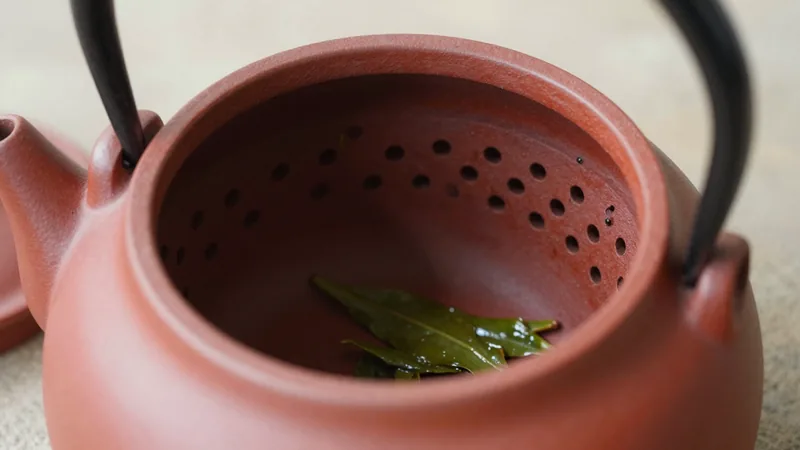
Filter size matters most for Japanese tea (types in our Japanese green tea guide). Fukamushi sencha is steamed 2–3 times longer than ordinary sencha, which breaks the leaf into fine particles; MAFF says to pour it quickly because of them (MAFF). A coarse basket lets those particles into the cup.
The Japanese entry lists the filter types found in kyusu: a clay filter made in one piece with the pot, mesh rings, removable baskets, flat and dome screens at the spout, and a band of mesh around the inside wall (ja.wikipedia: 急須). What vendors say about theirs:
- Takasuke Tokoname kyusu: "smaller size clay mesh," sold as "perfect for brewing deeper steamed teas." $74.50.
- Cera-Mesh kyusu: clay mesh (sasame) filter, 190 ml for $88.50.
- Hario ChaCha: a glass pot with a "wide open mesh basket" that lets leaves move. $36.00.
- ForLife Stump: a 0.3 mm steel infuser, sold for teas from rooibos to large-leaf oolong. $42.75.
A gaiwan has no filter at all. You hold back the leaf with the lid, which stops whole leaves; fine particles are harder to stop.
Materials and heat
Porcelain and glass. A glazed gaiwan does not alter the tea's flavor or aroma during brewing, and its open bowl lets you watch the leaf (Wikipedia: Gaiwan). Glass pots do the same job for show: Ippodo sells its 24 oz glass teapot so you can watch the leaf unfurl, for $40.00.
Unglazed clay. Tokoname clay is iron-rich and fires red (Aoyama Square). Banko makers say their teapots develop a sheen the more they are used (Aoyama Square). Our Yixing teapot guide covers whether clay changes taste.
Heat. Wikipedia's gaiwan entry says a gaiwan is "less suitable for black teas as the large lid allows heat to escape too quickly," and that handling one "can take some practice ... as the liquid is hot" (Wikipedia: Gaiwan). A Western pot with an infuser needs no technique at all: lift the basket out when time is up.
Which to buy first
| If you mostly drink | Buy first | Size to look for | Price range we found |
|---|---|---|---|
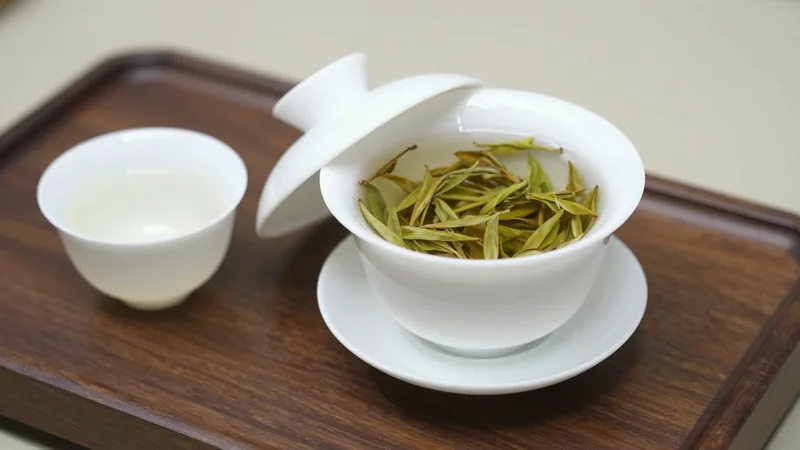
| Oolong, puer, Chinese green or white, tasting several teas | Porcelain gaiwan | 100–150 ml | $6.75–$29.00 |
| Japanese sencha, gyokuro, fukamushi | Kyusu with a fine clay or mesh filter | 250 ml for sencha, 90 ml for gyokuro | $74.50–$260.00 |
| Black tea, Earl Grey, rooibos, blends; two or more people | Infuser teapot | 18–27 oz (530–800 ml) | $29.00–$79.95 |
| Not sure yet | Porcelain gaiwan | 100 ml | $6.75–$18.00 |
Sources: sizes from Wikipedia: Gaiwan and MAFF; prices from the table above.
Three rules:
- Match the filter to the leaf. Broken, deep-steamed leaf needs a fine clay or 0.3 mm mesh. Whole leaf works in anything.
- Match the volume to the session. A 100 ml gaiwan serves one or two people in tasting cups; one 250 ml kyusu pour fills two 100 ml cups (MAFF).
- Start with porcelain. It does not alter flavor, so one cheap porcelain gaiwan or pot can brew every tea. Save unglazed clay for later.
Frequently Asked Questions
Can I brew Japanese sencha in a gaiwan?
Yes for whole-leaf sencha, poorly for fukamushi. Fukamushi is steamed 2–3 times longer than ordinary sencha and breaks into fine particles, and a gaiwan's lid does not hold them back. A kyusu with a fine clay filter, from $74.50 at Rishi, does.
How big should my first gaiwan be?
100–150 ml is typical. Yunnan Sourcing sells 60 ml for $6.75 and 100 ml for $9.25; Red Blossom's Dehua porcelain gaiwan is 180 ml for $18.00, as of October 1, 2026.
Why are kyusu so much more expensive than gaiwans?
Most of the kyusu we priced are Japanese clay pots with built-in clay filters, and Ippodo calls its Banko pot "completely handmade." Our kyusu ran $36.00–$260.00 against $6.75–$29.00 for gaiwans, or about $42.19 per 100 ml of capacity for an Ippodo Tokoname pot against $9.25 for a porcelain gaiwan.
Is a gaiwan good for black tea?
It works, but Wikipedia's gaiwan entry calls it less suitable for black tea because the wide lid lets heat escape. For a pot of black tea, an 18–24 oz infuser teapot at $42.75–$46.55 is the simpler buy.
What do Tokoname and Banko mean on a kyusu?
They are pottery towns. Tokoname ware (Aichi) was designated a Japanese traditional craft on June 2, 1976, and Yokkaichi Banko ware (Mie) on January 12, 1979.