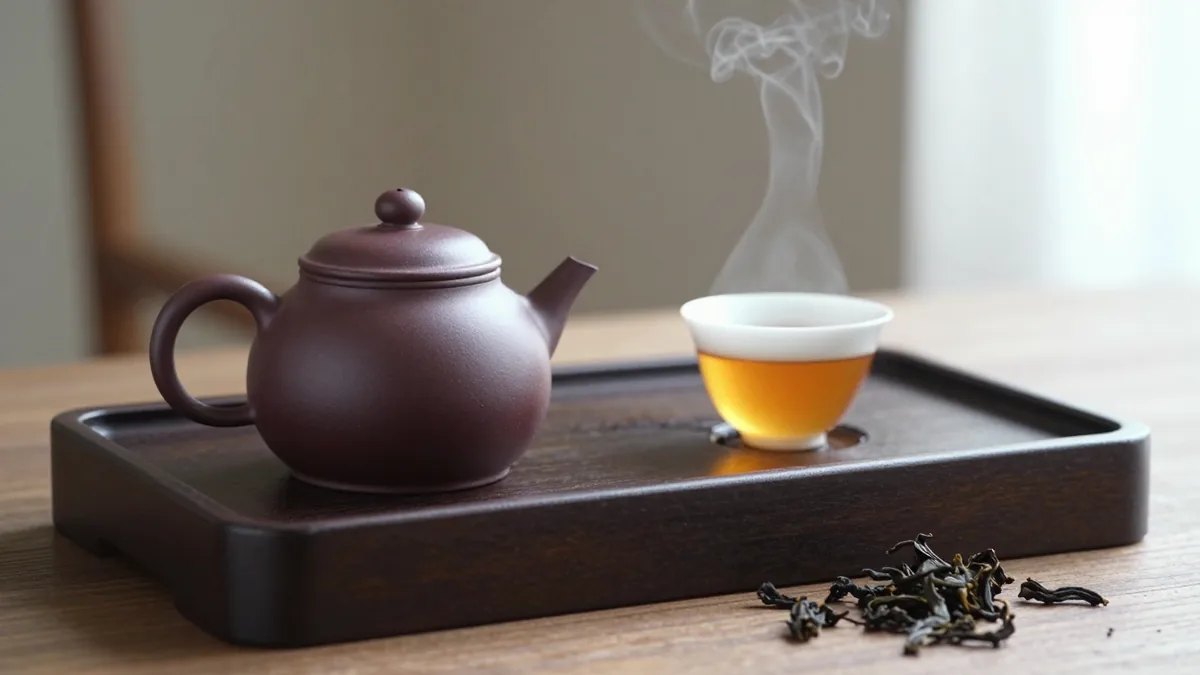
A Yixing teapot is an unglazed stoneware pot made from zisha clay mined around Dingshu town in Yixing, Jiangsu, and fired at about 1,100–1,200 °C. The three main clays are zini (purple), zhuni/hongni (red) and duanni (beige). As of October 1, 2026, Yunnan Sourcing's 42 Yixing teapots ran $60–$188 (median $98) and one Yixing seller's 493 fully handmade pots ran $228–$570 (median $369); a "fully handmade" pot under $50 is a red flag.
Yixing pots are small, unglazed clay teapots built for gongfu brewing. Collectors pay thousands for named makers. Most drinkers need one honest pot for one type of tea.
This guide covers where the clay comes from, how the clay types differ, how to spot a fake, what real pots cost, and the two ways vendors tell you to season a new pot.
What Makes a Teapot "Yixing"
The name is a place: Yixing, a city in Jiangsu province. Wikipedia says the pots are actually made in nearby Dingshan, on the west side of Lake Tai.
The clay is called zisha, "purple sand." It is mined principally at Huanglongshan and Zhaozhuangshan. The Huanglong Mountain mine sits in Dingshu town; its No. 4 mine was built from 1972.
Three facts define the material:
- Unglazed. Yixing ware is "typically left unglazed," so the clay touches the tea (Wikipedia).
- Stoneware firing. Typical firing is 1,100–1,200 °C in an oxidizing atmosphere (Wikipedia).
- No temper. Potters used zisha as the sole ingredient, with no added temper, according to a neutron activation study of Zisha clay by Zhu, MacDonald, Hang, Zhu and Glascock.
Supply is limited. The same study reports that "In 2005, the China Yixing Municipal Government issued legislation to limit the quantity of raw materials extracted from the deposit." The Huanglong Mountain mine entry says mining "was suspended in 2005" and the mines were placed under protective management. Mud and Leaves, a teaware seller, adds that "mining of zisha continues to this day" at a much smaller scale, and that clay mined before 2005 still sits in storage.
Get brewing and teaware notes
Steep times, water temperatures, leaf ratios, and teaware that is worth buying. Free, no spam.
No fixed schedule. Unsubscribe anytime.
Zini, Zhuni, Hongni and Duanni: The Clay Types
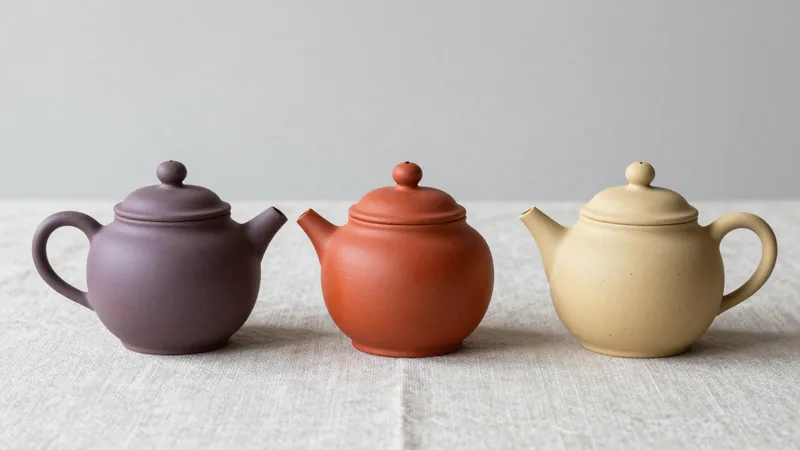
Wikipedia groups zisha into three color families: purple, red and beige. Vendors split the red family further.
| Clay | Fired color | Porosity and firing behavior | Teas vendors pair it with | Share of Huanglongshan zisha ore |
|---|---|---|---|---|
| Zini (purple clay) | Purple-brown | Moderately porous, steady heat retention | Yancha and roasted oolong, aged sheng, shou, dark tea, black tea | 80% |
| Zhuni (vermilion clay) | Bright orange-red | Denser, higher shrinkage, less porous; keeps aroma sharp | Dancong, Taiwanese oolong, aromatic black tea | part of hongni share |
| Hongni (red clay) | Red | Between zini and zhuni, depending on clay and firing | Choose by firing; behaves like the clay it is closest to | 8% |
| Duanni (beige/yellow clay) | Beige to pale yellow | More porous; softens sharp teas | Young sheng, roasted oolong, bitter or astringent teas | 12% |
Sources: clay behavior and pairings from Path of Cha; ore shares from Mud and Leaves, which estimates that zisha ore is only 3–5% of Huang Long Shan, and of that ore, 80% is zini, 12% duanni and 8% hongni.
Those shares explain prices. If hongni is 8% of an ore body that is 3–5% of the mountain, red clay is roughly 0.24–0.4% of the mountain. Zhuni is a smaller slice of that. Mud and Leaves warns that "If a zhuni teapot is being sold for $50 USD or less, there is probably something wrong with it."
Porosity follows firing temperature. Path of Cha puts it simply: "The higher the firing temperature, the less porous the clay becomes." A higher-pitched ring when you tap the lid gently against the pot points to a hotter firing.
Does the Clay Change the Tea?
There is some lab evidence. A 2018 study in the Journal of the Science of Food and Agriculture brewed the same oolong in six pots: Zisha, Zhuni, stainless steel, ceramic, glass and plastic.
Tea from the Zisha and Zhuni pots had higher EGC, EGCG and total catechins, less caffeine, and the lowest mineral and potassium levels. The authors concluded the clay pots "produce tea infusions that are presumably less bitter and more fragrant." Differences between the clay pots and stainless steel were not all statistically significant.
That is one study with one oolong. It supports the vendor advice to use clay for oolong and dark tea. It does not show that a $500 pot beats a $100 pot.
For the brewing method itself, see our gongfu brewing guide. Yixing pots are usually small, and gongfu ratios assume a small vessel.
How to Spot a Fake Yixing Teapot
Fakes fall into two groups: pots made of non-zisha clay sold as zisha, and real zisha pots sold as something more expensive (fully handmade, rare clay, famous maker). Check these signs:
- Price. Path of Cha says that if a "fully handmade teapot with intricate details costs only $25-50, something (or everything) is off."
- Wheel marks. Zisha's "low plasticity prevents it from being wheel-thrown." Circular throwing lines inside the pot are "not a good sign" (Path of Cha).
- Surface. Real zisha "contains visible mineral particles and showcases natural surface irregularities." Mud and Leaves says pots that "look very shiny before they have been used, that feel sandy or muddy to the touch, that have a bad or chemical smell, should all be avoided."
- Color. Colors outside the natural purple, red and beige range are often adjusted. Tea Muse notes that cobalt oxide and manganese dioxide are added to create black, blue-green, deep green or light beige.
- Smell. Fill a new pot with hot water and smell it after a few minutes. Clay should smell faintly earthy. A chemical or perfumed smell is a reason to return it.
Slip-cast is not fake, just cheaper. Wikipedia explains that "The more expensive pots are shaped by hand using wooden and bamboo tools," while "cheaper Yixing pots are produced by slipcasting," where liquid clay is poured into a mold. The problem is only when a slip-cast or mold-pressed pot is sold as fully handmade. Path of Cha's view is that whether a pot is fully or half handmade matters less than "whether or not it does a good job transforming tea taste."
What Real Yixing Pots Cost
We pulled two vendor catalogs on October 1, 2026:
| Vendor listing | Teapots | Lowest | Median | Highest |
|---|---|---|---|---|
| Yunnan Sourcing, Yixing teapots | 42 | $60 | $98 | $188 |
| Yiqin Teahouse, full handmade zisha | 493 | $228 | $369 | $570 |
Source: each store's public product feed, fetched 2026-10-01. Yunnan Sourcing count includes in-stock and sold-out teapots, excluding cups, gaiwans and pitchers. Yiqin count excludes one pot-and-cups set.
Single examples from the same day:
- Yunnan Sourcing Da Hong Pao clay Xi Shi, 120 ml: $75, or $0.63 per ml of capacity.
- Path of Cha "The Right of Qin," fully handmade zini, 180 ml: $197, or $1.09 per ml.
The median fully handmade pot at Yiqin costs 3.8 times the median Yunnan Sourcing teapot. That gap is the handmade premium plus maker reputation. A pot under $50 can still be a fine brewer, but it is very unlikely to be fully handmade from high-grade clay.
A worked cost check: a $98 pot used 5 times a week for 2 years serves 520 sessions, about $0.19 per session. Three dedicated pots at that price cost $294, still less than one median fully handmade pot at $369.
Seasoning and Daily Care
Vendors disagree on seasoning. All of them agree on what to avoid.
Method 1: hot-water and tea soak, no boiling. Yiqin Teahouse recommends putting loose tea in the pot, filling it with hot water to cover the leaves, and letting it steep for 4–8 hours or overnight. It lists boiling only as an optional advanced method.
Method 2: simmer in water. Path of Cha has you boil water in a larger pot, lower the heat so it does not boil hard, and leave the teapot and lid in for 15–20 minutes. Jiangnan Sourcing goes further: a 30-minute simmer in water, then a 30–60 minute simmer in tea, cooling in the liquid.
If you simmer, start the pot in cool water and let it cool in the water afterward. Yiqin warns that "sudden temperature changes can cause cracks." Set the pot on a folded cloth so it does not rattle against the pan.
One pot per tea type. Unglazed clay absorbs flavor. Wikipedia notes that connoisseurs "recommend using each tea vessel for one kind of tea (white, green, oolong, black, or puer) or even one variety of tea only." A practical split for three pots: roasted oolong, sheng puer, shou puer. Our sheng vs shou puer guide explains why those two taste so different.
Daily care:
- Never use soap. Jiangnan Sourcing says the clay's pores "can trap residue and affect flavor."
- Empty the leaves, rinse with hot water and dry with the lid off.
- Pre-warm the pot before pouring boiling water into it.
- No dishwasher, no abrasive pads.
Is Yixing Clay Safe?
The main lead risk in ceramics is glaze, and Yixing pots are unglazed inside. Alameda County's lead program explains that lead "has been used to make ceramic dishes for centuries, often being added to a glaze for the bright colors," and warns about bright colors or decorations on surfaces that touch food or drink.
The U.S. limits are set in FDA Compliance Policy Guide 545.450--Import-and-Domestic---Lead-Contamination.pdf). Teapots are treated as hollowware by size: under 1.1 liters is small hollowware, with a lead leaching limit of 2.0 micrograms per mL; 1.1 liters or more is large hollowware at 1.0. A typical 100–200 ml Yixing pot falls in the small category.
The FDA's recent lead warnings, starting in August 2025, named imported cookware "made from aluminum, brass, and aluminum alloys," not clay teapots.
Practical rules:
- Avoid pots with painted or enameled decoration on the inside.
- Avoid pots with a strong chemical smell or color that rubs off on a wet white cloth.
- Buy from sellers who name the clay and the maker and accept returns.
Frequently Asked Questions
How can I tell if a Yixing teapot is real?
Look for visible mineral grains, a matte surface before use, no wheel-throwing lines inside, and a faint earthy smell when filled with hot water. Be wary of a "fully handmade" pot priced at $25–$50 or a zhuni pot at $50 or less. Fully handmade pots at one Yixing seller started at $228 on October 1, 2026.
Do I need to boil a new Yixing teapot?
No. Vendors are split: Yiqin Teahouse recommends a 4–8 hour hot-water and tea soak with no boiling, while Path of Cha simmers the pot for 15–20 minutes. Both work. If you simmer, start in cool water and let the pot cool in the water to avoid cracks.
Which Yixing clay is best for which tea?
Vendors pair zini with roasted oolong, aged sheng, shou and black tea, and zhuni with aromatic oolongs like dancong and Taiwanese high mountain tea. Duanni is often used for young sheng and bitter or astringent teas. Zini makes up about 80% of Huanglongshan zisha ore, so it is the easiest to find.
Why use one teapot per type of tea?
The unglazed clay absorbs flavor from every brew. Mixing roasted oolong and green tea in one pot muddies both. Three dedicated $98 pots cost $294, less than one median fully handmade pot at $369.