Korean tea comes mainly from three places: Hadong on the slopes of Jirisan, Boseong in South Jeolla, and Jeju island. Korean law grades green tea by picking date around Gogu, the solar term near April 20: ujeon before it, then gogu, sejak, jungjak in May and daejak from June. Balhyocha means "fermented tea" and is used for oxidized teas that range from oolong-like to black. The Tea Explorer catalog, 7,306 teas from 40 vendors, fetched 2026-10-01 lists 16 Korean teas; only 6 were in stock as of October 1, 2026.
Korea grows far less tea than China or Japan, and most of it is green. The interesting parts are the grading system, which is written into law, and the oxidized teas that Korean labels call balhyocha. This guide covers both, with what the teas cost in the US.
Three regions: Hadong, Boseong, Jeju
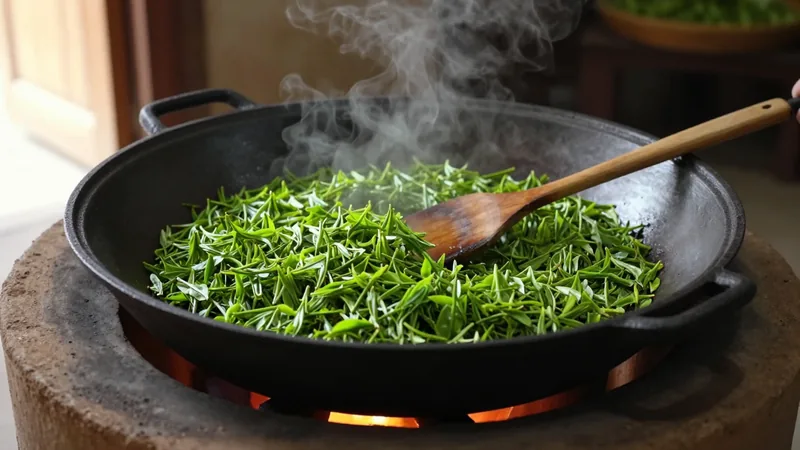
Korean Wikipedia lists the main green tea areas as Hadong and Sacheon in South Gyeongsang, Boseong and Gurye in South Jeolla, and Jeju (Korean Wikipedia).
| Region | Province | What sets it apart | Typical teas | Catalog listings |
|---|---|---|---|---|
| Hadong (Hwagae valley) | South Gyeongsang | old seedling bushes among rocks on Jirisan; hand-picked; FAO heritage site since 2017 | pan-roasted green, jaeksul-cha black, balhyocha | 6 |
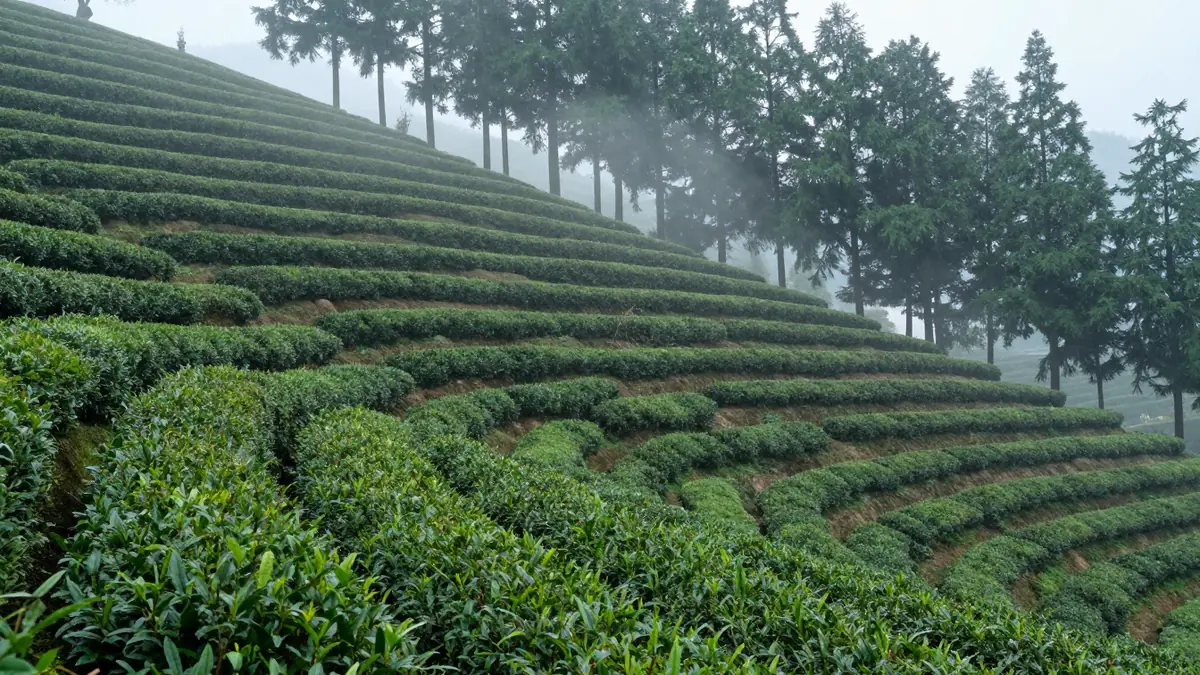
| Boseong | South Jeolla | largest planted area, terraced estates, Korea's first geographical indication (2002) | sejak and jungjak green, matcha, hwangcha | 6 |
| Jeju | Jeju | volcanic-ash soil, flat machine-harvested estates | steamed sejak green, oolong, matcha | 3 |
Sources: FAO GIAHS, Yangsan Ilbo, O'Sulloc Tea (Wikipedia). Listing counts from the Tea Explorer catalog, 7,306 teas from 40 vendors, fetched 2026-10-01; Hadong counted by producer name.
Hadong. FAO designated the traditional Hadong tea agrosystem in Hwagae-myeon a Globally Important Agricultural Heritage System in 2017, after Korea listed it nationally in 2015 (FAO). Hwagae is 91% steep mountain land, so households grew tea between rocks instead of rice. In 2015, 801 of 951 rural households there (84.2%) farmed tea, and FAO credits Hwagae with 20% of Korea's tea output. Leaves are picked by hand and roasted in iron pots. What-Cha's Hadong teas come from the Dong Cheon cooperative and list the cultivar as descendants of tea brought to Korea about 1,200 years ago (What-Cha).
Boseong. Boseong county has about 797 ha of tea and 573 farms producing 5,000–6,000 t of fresh leaf a year (Greened, April 2026). That is about 37% of Korea's tea area; Boseong green tea was Korea's first registered geographical indication in 2002, and the Daehan Dawon estate dates to 1939 (Yangsan Ilbo, June 2026). The county lost about 1,000 ha in the five years to 2012 as coffee took over, South Jeolla made 60.5% of Korea's green tea (2,354 t) at its 2007 peak (Namdo Ilbo, December 2025).
Jeju. The O'Sulloc business began in 1979 and planted its Dosun field on Hallasan's slopes in 1980; its Jeju and Gangjin estates total about 330 ha, all picked by machine, on soil made mostly of volcanic ash (Wikipedia). Jeju tea is often steamed like sencha. Harney says its Jeju Sejak leaves "are steamed to preserve their vivid green color" (Harney), and What-Cha's Jeju oolong uses the Japanese cultivar Yabukita (What-Cha).
Exports are small but rising: 136 t in 2018 to 228 t in 2023 (+68%), and $4.21 million to $6.60 million (+57%), helped by matcha demand (Namdo Ilbo).
Get origin and garden notes
Where tea is grown, how each region makes it, and the next origin explainer. Free, no spam.
No fixed schedule. Unsubscribe anytime.
Korean green tea grades follow the solar calendar
Korea's tea industry law sets five picking-date labels for green tea, keyed to Gogu (곡우, Grain Rain), the solar term that starts around April 20 (Wikipedia). The current table was amended on December 31, 2021 (Enforcement Rule, Annex 1, law.go.kr).
| Grade | Legal picking window | Leaf standard | Calendar dates if Gogu is April 20 |
|---|---|---|---|
| Ujeon (우전, "before the rain") | before Gogu in a normal year | 1 bud, 2 leaves | before April 20 |
| Gogu (곡우) | Gogu or within 7 days after | 1 bud, 2 leaves | April 20–27 |
| Sejak (세작, "thin sparrow") | 8 to 10 days after Gogu | 1 bud, 3 leaves | April 28–30 |
| Jungjak (중작) | May | 1 bud, 3 leaves | May 1–31 |
| Daejak (대작) | June onward | not specified | from June 1 |
Source: Enforcement Rule of the Act on Tea Industry Development, Annex 1 (PDF); English grade glosses from Wikipedia. Calendar column is our arithmetic.
The same rule requires the label to show the picking period as year, month and early/mid/late third, and the city or county where the leaf was picked. Blends must show the latest picking date in the mix (law.go.kr).
Vendors do not all follow it. What-Cha labels its Hadong daejak as picked in late May 2026 (What-Cha), where the law says June. It calls sejak "2nd picking in Spring" on one listing (What-Cha) and jungjak "3rd spring picking" on another (What-Cha). Harney describes sejak as "harvested just after the prized first flush" (Harney). Read the grade as a rough position in the season and check the month on the bag.
Ujeon commands the money. A 2013 study of six premium Korean green teas listed these harvest dates and Korean retail prices (Foods, 2013):
| Tea (maker) | Harvest | 2013 price per 100 g |
|---|---|---|
| Illohyang (Amorepacific) | ~April 5 | $164.62 |
| Ujeon Okro (Hwagae Jeda) | April 16 | $123.46 |
| Daehan Ujeon (Daehan Tea) | ~April 20 | $69.14 |
| Ouksu (Amorepacific) | May 26 | $25.80 |
The late-May tea sold for about a sixth of the early-April one.
What changes between ujeon and daejak
A Boseong study plucked leaves from late April to late May 2013 and labeled the four lots ujeon, sejak, jungjak and daejak (Molecules, 2014):
| Grade (picked) | Theanine (mg/g) | Caffeine (mg/g) | EGCG (mg/g) | Total catechins (mg/g) |
|---|---|---|---|---|
| Ujeon (late April) | 6.46 | 29.54 | 105.37 | 200.40 |
| Sejak (early May) | 4.60 | 27.21 | 103.95 | 201.00 |
| Jungjak (mid-May) | 2.84 | 27.19 | 111.59 | 212.20 |
| Daejak (late May) | 2.19 | 26.74 | 112.86 | 215.19 |
Theanine fell 66% from ujeon to daejak. Total catechins rose 7.4% and EGCG rose from 105.37 to 112.86 mg/g. In a 3 g serving that is 19.4 mg of theanine in ujeon leaf against 6.6 mg in daejak, before any of it reaches the cup. Caffeine barely moved: 29.54 to 26.74 mg/g. Our L-theanine and caffeine studies page covers what those amounts do.
Early grades carry more theanine and fewer catechins; daejak carries the reverse. If a daejak tastes harsh, brew it cooler or shorter, as in our bitter green tea guide.
Balhyocha and hwangcha: one word, three teas
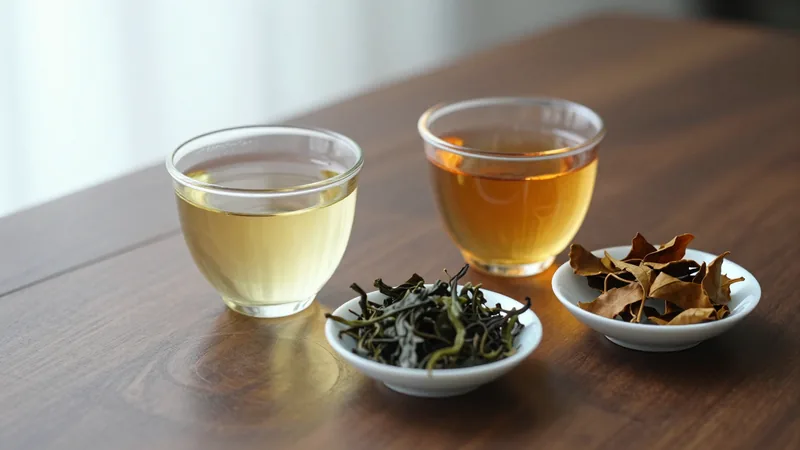
Balhyocha (발효차) translates as "fermented tea", but Korean tea writing uses "fermentation" for oxidation: Korean Wikipedia defines semi-fermented tea as tea oxidized 10–70% (Korean Wikipedia). Korean researchers classify tea as non-fermented, semi-fermented (10 to 65%) and fermented (85% or more) (Prev Nutr Food Sci, 2018). On that scale green tea is non-fermented, oolong is semi-fermented and black tea is fermented. Our oolong oxidation guide covers the chemistry.
Korean balhyocha is made from Korean Camellia sinensis bushes, and makers place it anywhere from oolong to black. A Korean sensory study notes that Korean fermented tea brews clear and is "not strong", which suits blending (Prev Nutr Food Sci, 2018). What-Cha describes its Boseong balhyocha as a tea that "underwent both oxidization and fermentation" with a taste "somewhat reminiscent of a good GABA oolong" (What-Cha).
Hwangcha (황차) adds to the confusion. Chinese yellow tea gets its color from menhuang, a covered "yellowing" step after the kill-green (Korean Wikipedia). Korean hwangcha is usually described as partly oxidized green tea, closer to oolong (Wikipedia; Korean Wikipedia). Hadong also has jaeksul-cha (잭살차), a traditional small-leaf black tea (Korean Wikipedia). And a third meaning is growing: South Jeolla's agricultural research service is making microbially fermented dark tea from surplus green tea, also called balhyocha (Namdo Ilbo).
The catalog shows the mess. The 3 listings with "balhyocha" in the name carry 3 different type labels: black, dark, yellow. Check the oxidation level and brewing temperature on the product page, not the name.
What Korean tea costs in the US catalog
The Tea Explorer catalog, 7,306 teas from 40 vendors, fetched 2026-10-01 has 16 Korean listings; 13 are What-Cha and 6 were in stock as of October 1, 2026. Prices for the UK sellers are converted to USD.
| Type | Listings | In stock | Median $/g | Range $/g |
|---|---|---|---|---|
| green | 7 | 4 | $0.39 | $0.23–$0.81 |
| black | 3 | 1 | $0.82 | $0.41–$0.86 |
| yellow | 3 | 1 | $0.58 | $0.35–$1.06 |
| dark | 1 | 0 | $0.67 | single listing |
| matcha | 1 | 0 | $0.32 | single listing |
| oolong | 1 | 0 | $0.39 | single listing |
Source: Tea Explorer catalog, 7,306 teas from 40 vendors, fetched 2026-10-01.
- Korean green costs more than Japanese sencha. The Korean green median is $0.39/g against $0.32/g for Japanese sencha across all listings, with small Korean samples (n=7 vs n=72).
- Grade shows up in price. From the same Hadong cooperative, What-Cha's Korea Dong Cheon Sejak Jaksulcha Semi-Wild Green Tea costs $0.78/g and Korea Dong Cheon Daejak Semi-Wild Green Tea $0.27/g, 2.9x apart.
- Cheapest: Jeju Sejak from Harney & Sons Fine Teas at $0.23/g ($13.00 for 56.7 g). Most expensive: Korean Hwangcha Yellow from Rare Tea Company at $1.06/g, from a farm in Jangseong, South Jeolla (Rare Tea Company).
- 2026 harvest: The Steeping Room's 2026 Boseong Sejak Green Tea from Korea lists April 2026 picking at $0.39/g (The Steeping Room).
Brewing Korean teas
Vendor instructions for the teas above:
| Tea | Water | Leaf | Time |
|---|---|---|---|
| Hadong green, sejak or daejak (What-Cha) | 70 °C | 1–2 tsp per cup | 30–45 s |
| Jeju Sejak (Harney) | 175 °F (79 °C) | not stated | 3 min |
| Hwangcha (Rare Tea Company) | 80 °C | 3 g per 150 mL | 60–90 s, 3+ infusions |
| Hadong balhyocha (What-Cha, Jukro) | 90 °C | 1–2 tsp per cup | 45–60 s |
| Boseong balhyocha (What-Cha) | 90 °C | 2 tsp per cup | 3–5 min |
Sources: What-Cha daejak, Harney, Rare Tea Company, What-Cha Jukro, What-Cha Boseong.
The pattern: green Korean teas want cool water and short steeps; balhyocha takes 90 °C water, like many oolongs. Temperatures for other types are in the steeping chart.
Frequently Asked Questions
What is ujeon tea?
Ujeon is the top Korean green tea grade, picked before Gogu, the solar term around April 20, from one bud and two leaves. In a 2013 Boseong study ujeon leaf held 6.46 mg/g of theanine, about three times the 2.19 mg/g in late-May daejak. In 2013, Korean ujeon teas retailed for $69–$124 per 100 g.
What is the difference between sejak, jungjak and daejak?
Korean law sets sejak at 8 to 10 days after Gogu, jungjak in May and daejak from June. Sejak and jungjak allow one bud and three leaves, and in a 2013 Boseong study later grades carried less theanine and more catechins. In the catalog, What-Cha's Hadong sejak costs 2.9x its daejak per gram.
Is balhyocha a black tea or an oolong?
It depends on the maker. Balhyocha means "fermented tea", and Korean classification uses that word for oxidation: semi-fermented 10–65%, fermented 85% or more. The 3 balhyocha listings in our catalog are typed black, dark, yellow, so check the oxidation and brew at about 90 °C.
Where does Jeju tea come from?
The best-known source is O'Sulloc, whose estates sit on volcanic-ash soil; the business began in 1979 and planted its Dosun field in 1980. Its estates total about 330 ha and are machine-harvested. Jeju green tea is often steamed, like Japanese sencha.