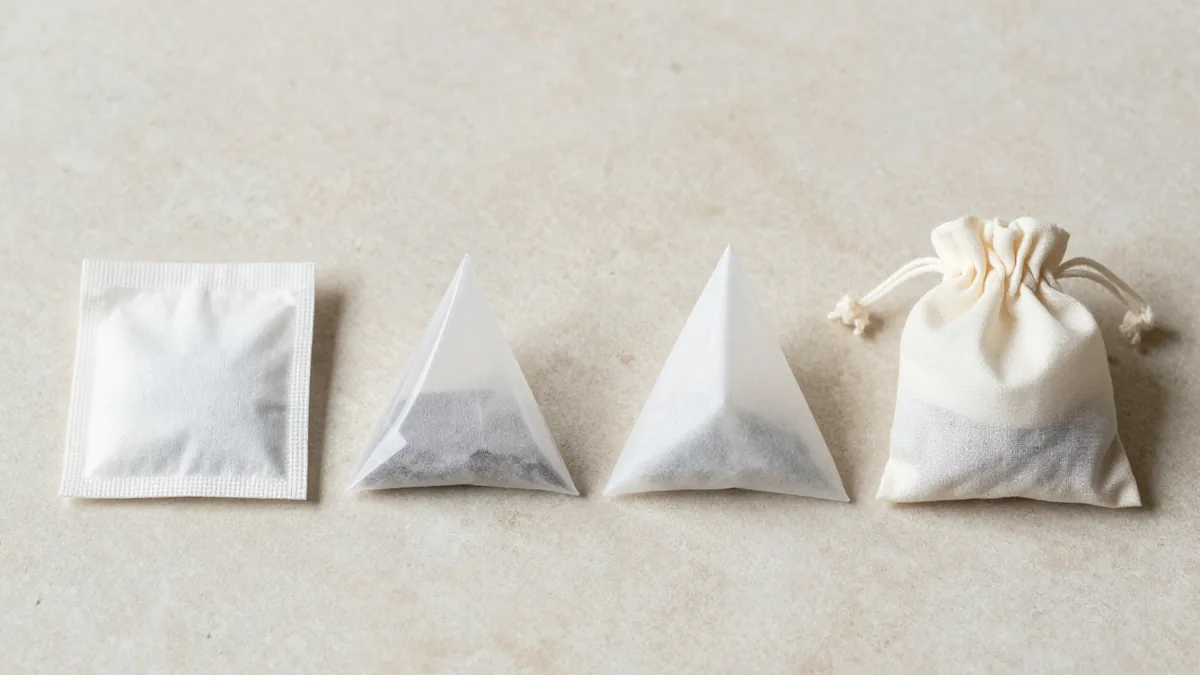
Paper tea bags are cellulose, often with a polypropylene or PLA seal; pyramid bags are usually nylon, PET or PLA mesh. A 2019 McGill study reported 11.6 billion microplastic and 3.1 billion nanoplastic particles from one plastic bag at 95 °C, but a 2020 re-test co-authored by Germany's BfR found 5,800–20,400 particles above 1 µm per bag. Published counts span about eight orders of magnitude, and the FDA, WHO and BfR say current evidence does not show a health risk from microplastics in food.
What tea bags are made of
| Material | What it is | Plastic in contact with the water | What studies found |
|---|---|---|---|
| Filter paper with heat-seal fibre | Abaca (Manila hemp) or wood-pulp cellulose, with a thermoplastic fibre so the edges seal | Polypropylene in many bags | Xu 2021 found PP-cellulose composites in branded bags; Mateos-Cárdenas 2022 found PP fragments still in soil after 12 months |
| Folded or crimped paper, no seal | 100% cellulose, folded and pressed | None stated by the maker | Stash says its filter paper is 100% wood cellulose with no glue and no plastic (Stash FAQ) |
| Paper sealed with PLA | Cellulose with polylactic acid, a corn- or sugarcane-based plastic, as the seal | PLA | Cellulose-PLA bags lost 66–78% of their mass in 7 months buried in a field (Courtene-Jones 2024) |
| PLA mesh ("plant-based mesh") | Woven or non-woven PLA, often in pyramids | PLA | About one million PLA nanoparticles per bag (Banaei 2023); pure PLA bags were intact after 12 months in soil (Mateos-Cárdenas 2022) |
| Nylon or PET mesh | Nylon-6, nylon-6,6 or polyethylene terephthalate pyramids | Nylon or PET | The source of the 11.6 billion figure (Hernandez 2019) and of every later dispute about it |
| Cotton mesh | Open-mesh woven cotton thread | None | The fabric named in the 1903 US patent for a "tea-leaf holder" (US 723,287) |
| Loose leaf, steel or glass infuser | No bag | None | We found no study measuring particle release from a stainless-steel infuser |
Brand statements were checked on October 1, 2026.
A flat paper bag with sealed edges needs a heat-sealable fibre; a folded, crimped or stapled bag does not. The Tea Association of the USA says many of its members now use PLA, "not Polypropylene/petroleum based plastic," for the seal.
Get tasting and processing notes
Oxidation, rolling, roasting oolong, aging pu-erh, and how to taste tea side by side at home. Free, no spam.
No fixed schedule. Unsubscribe anytime.
The 2019 McGill study: 11.6 billion particles
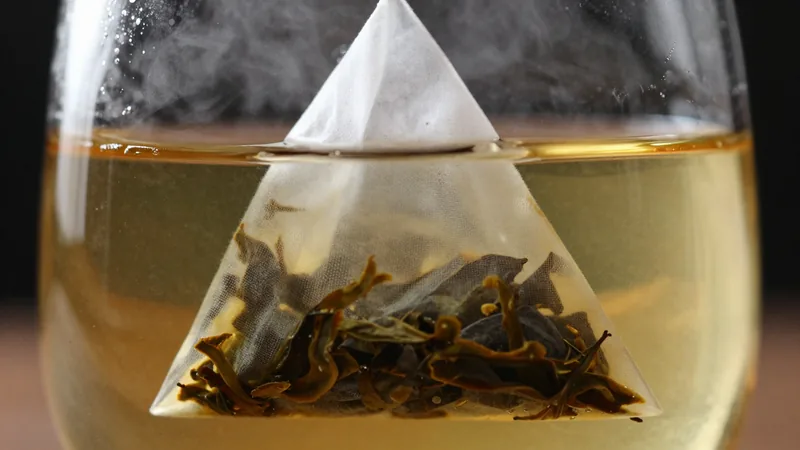
Hernandez et al., published in Environmental Science & Technology in November 2019, is the source of the "billions of particles" headline. The abstract says steeping one plastic tea bag at 95 °C "releases approximately 11.6 billion microplastics and 3.1 billion nanoplastics into a single cup." Spectroscopy matched the residue to nylon and PET.
Three details matter for reading that number:
- The bags were empty. The tea was removed and the bags rinsed before extraction, per the German Federal Institute for Risk Assessment's (BfR) description.
- The "cup" was 10 mL. BfR describes extraction for 5 minutes in 10 mL of 95 °C water, with the count scaled back to one bag.
- Most particles were below 1 µm. Of the total, 2.3 million were larger than 1 µm. The rest were sub-micron, counted by size on an electron microscope image of a dried film. The chemistry was checked for the film as a whole, not particle by particle.
The pushback: 5,800 to 20,400 particles, not 2.3 million
A comment by Busse et al. in the same journal in 2020, by seven German chemists from BfR, state food-safety labs, a commercial lab and universities, re-ran the experiment with Raman spectroscopy, which identifies each particle. BfR's August 5, 2025 statement summarizes the result:
- 5,800 to 20,400 microplastic particles above 1 µm per bag, against 2.3 million reported by Hernandez. That is 113 to 397 times fewer.
- Microplastic made up a low single-digit percentage of all particles found.
- The particles were already on the bag surface before brewing and partly washed off; electron microscope images showed no change to the bag material itself.
- BfR's explanation for the huge original count: drying the extract made dissolved oligomers, short-chain by-products of nylon and PET manufacture, crystallize, and they were counted as plastic particles. BfR called the method "completely unsuitable" for microplastics and said those dissolved substances pose no health risk at the reported amounts.
The McGill group published a response. The 2019 paper has not been retracted. A separate 2022 tea-bag study from Bangladesh was retracted in 2024.
Oligomers are a separate issue. A European Commission and BfR team measured PET oligomers leaching from PET bags: no genotoxicity alerts, but amounts were in some cases "significantly higher" than the toxicological threshold in a worst case of many cups a day. No legal limit exists for them.
Later studies, 2021 to 2026
| Study | Bag material | Brewing conditions | Reported release | Counting method |
|---|---|---|---|---|
| Hernandez 2019, McGill | Nylon, PET | Emptied bags, 95 °C, 5 min in 10 mL (per BfR) | 11.6 billion micro + 3.1 billion nano per bag; 2.3 million of them above 1 µm | Electron microscope count of a dried extract |
| Busse 2020, BfR and German labs | Plastic bags | Hot-water extraction | 5,800–20,400 particles above 1 µm per bag | Raman spectrum of each particle (BfR summary) |
| Xu 2021, UCD | Nylon 6/6; PP-cellulose; plastic-free, 6 brands | Steeping, then microwaving | "Numerous" nylon particles, more after microwaving; many residues were tea, not plastic | Infrared imaging |
| Banaei 2023, UAB | PLA | Simulated cup | About 1 million PLA nanoparticles per bag | Nanoparticle tracking |
| Kashfi 2023 | 45 Persian and German herbal bags | Brewing | 412 and 147 items per bag on average; mostly PE and nylon fibres | Microscope + identification of particles 100–250 µm and up |
| Yue 2024, Wuhan | PET, PP, nylon-6 | Brewing | 80–1,288 micron-sized pieces and 0–63.8 µg submicron plastic per bag | Raman imaging + pyrolysis GC/MS |
| Banaei 2024, UAB | PP, cellulose, nylon-6 | Simulated cup | 1.20 billion/mL (PP), 135 million/mL (cellulose), 8.18 million/mL (nylon-6) nanoparticles | Nanoparticle tracking |
| Yaroslavov 2025 | 8 bags: nylon, PP, cellulose | Several temperatures and times | Up to 14 billion/L (synthetic) and 170 billion/L (cellulose) particles, 200 nm–1 µm | Light scattering + nanoparticle tracking |
| Jayasekara 2026, Sri Lanka | Nylon | 100 °C, 5 min; cold 2 °C, 1 h | 16,000–24,000 particles per mL above 12 µm (hot) | Optical coherence tomography |
| Song 2026, Nanjing | Commercial plastic-containing bags | First and second steep | About 430,000 per bag on the first steep, far fewer on the second | Flow cytometry with staining |
Per-mL figures depend on the lab's water volume and cannot be converted to per-cup counts.
The spread is the main finding. A 2024 review in Comprehensive Reviews in Food Science and Food Safety noted that one study reported about 15 billion particles per cup from a single bag and another about 106 per bag (Canga 2024), a ratio of roughly 1.4 × 10⁸. A 2026 systematic review found 19 studies that measured release under brewing conditions and concluded that "standardized methodologies for detection and quantification" are still missing.
Two patterns hold across methods:
- Non-woven plastic releases more than woven. Yue 2024 found woven nylon-6 bags released "far fewer" microplastics than non-woven filter bags.
- Paper bags shed cellulose particles too. Banaei 2024 and Yaroslavov 2025 both counted cellulose particles from paper bags; Yaroslavov's maximum concentration from cellulose was 12 times that from synthetic bags, and found enzymes broke the cellulose particles down while the synthetic ones stayed intact.
Does any of this harm you?
No regulator has found that it does. The FDA says "current scientific evidence does not demonstrate that levels of microplastics or nanoplastics detected in foods pose a risk to human health," and lists tea among the foods where microplastics have been reported. The WHO's 2019 drinking-water review said microplastics "don't appear to pose a health risk at current levels" and that particles larger than 150 µm are not likely to be absorbed. BfR said in 2025 that harmful effects on human health have not been shown, while noting that data are too thin for a full assessment of effects on the gut barrier.
The cell studies point to open questions, not answers:
- Banaei 2024 found human intestinal cells took up PP, cellulose and nylon particles after 24 hours at 100 µg/mL. It measured uptake, not harm.
- Banaei 2023 saw no significant cytotoxicity from PLA nanoparticles at 100 µg/mL over 48 hours and "a slight barrier disruption" at short times.
- Song 2026 reported changes in tight-junction proteins and inflammatory responses in macrophages and intestinal cells.
After the cup: what happens in compost and soil
"Plant-based" and "biodegradable" do not mean the same thing outdoors.
- Mateos-Cárdenas 2022 buried bags from 8 brands for 12 months. Cellulose-only and cellulose-PLA bags were gone after 3.5 months. Cellulose-PP bags broke into PP fragments still present at 12 months. Bags of pure PLA, sold as fully biodegradable, stayed intact the whole year.
- Courtene-Jones 2024 buried three PLA-containing bags for 7 months. Two cellulose-PLA blends lost 66% and 78% of their mass, mostly the cellulose. The pure PLA bag was unchanged, and it suppressed earthworm reproduction at 0.04% of soil weight and above.
In both burial studies the cellulose part of a bag disappeared and pure PLA did not.
What brands say, and what our catalog shows
We checked two US brands' own pages on October 1, 2026:
- Stash: "The filter paper used for Stash Tea bags is made from 100% cellulose fibers (wood)." The paper is "machine folded and pressed, therefore no glue is needed," the bags "do not contain any plastic," and the paper is "not coated with the compound epichlorohydrin," a chemical used in some wet-strength paper.
- Numi: "Our teabags are compostable and made from manila hemp cellulose (plant fiber)." Numi's wrappers are lined with sugarcane-based PLA and are not recyclable.
Bags are a small part of the specialty market. Of 7,306 teas from 40 vendors in the Tea Explorer catalog (fetched October 1, 2026), 391 (5.4%) from 11 vendors have "tea bag," "sachet" or "pyramid" in the product name. The rest are loose leaf, cakes or powders; browse them on /teas.
How to cut exposure
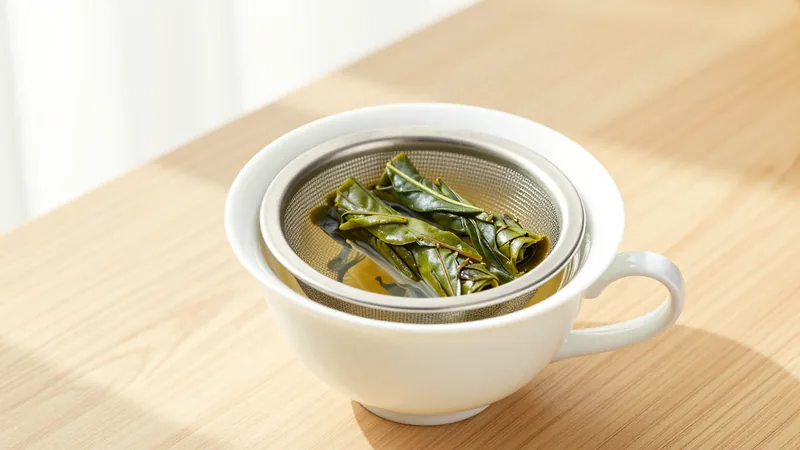
- Brew loose leaf in a stainless-steel, glass or ceramic infuser. It also costs less per cup; see loose leaf vs tea bags and the brewing guides.
- If you use plastic mesh bags, rinse them. Three rinses in room-temperature water cut micron-sized particles by 76–94% and submicron ones by 80–87% (Yue 2024).
- Do not microwave a bag in the cup. Microwaving amplified particle release from nylon bags (Xu 2021).
- Re-steep instead of opening a new bag. The second steep released far fewer particles than the first (Song 2026).
- Cold brewing is not a fix. One hour at 2 °C released fewer large particles than hot water but the same number of small ones (Jayasekara 2026). For ratios see cold brew tea.
Frequently Asked Questions
Do paper tea bags contain plastic?
Some do. Flat paper bags with sealed edges often contain a polypropylene or PLA heat-seal fibre, while folded, crimped or stapled bags can be 100% cellulose.
How many microplastics does a tea bag release?
Published figures run from about 106 per bag to about 15 billion per cup, roughly eight orders of magnitude apart. The 2019 McGill figure of 11.6 billion came from a method BfR called unsuitable; a 2020 re-test found 5,800–20,400 particles above 1 µm per bag.
Are PLA "plant-based" tea bags plastic-free?
No. PLA is a plastic made from corn starch or sugarcane. One study counted about one million PLA nanoparticles per bag, and pure PLA bags stayed intact after 12 months buried in soil.
Is drinking tea from bags dangerous?
The FDA, WHO and BfR all say current evidence does not show that microplastics in food or water harm human health. Cell studies show human intestinal cells can take up tea-bag particles at 100 µg/mL, but no study has shown harm in people.
What is the lowest-plastic way to brew tea?
Loose leaf in a stainless-steel, glass or ceramic infuser avoids the bag entirely. If you use plastic mesh bags, three room-temperature rinses removed 76–94% of micron-sized particles in one study.